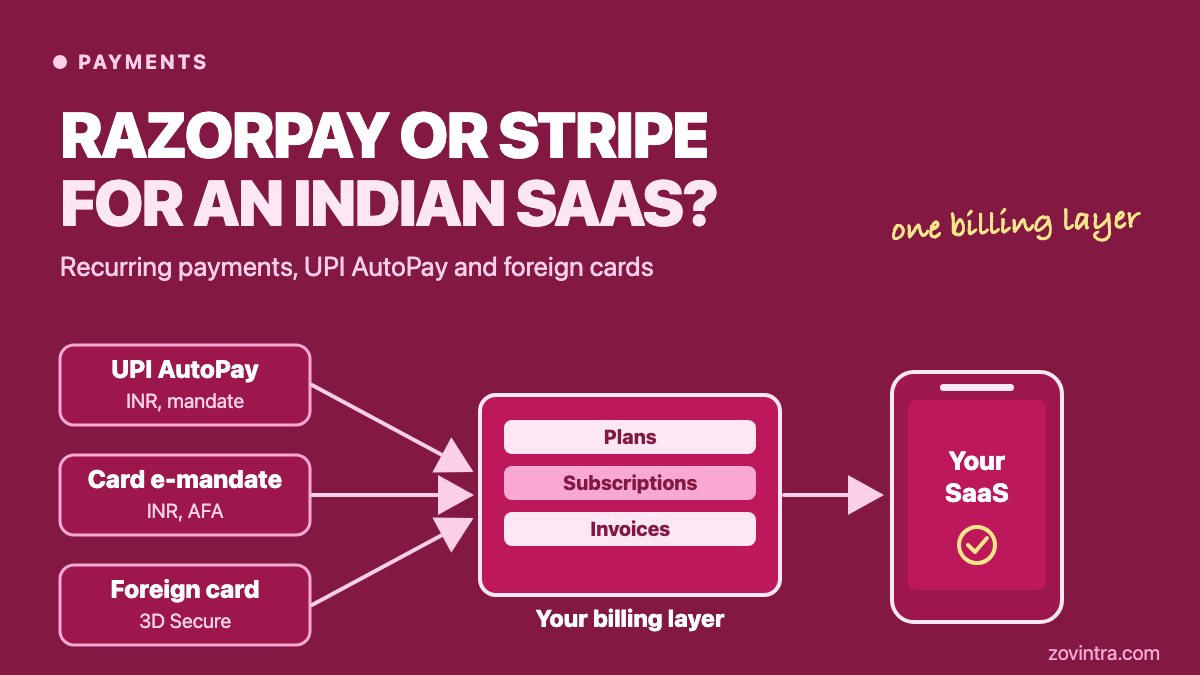
Most Indian SaaS products end up with two payment paths behind one billing layer of their own: an India-ready gateway for rupee subscriptions (UPI AutoPay and card mandates) and a way to take foreign cards. Whether a single gateway can do both depends on access first. Stripe says new Indian businesses cannot sign up on its website and must request an invite, so confirm that before you design around it. This post covers the 2026 RBI rules, the two rail types, what breaks after sign-up and what to settle before billing code is written. RBI is the Reserve Bank of India, UPI is the Unified Payments Interface and AFA is additional factor authentication, such as a card OTP or a UPI PIN. This is engineering guidance, not tax or legal advice.
What do the RBI e-mandate rules change for a subscription?
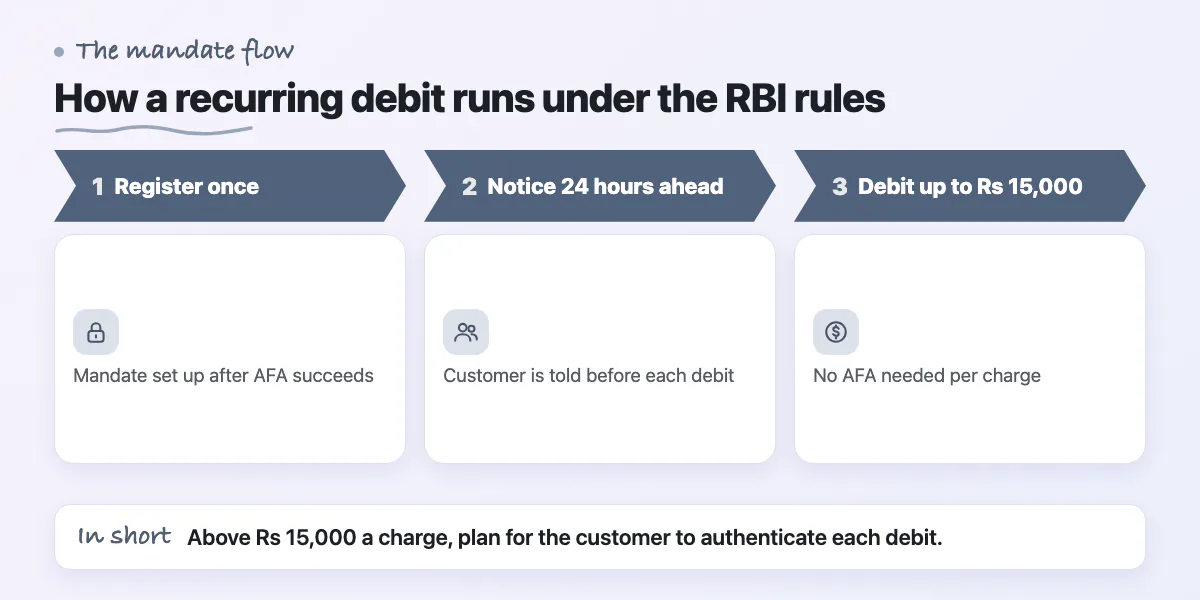
RBI issued its Digital Payments - E-mandate Framework, 2026 on 21 April 2026. It covers recurring payments made with cards, prepaid payment instruments and UPI, domestic or cross-border. Business Today reported it the same day. From the RBI page, the points that matter for a subscription product are these.
- The customer registers the mandate once, and only after AFA succeeds.
- Recurring transactions up to Rs 15,000 can be authorised without AFA. The limit is Rs 1 lakh for insurance premiums, mutual fund subscriptions and credit card bill payments. Software subscriptions are not among those three categories, so Rs 15,000 is the limit to plan around.
- The issuer must notify the customer at least 24 hours before each debit.
- No charge may be levied on the customer for using the e-mandate facility.
- Acquirers, the banks that sign up merchants, are responsible for the merchants they onboard following the rules.
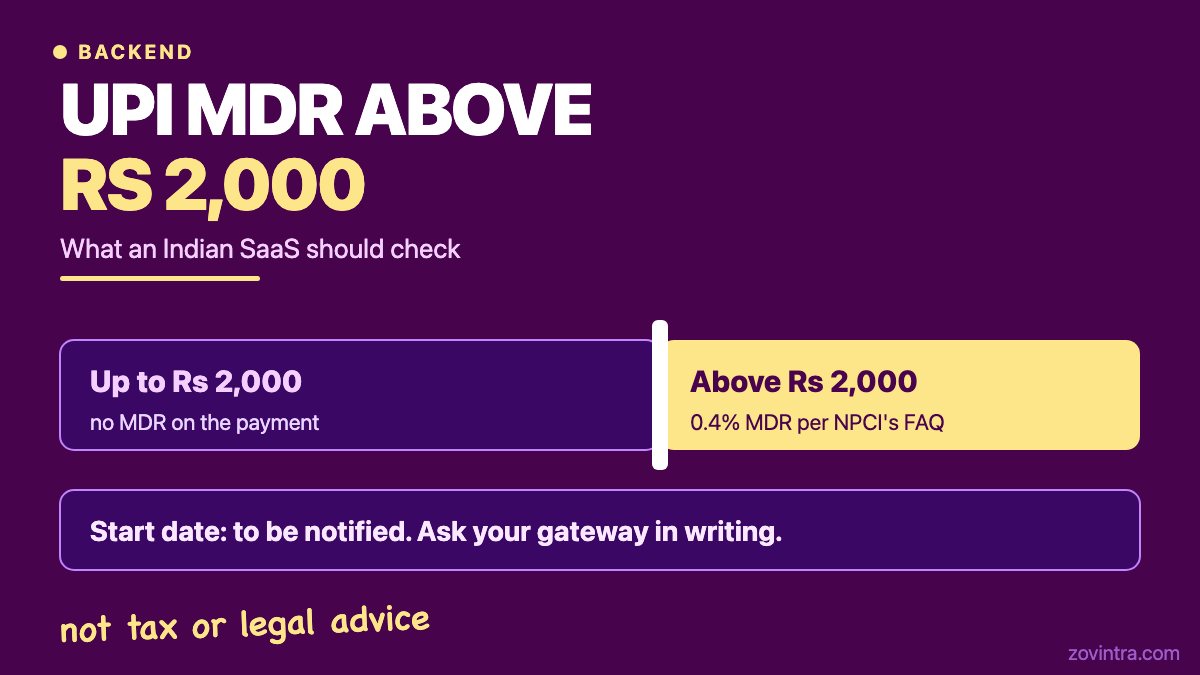
For a product, the line to watch is Rs 15,000 per charge. Above it, the customer is asked to authenticate each debit on a card, and Stripe's documentation says UPI does not support recurring transactions above Rs 15,000. If your annual plan is billed as one large charge, expect friction on every renewal.
Can you open a Stripe account, and can Razorpay take foreign cards?
Start with access. Stripe's support page says Stripe is invite-only in India: new Indian businesses cannot create an account on the website and must request an invite from Sales, while active accounts continue to be supported. The page carries no date. Trade press reported the move in June 2024. Ask Stripe for the current position before you plan around it.
If you do get in, Stripe's export documentation sets conditions. The account must be a registered Indian business, not an individual. You choose a transaction purpose code. Physical goods need an Importer Exporter Code, and services need one only in some cases. Every foreign card payment needs the customer's name and billing address. Foreign cards need 3D Secure, and Stripe pays out in rupees. Subscriptions for foreign customers run through Stripe Billing.
Razorpay's documentation says Indian businesses can accept Visa, Mastercard, American Express and other international cards and settle into an Indian bank account, after an application that follows eligibility rules set by its banking partners. Its subscriptions FAQ says the 2021 RBI rules apply to domestic cards only, and that international card settlements are in rupees at the rate on the day the payment is created. We did not find a full list of countries and card types for international subscriptions, so ask Razorpay in writing.
Foreign payments also touch invoicing. One condition for a service to count as an export under section 2(6) of the IGST Act is that payment is received in convertible foreign exchange. Take the invoice format and any export paperwork to your chartered accountant, not your developer. For the Indian side, see our post on the GST fields invoicing software must capture.
UPI AutoPay or card mandate, and what breaks after sign-up?
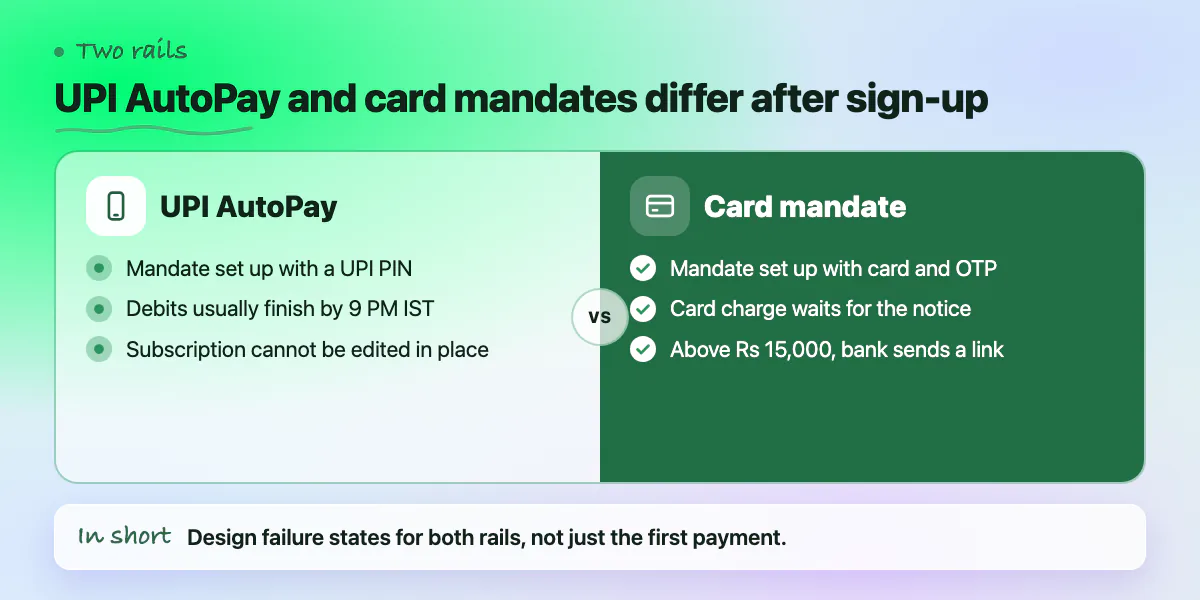
Razorpay's guide, a vendor page dated 5 May 2026, says UPI AutoPay suits low-ticket products and card mandates suit enterprise SaaS. We agree with the direction. We would not copy its numbers, because the page contradicts itself on card thresholds and on mandate volumes. Use RBI and the gateway docs for limits. Setup differs too: a UPI mandate needs a UPI PIN, while a card mandate needs card details and an OTP.
Most billing bugs show up after the first payment. These are the cases to design for.
- The pre-debit notice fails. Stripe lists decline codes for an undelivered notice (debit_notification_undelivered) and for a customer who paused auto-debit or did not authenticate (transaction_not_approved). Treat both as retry later or ask the customer, not as a lost customer.
- Charges take time. Stripe says it waits 26 hours before charging a card to allow for the notice, and the payment sits in a processing state that cannot be cancelled. Razorpay says UPI AutoPay debits normally finish by 9:00 PM IST on the debit date, and retries can run to the next day. Do not mark an invoice failed at midnight.
- The mandate is cancelled or expires. Stripe says to bring the customer back on-screen to create a new mandate before the next off-session charge.
- A debit is above Rs 15,000 on a card. Razorpay says the bank sends an authentication link that stays active for 72 hours.
- A customer upgrades mid-cycle. Razorpay's API docs say you cannot update a subscription authorised through UPI or eMandate, and its FAQ says only card subscriptions can be updated. Stripe's docs say you cannot cancel or update a mandate. Our reading, as general engineering advice: treat a UPI upgrade as a new subscription with a fresh mandate, and design that screen on purpose.
One gateway or two? Keep a billing layer of your own
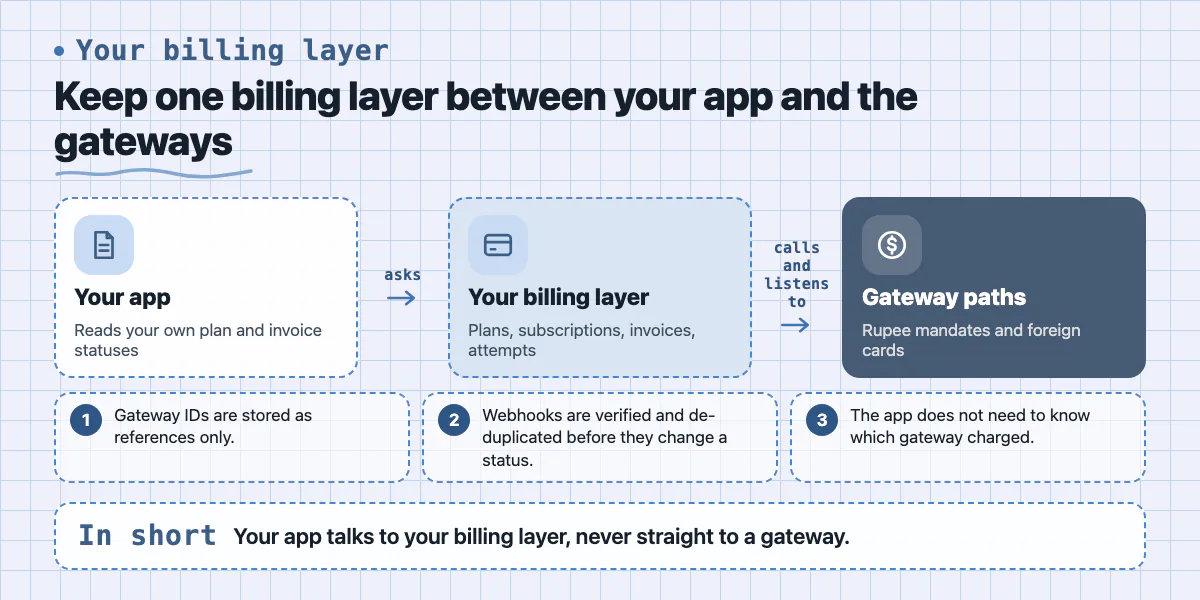
Even with one gateway, the rupee and foreign-card paths behave differently. With two, your app should not have to know which one charged the customer. The usual fix is a small billing layer you own. It holds your plans, customers, subscriptions, invoices and payment attempts, with the gateway's IDs stored as references. Your statuses, such as trialing, active, past due and cancelled, belong to you. A gateway event becomes one of your events after you verify its signature and ignore duplicates. Our post on payment webhooks covers those two checks. Open the gateway account in the company's name, in line with our ownership checklist for other accounts.
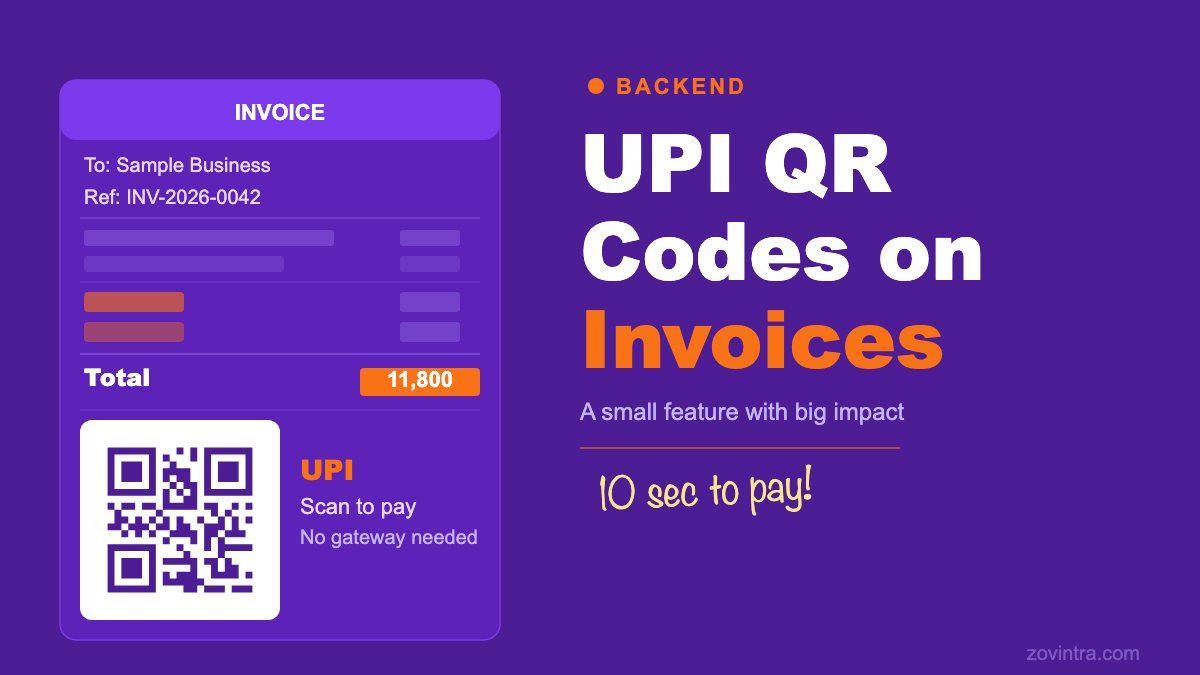
Our BillFlow case study is a design concept for a billing platform with several gateway integrations and tax handling. It is a concept, not a shipped product. If you want a UPI-first example, see UPI QR codes on invoices, which is about showing a QR, not collecting recurring payments.
Settle these before the build starts.
- Access: can you get a Stripe account at all, and has Razorpay approved international cards for your business type?
- Plan prices: does any plan charge more than Rs 15,000 in one debit? If so, decide what the customer sees on each renewal.
- Plan changes: can customers upgrade mid-cycle, and what happens to their mandate when they do?
- Failure states: write down pending, processing, failed, mandate cancelled and mandate expired, with what the customer sees in each.
- Grace period: how long does a customer keep access after a failed charge?
- Invoices: ask your accountant what an Indian invoice and a foreign invoice must show.
- Written answers: ask each gateway about international subscriptions, settlement currency, fees and payout timing.
- Testing: run the gateway's sandbox cases for cancelled mandates and undelivered notices before launch.
When you can skip the two-path design
You do not need both paths if every customer is in India, since the rupee path is the whole job. You also may not need one if you invoice a few business customers once a year by bank transfer, because no auto-debit means no mandate. If you have no revenue yet, start with one gateway behind a thin billing module and add the second path when the first foreign customer asks. Selling inside an app store is a separate topic, because store billing rules apply there.
Want a second opinion before you build billing?
If you are planning subscription billing for an Indian SaaS, we can help scope the plan and invoice data model, the webhook handling and the gateway integration, and review the design before you build. We do not give tax, legal or RBI compliance advice, so keep your accountant and your gateway in the loop. You can book a scoping call or read about our custom software work.
Common questions
Can a new Indian business open a Stripe account?
Stripe's support page says Stripe is invite-only in India: new businesses cannot sign up on the website and must request an invite from Sales. Active accounts continue to be supported. The page gives no date for wider access. Ask Stripe about your case, and plan for Razorpay or another India-ready gateway if the answer is no.
Do UPI AutoPay payments work above Rs 15,000?
Under the RBI framework, recurring debits up to Rs 15,000 can go without AFA, with Rs 1 lakh for some categories such as insurance and mutual funds. Stripe's documentation says UPI does not support recurring transactions above Rs 15,000. Razorpay lists higher mandate limits, but its frictionless debit limit is Rs 15,000 for most categories. Check your plan prices against both.
Do I need a separate gateway for foreign customers?
Not always. Stripe and Razorpay both describe accepting foreign cards for Indian businesses, with Stripe paying out in rupees and Razorpay settling in rupees. The real question is access and fit, such as whether your gateway supports foreign subscriptions. If one gateway covers both, a single path can work. Keep your own billing layer either way.
Sources
- Digital Payments - E-mandate Framework, 2026
- RBI caps recurring payments at Rs 15,000 without OTP
- UPI AutoPay vs card e-mandates
- Subscriptions: supported payment methods
- Accept payments from international customers
- Stripe accounts are invite-only in India
- Stripe moves to Invite Only in India
- Accept international payments from India
- The Integrated Goods and Services Tax Act, 2017
Building something similar?
Talk to our engineering team about your architecture, roadmap, and delivery timeline.
Request a Technical Review →
We design, engineer, and deploy high-performance web platforms, mobile applications, and intelligent cloud systems.