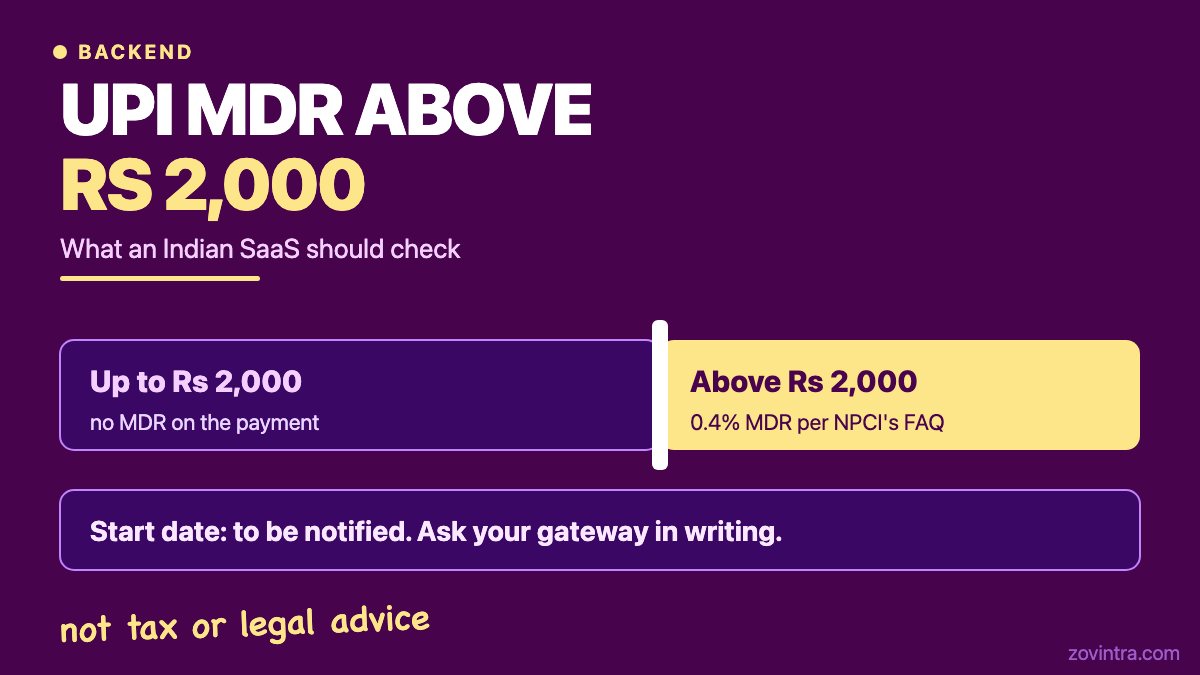
NPCI's FAQ says a 0.4% UPI MDR (merchant discount rate) will apply to merchant payments above Rs 2,000. No start date has been notified. NPCI is the National Payments Corporation of India and UPI is the Unified Payments Interface. The 15 October 2026 date that the press reported was replaced on 13 October by "immediately post Diwali at a date to be notified separately", and as of 15 November 2026 we found no notified date. This post is not tax or legal advice: check with your payment gateway and accountant.
What does the UPI MDR cover?
The facts below come from NPCI's FAQ (updated 15 October 2026) and the Press Information Bureau (PIB) release of 15 September 2026.
- Rate: 0.4% on person-to-merchant (P2M) UPI payments above Rs 2,000. For payments of Rs 75,000 and above, the MDR is capped at Rs 300 per transaction.
- Free: person-to-person payments, P2M payments up to Rs 2,000, and small merchants receiving up to Rs 1 lakh a month through UPI QR (the P2PM category). A P2PM merchant moves to the P2M category after receiving more than Rs 1 lakh a month for three months in a row.
- Flat Rs 5: for categories such as railways, telecom, insurance and fuel, on payments above Rs 2,000.
- Capital markets: 0.02%, capped at Rs 300.
- Recurring AutoPay mandates: NPCI says they carry no MDR. Credit-linked UPI payments follow separate credit rules.
NPCI's worked examples: a Rs 2,000 payment carries no MDR, Rs 3,000 carries Rs 12, Rs 50,000 carries Rs 200, and anything at Rs 75,000 or above carries Rs 300.
Who pays it, and can the merchant add it to the price?
The FAQ says the merchant pays the MDR to its acquiring bank. It says merchants cannot pass the charge on to customers, and that UPI apps may not charge a platform fee. The PIB release says the MDR is not a tax and is not collected by the Government or NPCI. It is shared among ecosystem participants such as banks and payment apps.
Does this affect software that only shows a UPI QR on invoices?
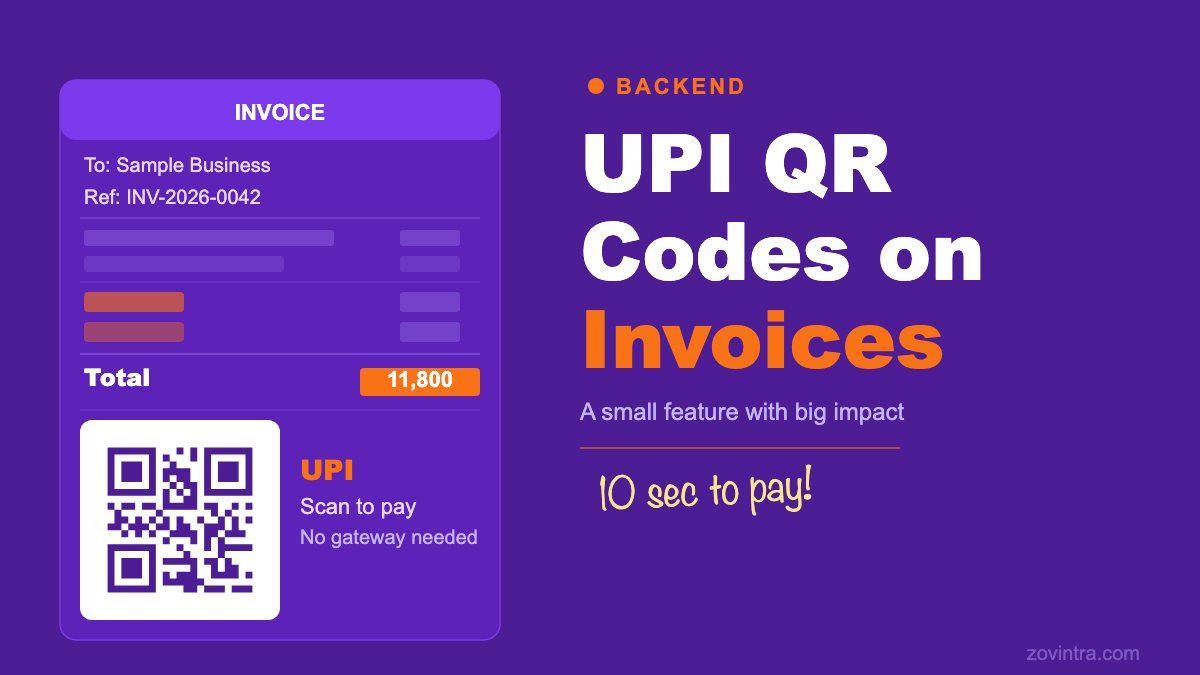
Mandizo displays UPI QR codes on invoices but does not process payments. As our post on UPI QR codes on invoices explains, the QR pre-fills the payee, the name and the amount in the payer's UPI app. On Mandizo there is no gateway call, no payment confirmation and no automatic status change.
The MDR, as NPCI describes it, sits between the merchant and its acquiring bank. It does not sit in the software that draws a QR. Our reading, which is not legal advice, is that the QR content does not need to change. We have not confirmed how any specific bank or gateway treats a business that gets paid through a QR on an invoice, so ask yours. NPCI's FAQ also says MDR applicability depends on the merchant account's category, not on the size of one payment alone.
What should an Indian SaaS check?
These checks apply if your product collects UPI payments through a gateway or a bank. They are engineering and process suggestions, not advice on tax or law.
- Ask your gateway in writing whether and from what date the MDR applies to your account, and how it will show on settlement reports. We have not verified how gateways will pass it on.
- Compare gross and net amounts in your reconciliation. If a fee is deducted from payments above Rs 2,000, the amount you receive will be lower than the invoice total, and your matching logic should handle that.
- Do not add a surcharge or change a price line to recover it without checking first. NPCI's FAQ says merchants cannot pass the MDR on to customers.
- Test the boundary. NPCI's example treats exactly Rs 2,000 as no MDR. Test amounts at Rs 2,000 and just above it.
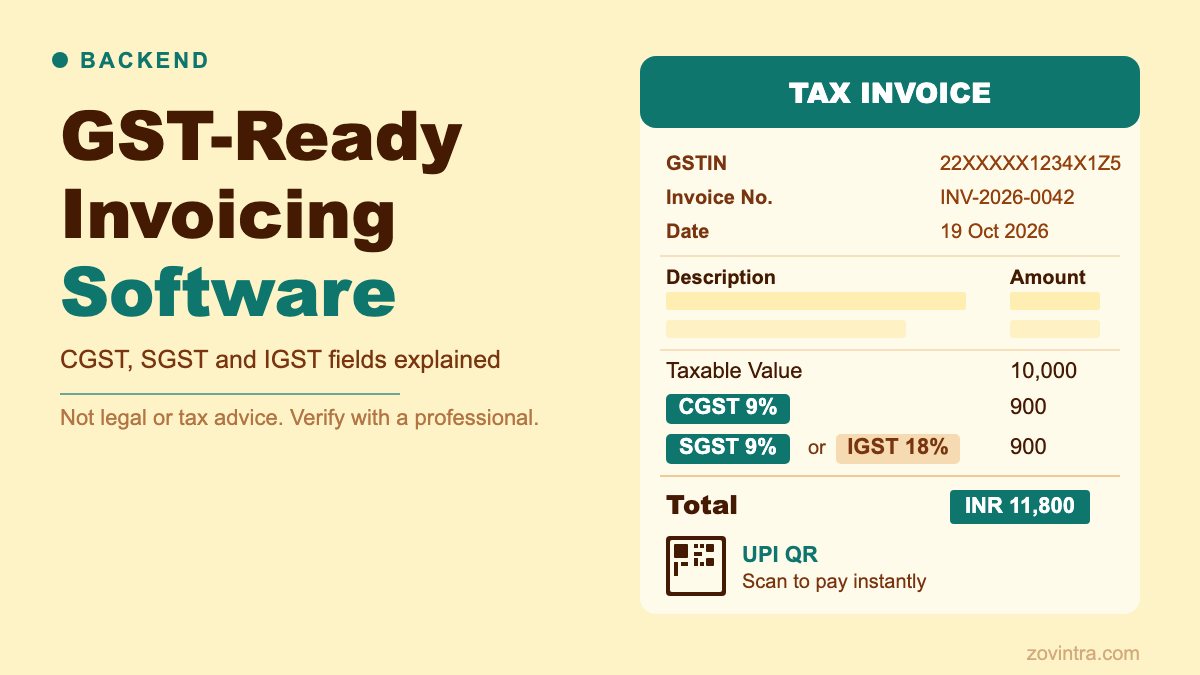
- Ask your accountant how the fee should be booked. We do not give accounting or tax advice. Our post on GST-ready invoicing requirements covers invoice fields, not fee treatment.
- Watch NPCI's press releases for the notified start date. The FAQ also says the framework for a dedicated small merchant fund will be finalised in consultation with the Reserve Bank of India (RBI) within three months.
What to do this week
- Write down every place your product or your customers receive UPI money: gateway, bank account, QR on invoices, payment links.
- Email your gateway or bank with the questions above.
- Check how many of your customers' payments are above Rs 2,000. Those are the ones the MDR could touch.
- Add the start date to your calendar once NPCI notifies it.
- Hold any customer message about fees until your gateway has answered.
When you can skip this
You can skip most of this if you only draw a UPI QR on invoices and never handle the money, if your customers' UPI payments are all Rs 2,000 or less, or if your customers are small merchants in the P2PM category described above. Your customers may still want to ask their own bank. If you do not collect UPI at all, skip it.
Need a second pair of eyes on your code?
Zovintra does not process payments or advise on payments compliance. If you want a read-only look at a billing codebase for secrets, dependencies and database security, the free code review does that, and Launch and Rescue covers the setup of apps built with AI tools.
Common questions
When does the UPI MDR start?
NPCI's FAQ says immediately post Diwali, at a date to be notified separately. The earlier 15 October 2026 date was reported by the press. We found no notified date as of 15 November 2026.
Can a merchant pass the UPI MDR on to the customer?
No, per NPCI's FAQ. Merchants cannot pass MDR charges on to customers, and UPI apps may not levy a platform fee.
Is a UPI payment of exactly Rs 2,000 charged?
NPCI's worked example shows no MDR on Rs 2,000. The MDR applies to payments above Rs 2,000.
Sources
- MDR on select UPI (P2M) transactions: FAQs
- UPI MDR on select merchant transactions shall be implemented post Diwali
- UPI continues to remain free for peer to peer transactions and 96% of merchant transactions
- UPI MDR rules article
Building something similar?
Talk to our engineering team about your architecture, roadmap, and delivery timeline.
Request a Technical Review →
We design, engineer, and deploy high-performance web platforms, mobile applications, and intelligent cloud systems.