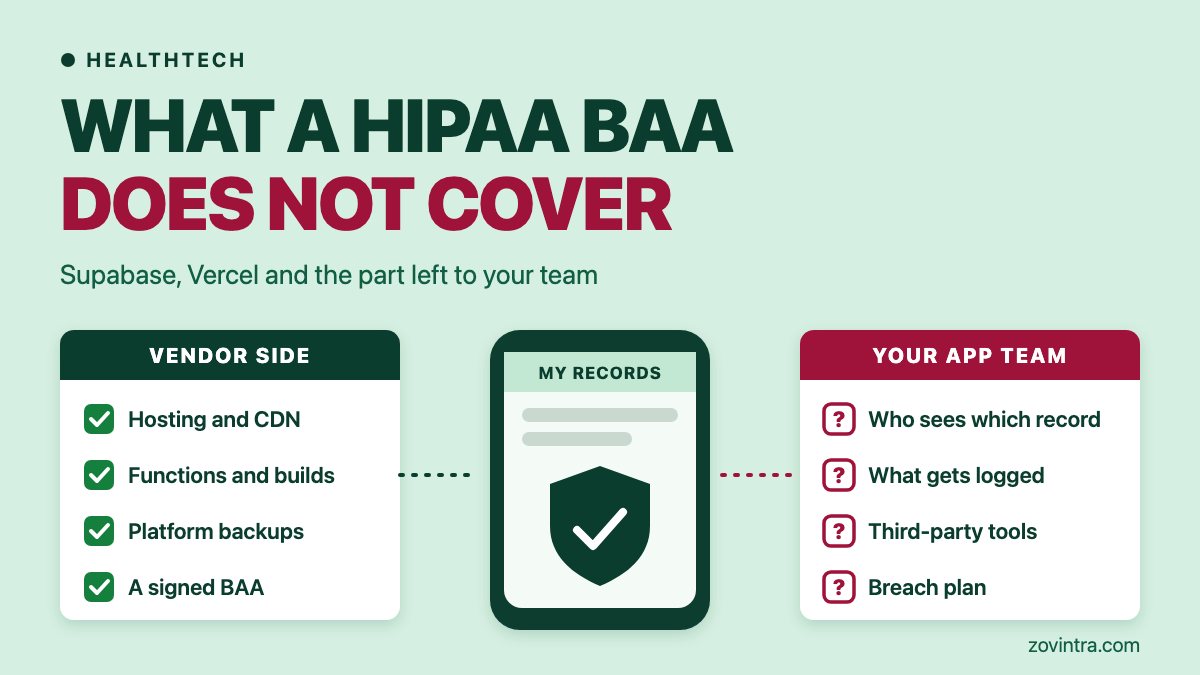
A signed Business Associate Agreement (BAA) with your hosting vendors does not make a patient app compliant with HIPAA, the US health privacy law (the Health Insurance Portability and Accountability Act). A BAA makes each vendor answerable for its own part of the stack. Vercel's own guide says a BAA helps support compliance but does not make a customer compliant, and Supabase's docs list settings you must keep on yourself. What is left is your app: who can read which record, what you log, which other tools see patient data, and how you react to a breach. This post separates the two halves. It is engineering information, not legal advice.
When does HIPAA not apply to your health app?
HIPAA binds covered entities, such as providers and health plans, and the business associates who handle patient data for them. So the first question is who you are building for. The US Department of Health and Human Services (HHS) published health-app scenarios in 2016. We read them through a law-firm summary, because HHS's own page blocked our fetch.
- Likely not a business associate: a consumer enters their own health data in your app with no provider involved; a consumer uploads records they got elsewhere; a provider recommends your app but has no business relationship with you.
- Likely a business associate: a provider contracts with you for a patient management app that does remote counselling, monitoring and messaging and feeds the provider's records; or a health plan offers your app to its members.
HHS says outcomes depend on the facts, mainly whether you have a formal relationship with a covered entity. Get your role confirmed by a lawyer, in writing, before you design anything.
Being outside HIPAA does not mean being outside the rules. The US Federal Trade Commission's Health Breach Notification Rule covers health apps that HIPAA does not reach. It counts an unauthorised disclosure as a breach and sets notice to affected people within 60 calendar days. If all your users are in India, India's data protection rules may matter more than this US law. Our post on DPDP and AI tools covers mapping where customer data flows.
Why does encryption not remove the need for a BAA?
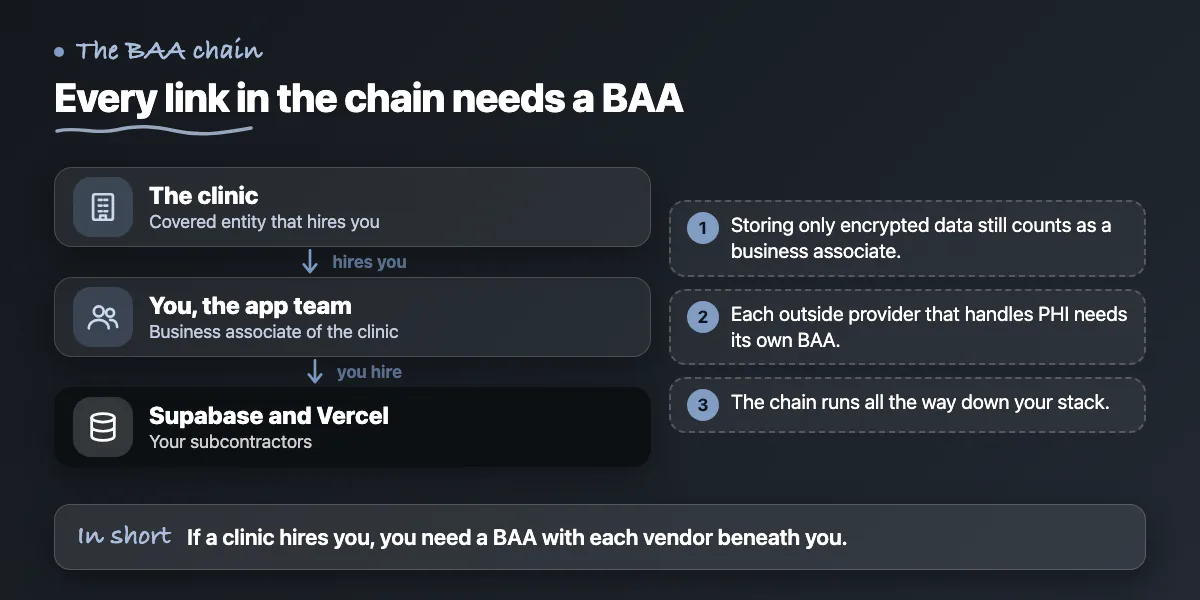
A common belief says that if a cloud vendor stores only encrypted data and holds no key, it never sees patient information, so no BAA is needed. HHS's cloud guidance says otherwise. A cloud provider that stores encrypted electronic protected health information (PHI) without the key is still a business associate. HHS calls this a "no-view" service. The same guidance says a cloud provider hired by a business associate is also a business associate, and that the customer still has to run its own risk analysis. We read this through a 2016 law-firm summary.
The chain matters to you. If a clinic hires you, you are the clinic's business associate, and Supabase and Vercel are your subcontractors. The Security Rule says a business associate that lets a subcontractor handle patient data must get satisfactory assurances and document them (45 CFR 164.308(b)). In practice that is a BAA. Vercel's guide describes the same chain: each outside provider that handles PHI needs its own BAA, all the way down your stack.
What does Supabase require for a HIPAA project?
Supabase's docs say you can store PHI on the platform if you meet these conditions, from its HIPAA project page and shared responsibility page.
- Sign a BAA with Supabase. The docs send you to a contact form.
- Enable the HIPAA add-on on your organisation. The shared responsibility page says you need at least the Team plan.
- Mark each project that holds PHI as High Compliance in its project settings. Supabase's Security Advisor then warns you if a setting drifts.
- Keep four settings on: Point in Time Recovery, SSL enforcement, network restrictions and Postgres connection logging. Supabase turns connection logging off by default on new projects.
- Turn on multi-factor authentication for every Supabase account.
- Keep PHI out of public Storage buckets, and do not move a project into an organisation without the HIPAA add-on.
Supabase says it encrypts data at rest and in transit, and suggests you consider encryption inside your app too. It lists application design, the schema, user management and the data as yours. The HIPAA project page does not say which services, such as Edge Functions, are in scope, so ask Supabase in writing.
None of these settings checks your access rules. A High Compliance project can still show one patient's record to another user. See RLS is on but your Supabase data is still readable and how to check if your Supabase data is public.
What does Vercel's BAA cover, and what stays with you?
Vercel's HIPAA guide was published on 3 November 2025 and last updated on 2 October 2026. It says a BAA is available on Enterprise and Pro, to customers who are covered entities or business associates. Pro customers buy a HIPAA add-on; Enterprise customers ask their account contact. The guide lists these core services as covered: the CDN, Vercel Functions, Global Config, the build and deploy pipeline, environment variable management and static IPs. Secure Compute, which gives private isolated environments and dedicated outgoing IP addresses, is Enterprise only.
The guide calls HIPAA a shared responsibility. Your side includes configuring access control, audit logging, custom domains and environment variables; vetting your database and storage providers and signing BAAs with them; running risk assessments; and monitoring access over time. It advises custom environments so PHI never reaches a preview deployment. Our post on Vercel environment variables across preview and production shows how those differ.
Two gaps are worth a written question to Vercel. The guide gives no advice on logs or analytics that may hold PHI, and it does not state the BAA status of development tools or marketplace integrations. Leave both off until you have an answer.
What does a BAA not cover? Your application
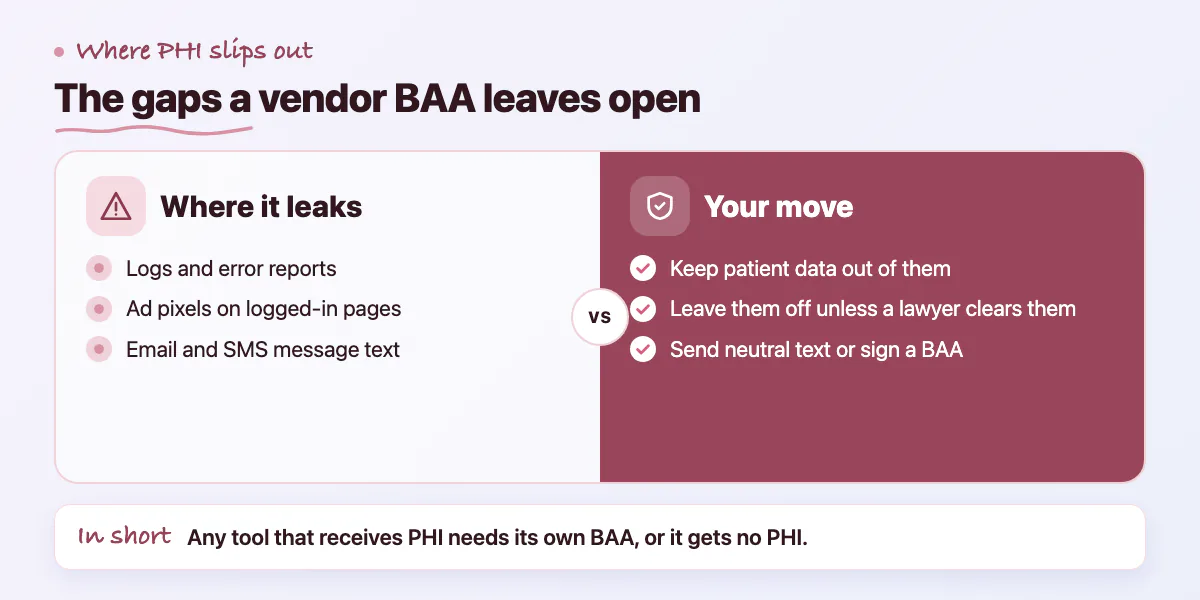
The Security Rule's technical safeguards are written for whoever builds the system. The rule asks for access control, audit controls, protection against improper changes, authentication of users and protection of data in transit (45 CFR 164.312). Encryption is labelled addressable, not required, under access control. Decide that point with your lawyer and write it down. General practice is to encrypt. The rule also requires a documented risk analysis, regular review of system activity records, and a contingency plan with backups and disaster recovery (45 CFR 164.308). A vendor BAA does none of this for you. These are the gaps teams leave open.
- Authorisation logic. Each patient should see only their own records, and each clinician only their assigned patients. Row-level security policies and server checks are your code. See broken access control in AI-generated apps.
- Logs and error reports. Console logs and error trackers can capture PHI by accident. Any tool that receives PHI needs its own BAA, so keep patient data out.
- Analytics and tracking scripts. A federal court in Texas struck down part of HHS's online tracking bulletin in June 2024. That part covered unauthenticated public pages; a law-firm summary says patient portals and other password-protected areas were not challenged. Keep ad pixels and session replay out of logged-in screens unless a lawyer clears them.
- Email, SMS and push messages. Send neutral text, such as "You have a new message", or sign a BAA with the messaging vendor.
- AI features. A language model API that sees patient text is another vendor in the chain.
- Backups. A contingency plan needs a restore you have actually tried. See backups for an AI-built app.
- Breach response. A business associate must tell the covered entity without unreasonable delay and no later than 60 calendar days after discovery (45 CFR 164.410). Your clinic contract may set a shorter time.
What should you scope before any patient data is stored?
Bring this list to any developer, including us. It is general engineering practice, not legal advice.
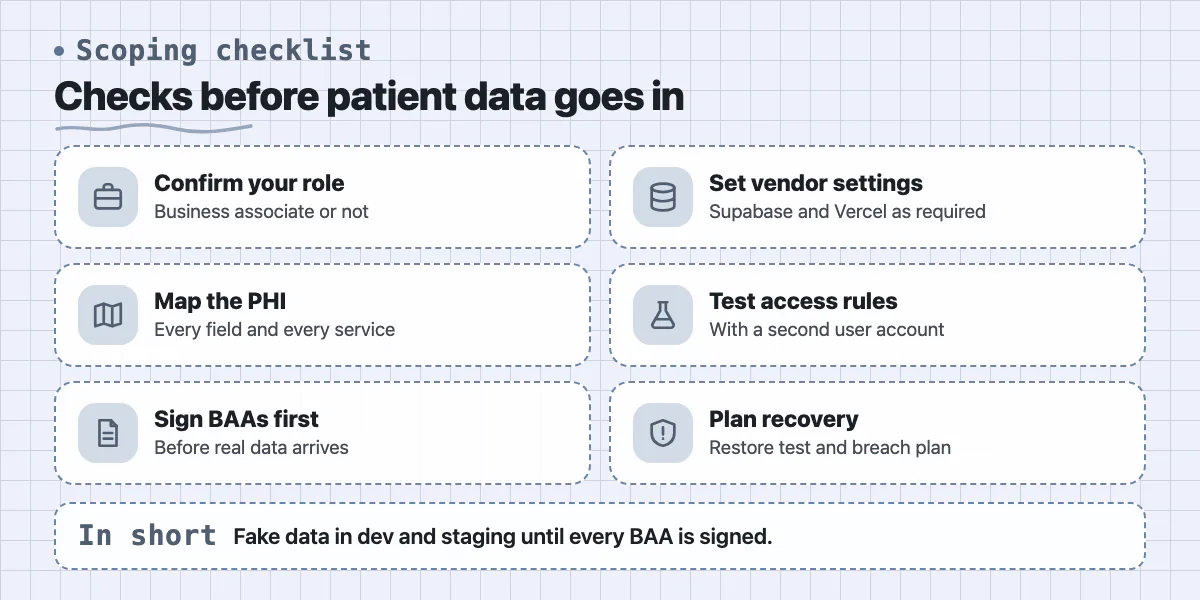
- Role: confirm in writing whether you are a business associate or a direct-to-consumer app.
- Data map: every PHI field, where it is stored, and every service it passes through, including email, logs, analytics and AI APIs.
- BAAs: signed with each service on that map before real data arrives. Use fake data in development and staging.
- Supabase: BAA, HIPAA add-on, High Compliance on, the four settings, multi-factor authentication on all accounts, no PHI in public buckets.
- Vercel: BAA for your plan, PHI kept out of preview deployments, secrets in environment variables, and a decision on Secure Compute.
- Access rules: each role's rights written down, enforced in the database and tested with a second user.
- Audit trail: who viewed or changed which record, kept where an admin cannot quietly edit it.
- Logs: no PHI in logs or error reports; test with a fake patient.
- Backups: a restore tested end to end, and a written contingency plan.
- Breach plan: who decides, who calls the clinic and by when.
- Risk analysis: written, dated and repeated whenever the app changes.
Consent and audit screens are part of this work. Our CarePoint hospital management design concept includes them. It is a concept, not a live system.
Want a scoping review before you store patient data?
If you plan to build on Next.js, Supabase and Vercel, we can review your data map and stack before real patient data goes in. ZoVintra builds web and SaaS products on this stack, and the free code review checks an existing app for access and secrets gaps. We do not give legal advice or certify HIPAA compliance. You can contact us with your stack and your launch date. For what to fund before launch, read the minimum viable secure MVP.
Common questions
Does a signed BAA with Supabase and Vercel make my app HIPAA compliant?
No. A BAA is a contract that makes the vendor accountable for its part. Vercel's guide says a BAA helps support compliance but does not make a customer compliant, and Supabase lists settings you must keep on. Access control, logging, risk analysis and breach response stay with your team.
Do I need a BAA if my vendor only stores encrypted data?
Yes, according to HHS's cloud guidance. A cloud provider that stores encrypted PHI without holding the key is still a business associate, in what HHS calls a no-view service. Encryption lowers risk but does not remove the agreement. Ask your lawyer to confirm how this applies to your case.
Which Vercel and Supabase plans can I use for patient data?
Vercel's guide says a BAA is available on Enterprise and Pro, with Pro buying a HIPAA add-on and Secure Compute limited to Enterprise. Supabase requires a signed BAA and the HIPAA add-on, and its shared responsibility page says at least the Team plan. Check current terms and prices with each vendor.
Sources
- HIPAA Projects
- Shared Responsibility Model
- HIPAA compliance guide for Vercel
- Guidance on HIPAA and Cloud Computing
- HHS Publishes Guidance on HIPAA and Cloud Computing
- HHS Issues HIPAA Guidance for Mobile Health Apps
- 45 CFR 164.312, Technical safeguards
- 45 CFR 164.308, Administrative safeguards
- 45 CFR 164.410, Notification by a business associate
- Updated FTC Health Breach Notification Rule
- OCR Bulletin on Online Tracking Technologies Declared Unlawful
Building something similar?
Talk to our engineering team about your architecture, roadmap, and delivery timeline.
Request a Technical Review →
We design, engineer, and deploy high-performance web platforms, mobile applications, and intelligent cloud systems.