Pick Supabase Auth if your data already lives in Supabase and no buyer has asked for single sign-on yet. Pick Clerk if you want finished sign-in and team screens this week and can live with a per-user bill once you pass 50,000 retained users. Pick Better Auth if you want the user table in your own database and have an engineer who will own upgrades. Auth.js is no longer the default for a new build: its maintainers now say new projects should start with Better Auth. The rest of this post shows how we get there, using only prices and limits we could read on each vendor's own pages. All prices are in US dollars.
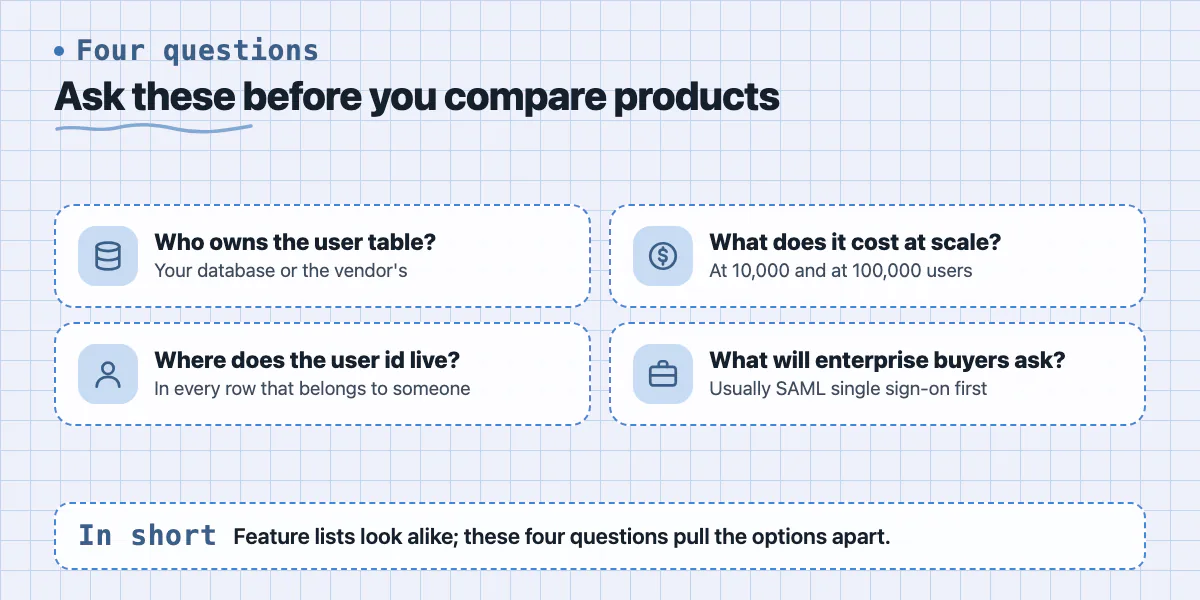
Which four questions decide this?
Feature lists look alike. Four questions pull the options apart.
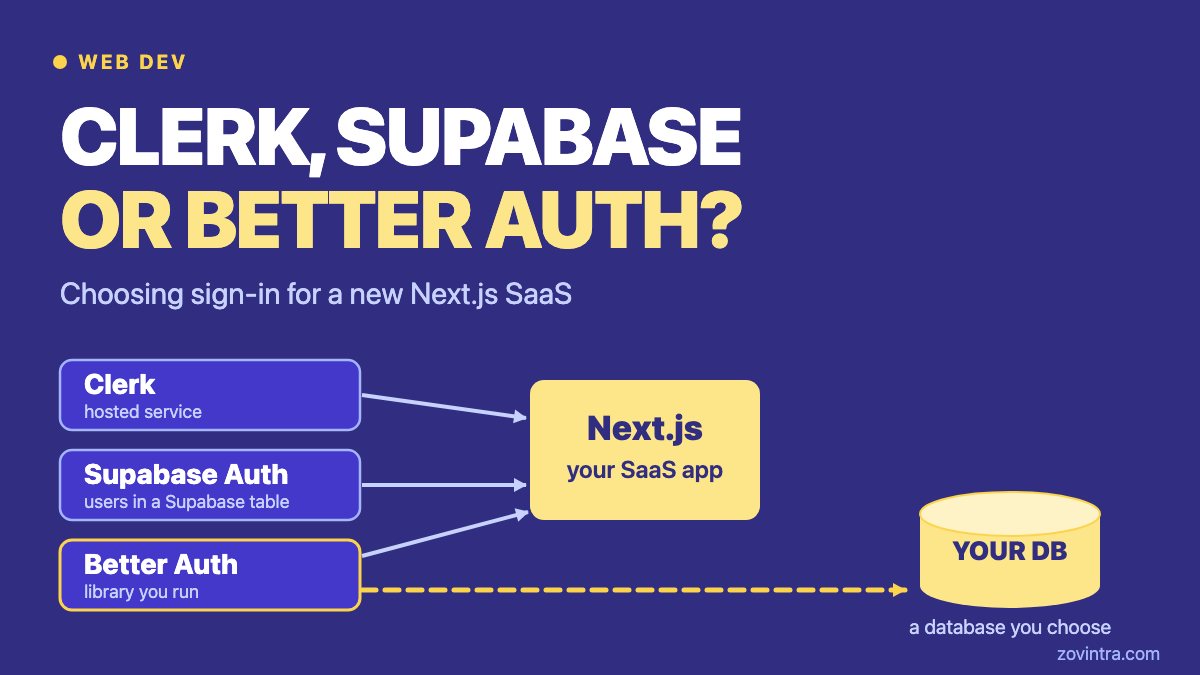
- Who owns the user table? With Supabase Auth, users sit in an auth.users table inside your project's Postgres database. With Better Auth, the library's command line tool generates the tables it needs in a database you pick: Postgres, MySQL, SQLite or MongoDB, directly or through Drizzle or Prisma. With Clerk, Clerk's servers hold the users and your database keeps their ids.
- Where does the user id live in your data? Every row that belongs to someone holds that id. It is the hardest thing to change later.
- What does it cost at 10,000 users and at 100,000? Work this out with each vendor's rates, not the headline free tier.
- What will an enterprise buyer ask? Usually SAML single sign-on (SSO) first, then automatic removal of leavers and an audit log. We cover that in our post on a first enterprise customer asking for SSO.
One rule holds for all three. The Next.js authentication guide recommends an auth library over writing your own, and says the main security checks belong close to your data, not only in a Proxy file that runs on every route. A sign-in product does not do your authorisation for you.
When is Supabase Auth the right default?
If your app already uses Supabase for its database, Supabase Auth is the shortest path. Its docs describe tokens that scope database access row by row through row-level security (RLS), the Postgres feature that decides which rows each user may read. Supabase's own guide says to create a public profile table whose id references auth.users, and to switch RLS on for it. Our guide to using Firebase Auth with Supabase RLS shows how identity reaches those policies, and the Mandizo project shows ownership rules on a real Supabase database.
On cost, the pricing page lists 50,000 monthly active users (MAU) on the Free plan and 100,000 on Pro, then $0.00325 per extra MAU. Pro starts at $25 a month, but that is the whole project plan, not an auth line item. Our post on running costs for Vercel and Supabase covers the rest of the bill.
The limits show up with enterprise buyers. SAML SSO is available on Pro and above and is managed with the Supabase command line tool. Supabase's SAML page lists gaps: no Single Logout, and an SSO user with the same email as a password user becomes a separate account. SSO users beyond the 50 included on Pro cost $0.015 each. On the pages we read, Supabase Auth has no built-in organisation model, so teams and invitations are tables and policies you design yourself.
What does Clerk give you, and what does it cost?
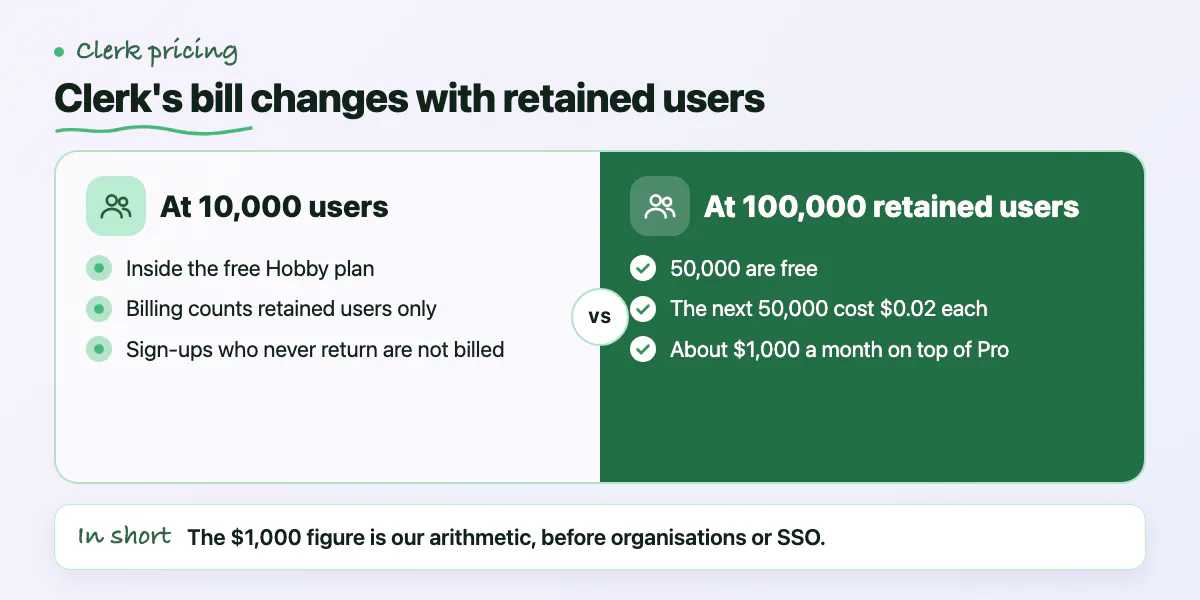
Clerk is a hosted service with finished sign-in components, organisations with roles and invitations, and an Expo software kit for React Native apps. Its changelog says every app gets 50,000 retained users free, up from 10,000. The pricing page explains the unit: a retained user is someone who visits at least one day after signing up, in that month. A person who signs up and never returns is not billed.
At 10,000 users you are inside the free Hobby plan. At 100,000 retained users in a month, the rates we read are 50,000 free, then $0.02 for each of the next 50,000. That is about $1,000 a month on top of the Pro plan, which starts at $25 monthly or $20 billed annually. This is our arithmetic on published rates, before organisations or SSO. Those cost extra: one enterprise connection is included per app, extra connections are $75 a month each, and beyond 100 retained organisations you need an add-on at $100 a month.
You can also keep Supabase for data and use Clerk for sign-in. Supabase lists Clerk as a third-party auth provider, and Clerk's guide shows RLS policies that read the Clerk user id from the session token. Clerk marks its older Supabase JWT template as deprecated since 1 April 2025, so use the native integration. Supabase bills third-party MAU at $0.00325 above the plan quota, so past those quotas the same person can appear on two bills.
Why would a team own its users with Better Auth?
Better Auth is an open source, framework-agnostic TypeScript auth library. In a Next.js App Router app you mount it with one route file. Plugins add organisations (owner, admin and member roles, invitations where you supply the email sender, optional teams), SAML 2.0 and OIDC single sign-on in a separate package, two-factor sign-in and passkeys. An Expo plugin keeps mobile sessions in Expo's secure storage.
Two announcements shaped this choice, and both are the project's own words. On 22 September 2025 the Better Auth team said it now maintains Auth.js, formerly NextAuth.js. Existing users keep security patches and urgent fixes, and the team strongly recommends Better Auth for new projects unless you need something it lacks, such as stateless sessions without a database. On 7 July 2026 it announced it is joining Vercel, and says Better Auth stays open source and framework and platform agnostic. Our view, not a fact from the post: that gives the project more resources, but the roadmap is now tied to one company.
The cost is work, not a bill. The library has no per-user fee, but you pay for the database and hosting, and you run the upgrades, email sending and abuse limits. Read the SSO plugin docs before launch. By default any signed-in user can register up to 10 SSO providers, and the sign-in call does not validate callback URLs, so you must set a limit and check them.
Better Auth runs on any Postgres, including the one Supabase gives you. But it is not on Supabase's list of third-party providers: Clerk, Firebase Auth, Auth0, Cognito, WorkOS, plus custom OIDC. If you want both, work out how RLS will know who the user is, or enforce access in your server code.
How do you choose, and keep the exit open?
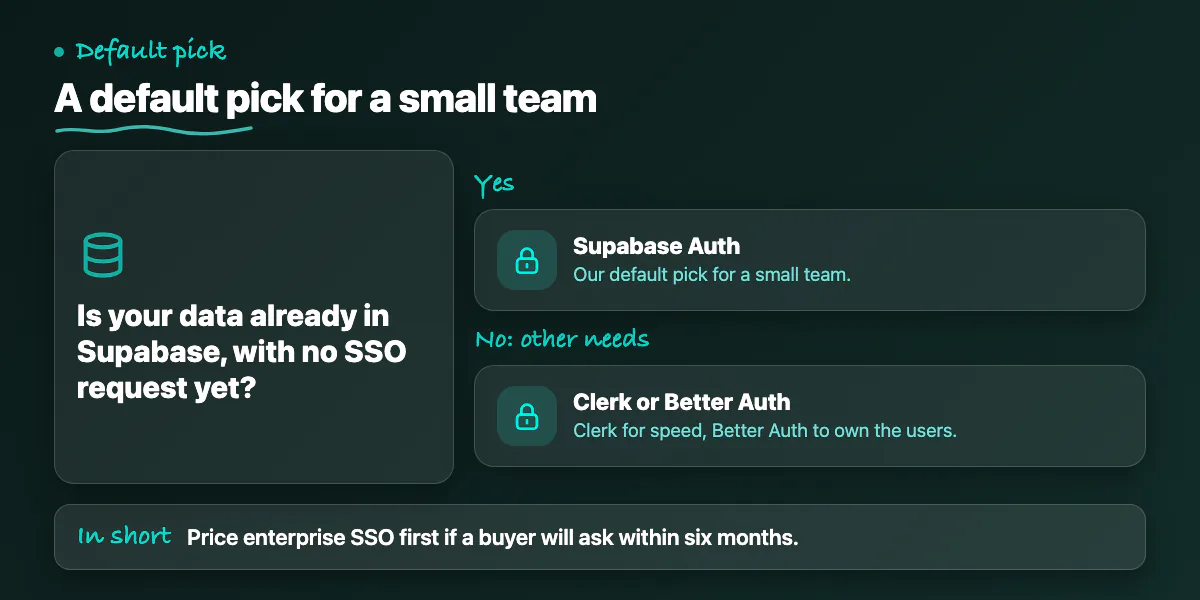
These are our default picks for a small team. They are general engineering judgement, not vendor advice.
- Data already in Supabase and no SSO request yet: Supabase Auth.
- Need polished sign-in and team screens fast, no spare engineer, under 50,000 retained users: Clerk.
- Want users in your own database, no per-user bill, and an engineer who will own upgrades: Better Auth.
- Existing NextAuth.js or Auth.js app: keep it running, and plan a move to Better Auth only when you next touch auth.
- Enterprise SSO within six months: price it first. Clerk meters extra connections, Supabase meters SSO users, Better Auth costs engineering time.
Moving later is mostly an id and password problem. Clerk lets admins export users as a CSV that includes hashed passwords, and it keeps your old ids as an external_id if you store them. Better Auth's guide for leaving Clerk says Clerk uses bcrypt while Better Auth defaults to scrypt, so you must configure bcrypt. It reuses Clerk ids as user ids and invalidates every active session, so everyone signs in again. Organisations need extra steps. With Supabase, your tables point at auth.users, and Supabase's docs say to reference only its primary keys. We did not verify how password hashes leave Supabase, so test an export first. Our post on moving from Firebase to Supabase Auth lists the risks of switching a live app.
A short checklist before you build, as general practice:
- Write the monthly cost at 10,000 and 100,000 users for your top two choices.
- Keep your own profiles table and point other tables at it, so a provider change touches one table.
- Export and re-import 10 test users to see what survives.
- Sign in from your mobile app in the first week. Clerk and Better Auth both publish Expo guides; check Supabase's React Native guide too.
- Check access in server code next to the data, not only in routing.
When does this choice not matter much?
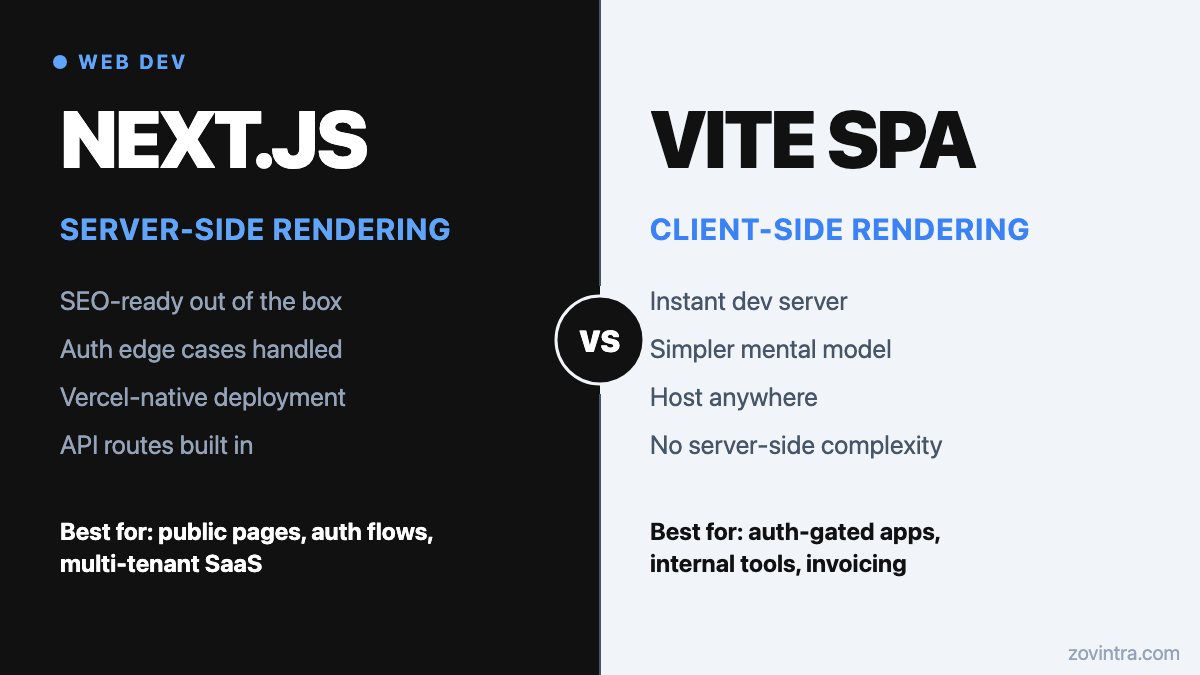
If you are testing an idea with a few dozen users, any of the three works and moving later is cheap. Spend the day on the product. If your app has no accounts, you need none of this. If your first customers are large companies that insist on their own identity provider, SSO is the main test, and an enterprise vendor such as WorkOS may fit better. We did not compare it here. This post covers three of the twelve libraries the Next.js guide lists. If you are still deciding between Next.js and a single-page app, settle that first, because the auth setup depends on it: see Next.js or a Vite React SPA.
Want a second opinion before you build?
If you are about to start a Next.js SaaS, we can check the sign-in choice against your pricing, mobile plans and likely enterprise buyers before anyone writes code. You can request an auth architecture review or contact us.
Common questions
Is Clerk free for a new SaaS?
Yes, up to a point. Clerk's changelog says every app gets 50,000 retained users free, and its pricing page lists a free Hobby plan at that size. Billing counts users who return at least a day after signing up. Pro starts at $20 to $25 a month, and extras such as additional SSO connections cost more.
Should a new project use Auth.js or Better Auth?
Better Auth's team, which has maintained Auth.js since 22 September 2025, strongly recommends Better Auth for new projects. The exception it names is needing a capability Better Auth lacks, such as stateless sessions without a database. Existing Auth.js apps keep security patches and urgent fixes, so there is no need to rush a move.
Can I use Clerk with Supabase?
Yes. Supabase lists Clerk as a third-party auth provider, and Clerk's guide shows RLS policies reading the Clerk user id from the session token. Clerk's older Supabase JWT template has been deprecated since 1 April 2025, so use the native integration. Supabase charges $0.00325 per third-party MAU above your plan's quota.
Sources
- Auth.js is now part of Better Auth
- Better Auth is joining Vercel
- Clerk changelog: new plans, more value
- Clerk pricing
- Clerk and Supabase integration
- Clerk migration overview
- Clerk Expo quickstart
- Clerk organizations
- Supabase pricing
- Supabase Auth overview
- Supabase: managing user data
- Supabase: enterprise SAML SSO
- Supabase: third-party auth
- Better Auth installation
- Better Auth Expo integration
- Better Auth organization plugin
- Better Auth SSO plugin
- Migrating from Clerk to Better Auth
- How to implement authentication in Next.js
Building something similar?
Talk to our engineering team about your architecture, roadmap, and delivery timeline.
Request a Technical Review →
We design, engineer, and deploy high-performance web platforms, mobile applications, and intelligent cloud systems.