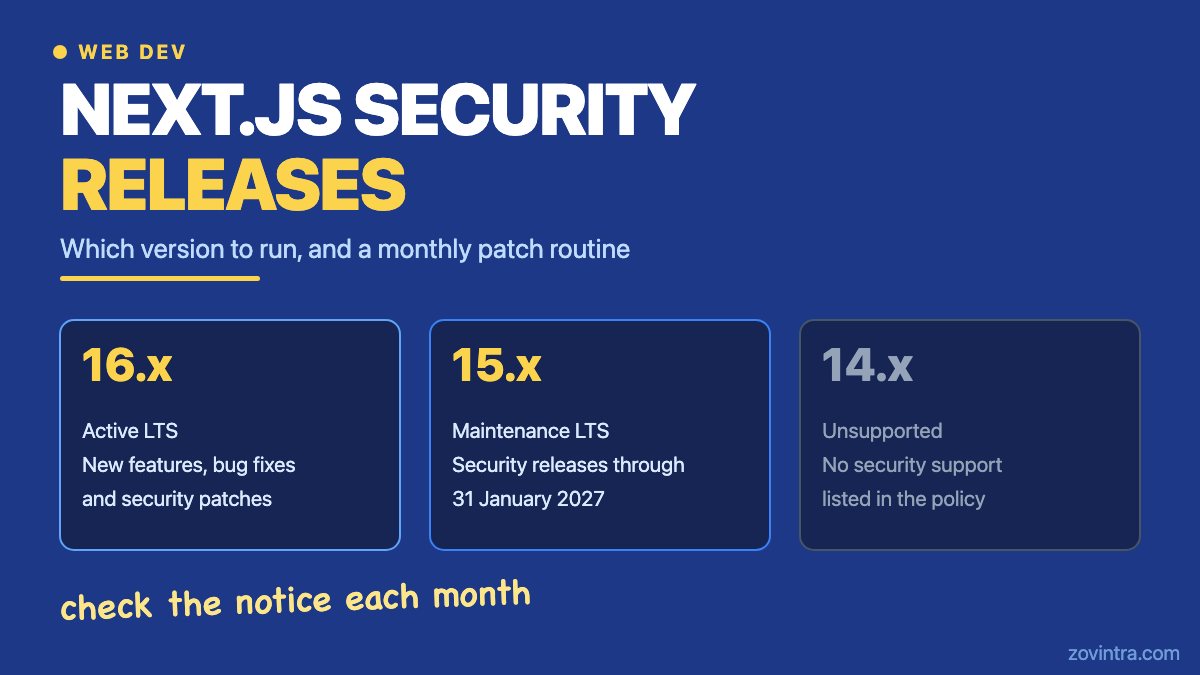
Next.js publishes security fixes roughly monthly. The 3 November release is in 16.4.5 and 15.5.29, and Next.js 14 is unsupported. The monthly schedule started in July 2026, and Next.js 15 gets security releases through 31 January 2027. If you run a production app, pick a supported line and put a monthly patch check in your calendar.
How often does Next.js ship security fixes now?
On 13 July 2026, the Next.js team moved to a formal security release program. Roughly once a month it posts advance notice on the Next.js blog, with the expected timeline and the highest severity expected. Urgent issues and ones already exploited in the wild still get ad-hoc patches.
The Next.js blog shows security releases on 20 July, 25 August, 30 September and 3 November, plus out-of-band ones on 22 September and 14 October. So the real pace is a monthly release plus the occasional emergency.
Who is affected by the 3 November release?
Not everyone, and not equally. The November 2026 security release lists seven advisories. The post labels one High and six Medium. The GitHub advisory pages rate all seven Moderate, including the one the post calls High, which matches the advance notice a week earlier that said seven medium issues. We use the post's labels below and flag the difference. Either way, patch.
- High in the post, Moderate on GitHub: cross-tenant cache disclosure. It affects apps with Cache Components enabled where the same public use cache function is called both directly and from inside unstable_cache, and the function reads a root parameter such as a tenant identifier. Where root parameters separate tenants, one tenant can receive another's data. The advisory says it needs a race during a cold process start, and that avoiding the use cache call inside unstable_cache is a complete workaround.
- Medium: nested use cache. It affects apps using Cache Components with nested public use cache functions, where an inner function reads a root parameter and the outer function finishes without waiting for a slower inner value. Content for one tenant, site or locale can reach another.
- Medium: binary arguments to use cache. Different binary arguments can produce the same cache identity. It matters only if you use those arguments to tell users or accounts apart and share the cache entries.
- Medium: shared shell cache poisoning. Self-hosted apps only, running next start with Cache Components on and Partial Prefetching off or unset, with a specific route shape. An unauthenticated request can cause wrong content or persistent 404 responses. The advisory lists partialPrefetching: true as a workaround.
- Medium: stale compressed response framing. Self-hosted apps that return an attacker-controlled fetched Response unchanged, behind an HTTP/1.1 reverse proxy that queues pipelined requests on a shared backend connection.
- Medium: cookie exposure in Edge routes. App Router Edge Route Handlers and Pages Router Edge API routes that set cookies with NextResponse.cookies.set() can expose the cookie in an internal header that same-origin JavaScript can read. It needs a sensitive cookie plus attacker JavaScript already running on your origin. Node.js Route Handlers and cookies().set() were not affected.
- Medium: SVG bypass in Image Optimization. An attacker-controlled image from a source you already permit can slip past images.dangerouslyAllowSVG: false and be decoded as SVG. The post says it does not itself show cross-site scripting or remote code execution. The advisory limits it to self-hosted apps and rates the impact as low availability.
So the headline cache issue does not hit every Next.js app. It needs Cache Components, a shared public use cache function, a root parameter and the unstable_cache call pattern all at once. A site with none of those is not exposed to that one.
By version line, the GitHub advisories list the four cache issues (the one labelled High, nested use cache, binary arguments and the shared shell) as affecting only 16.x. The stale response, Edge cookie and SVG issues also affect 15.x, up to 15.5.28.
Neither the release post nor the advisory pages say whether Vercel-hosted apps get platform protection from these issues. Do not assume you are covered. Patch.
What was in the October emergency release?
The 14 October 2026 update fixed three issues in 16.4.1 and 15.5.28. Two were rated Critical.
- Critical: unauthenticated remote code execution in use cache functions that return multiple typed arrays. It affects App Router with Cache Components. The post says there is no known workaround and to upgrade immediately, even if your app does not have similar functions.
- Critical: unauthenticated remote code execution in the Image Optimization API when using SVG. It affects Next.js running on glibc-based Linux. The workaround is a sharp version of 0.35.5 or later.
- High: denial of service in App Router with at least one Server Action. Crafted requests can use excessive CPU. Apps using Pages Router, or with no Server Actions, are not vulnerable.
Which Next.js version should I run?
The Next.js support policy gives the current picture. Here is what it says on 15 November 2026.
- 16.x: Active LTS. Released 21 October 2025. Gets new features, bug fixes and security patches.
- 15.x: Maintenance LTS. Security releases through 31 January 2027, extended from the original 21 October 2026. Maintenance LTS means only critical bug fixes and essential security updates.
- 14.x and 13.x: listed under Unsupported Versions, with no security support listed.
The November and October posts list fixed versions only for the 16.4 and 15.5 lines. If you are on 14, there is no patch to install. Fixing means upgrading. The November advisories list 15.0.0 and later as affected, so 14.x is not named in them, but that is not a safe sign: 14.x gets no security releases at all.
Our view: new work should start on 16.x. An app on 15.x has a hard date, 31 January 2027, so plan the move to 16.x now rather than in January. The support policy notes that Maintenance LTS updates land as semver-minor releases, even if they are breaking changes. So test a 15.x patch like a small upgrade, not a no-op.
What is a patch routine a small team can keep?
Our post on CI gates for a small team covers the checks that make a quick upgrade safe. Your runtime needs the same routine: see Node.js 20 end of life on Vercel.
- Watch the Next.js blog, or add a recurring calendar reminder for the start of each month. Read the advance notice for the expected date and highest severity.
- On release day, read the advisories and note which ones match your setup. Use the list above.
- Upgrade to the patched version on a branch. Use the exact version: npm install next@16.4.5 or npm install next@15.5.29, or later if a newer patch exists.
- Run your tests and build. Deploy to a preview. Click through login, checkout and any tenant-specific pages.
- Merge, deploy and watch your error monitoring.
- For anything Critical, or already exploited, skip the monthly rhythm and patch the same day.
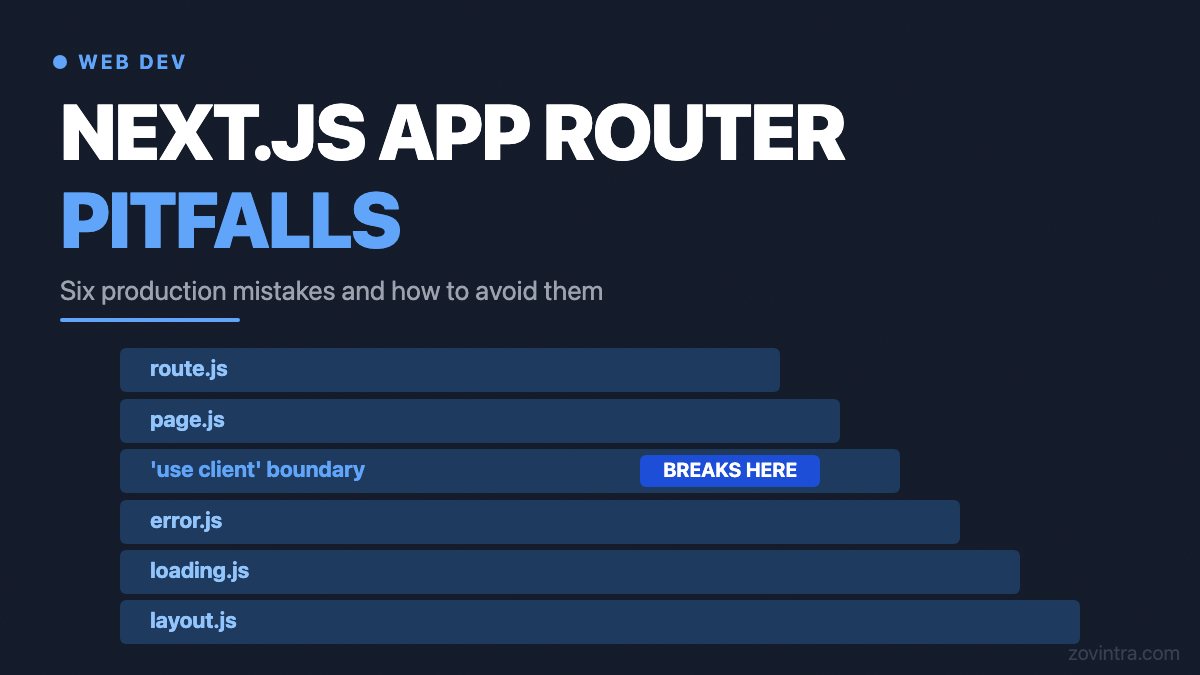
Our post on Next.js App Router pitfalls also covers how caching defaults changed between Next.js 14, 15 and 16, which is worth knowing before you rely on use cache.
What to do this week
When you can skip this
Skip the cache advisories if your app uses no use cache, no Cache Components and no Edge cookie routes. You should still patch. Skip the version question if you are already on a patched 16.x with a monthly routine. Skip the whole post if you do not use Next.js.
Want a second opinion?
Zovintra works with Next.js, Supabase and Vercel. If you want a read-only look at secrets, dependencies and database security in a Next.js repository, run the free code review or contact us. A broader starting point is our security checklist for an AI-built app.
Common questions
Does the November 2026 Next.js cache vulnerability affect every app?
No. The advisory the release post labels High needs Cache Components enabled and the same public use cache function called both directly and from inside unstable_cache, with the function reading a root parameter such as a tenant identifier. Apps without those features are not exposed to that one.
Is Next.js 14 still supported?
No. The support policy lists 14.x as unsupported and shows no security support. The latest security releases cover 16.x and 15.x only.
Until when does Next.js 15 get security fixes?
Through 31 January 2027. The support policy says this was extended from 21 October 2026. After that date, plan to be on 16.x.
Sources
- November 2026 Security Release
- Upcoming Next.js November Security Release
- Next.js Security Update for Upstream Vulnerabilities
- Next.js Security Release and Our Next Patch Release
- Support Policy
- Next.js blog index
- Next.js security advisories
Building something similar?
Talk to our engineering team about your architecture, roadmap, and delivery timeline.
Request a Technical Review →
We design, engineer, and deploy high-performance web platforms, mobile applications, and intelligent cloud systems.