CarePoint
A Hospital Management System for a Mid-Size Hospital
A concept study: we worked up this product, its architecture and its screens as an example of how we would approach it. The screens use fictional demo data and are design concepts, not screenshots of a live product, and this is not a client project.
About the Project
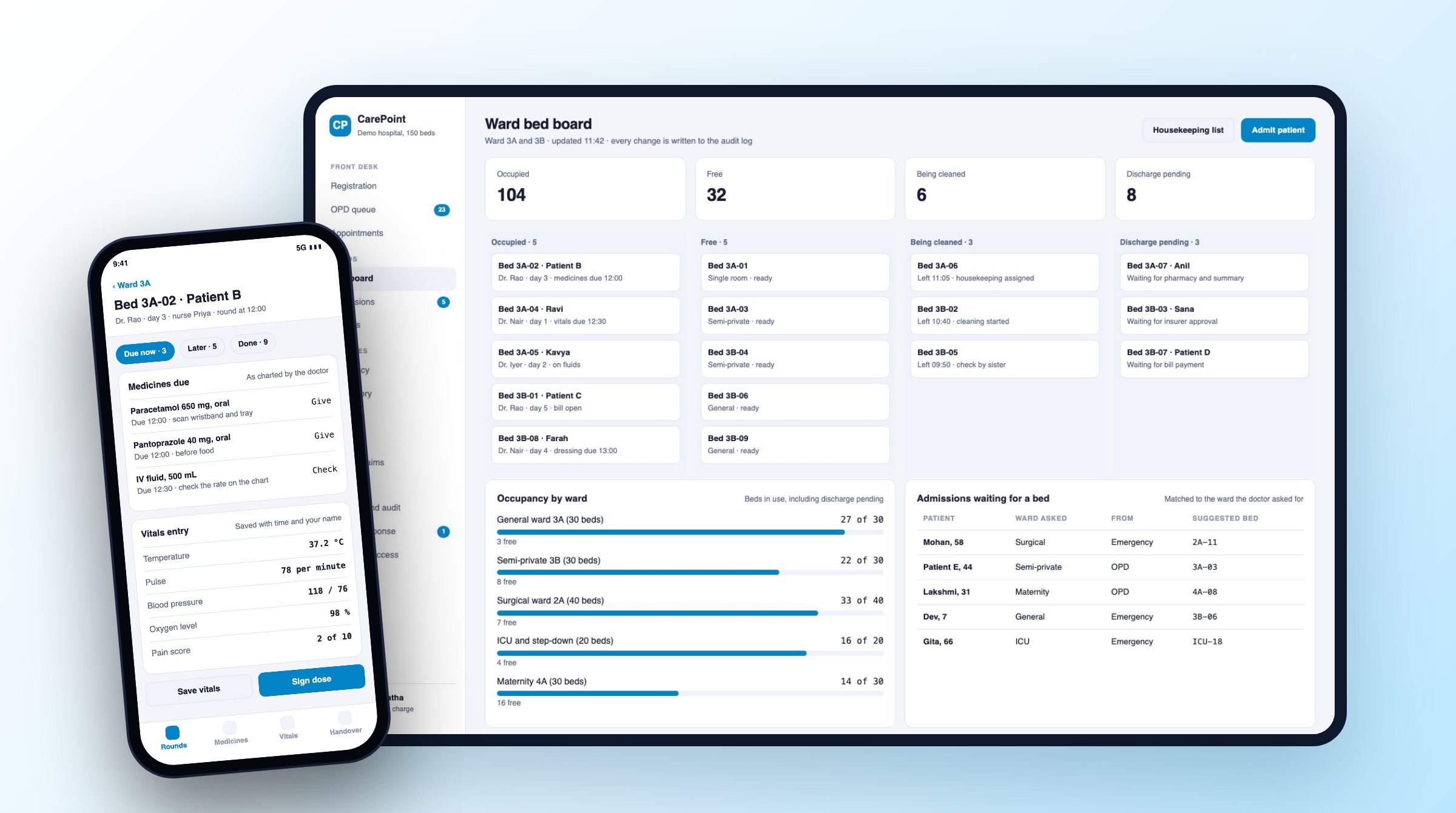
CarePoint is a design concept for a web-based hospital information system for a 150-bed hospital. It joins the daily work of one building: patient registration, the outpatient department (OPD) queue and appointments, in-patient department (IPD) admissions and a ward bed board, pharmacy, laboratory orders and results, and billing with insurer pre-authorisation tracking. Nurses and doctors get a tablet and Android app for rounds and medicine charting.
The record is built on FHIR R4 (Fast Healthcare Interoperability Resources) so data can move between systems, and patient registration is designed around an ABHA (Ayushman Bharat Health Account) scan-and-share flow. Trust screens are part of the first release, not an add-on: consent records, an audit log of who opened which record, role-based access, and a breach-response workflow. The design accounts for India's DPDP (Digital Personal Data Protection) Rules and the ABDM (Ayushman Bharat Digital Mission) ecosystem, and any AI-drafted note stays unsaved until a clinician reviews and signs it. This is software design only and gives no medical advice.
All screens use fictional demo data. This is a concept, not delivered client work, and nothing here claims certification or legal compliance.
Why This Matters Now
Market, rule and technology context for this kind of product, checked on 16 November 2026. Each item names its source.
- The National Health Authority picked EkaCare to build a voice scribe for public health facilities: it supports 15+ Indian languages, writes FHIR output, and a doctor must approve each note before it is saved to ABHA.Analytics India Magazine, 11 Nov 2026
- A government statement says over 104 crore health records are linked to over 93 crore ABHA accounts, so most patients arrive with an ABHA number already.News On AIR (government statement), 6 Jul 2026
- A security vendor's page (a secondary source) reports CERT-In guidance from May 2026 to patch critical flaws in internet-exposed systems within 12 hours, with health care among the sectors named; its binding status is unclear.Aviatrix (security vendor, secondary source), 26 May 2026
- The National Health Authority held a National Health Claims Exchange (NHCX) innovation meet and hackathon at IIT Hyderabad on 6 and 7 March 2026, and its chief called complex health claims a persistent pain point.ThePrint, Mar 2026
- A law firm's summary of the DPDP Rules, notified in November 2025, says consent notice, security safeguards and breach reporting duties start 18 months later, around May 2027.AMS Shardul (law firm summary, secondary source), Nov 2025
- HL7's version history lists FHIR R5 as the latest published release and R4 (version 4.0.1) as the normative base, which is why the record model here starts from R4.HL7 International, R5 published 26 Mar 2023
Requirements & Objectives
- Register patients at the front desk with an ABHA scan-and-share option, and allow registration without ABHA.
- Run the OPD queue and doctor schedules with tokens, waiting times and appointment booking.
- Manage IPD admissions, transfers and discharges on a live ward bed board, including cleaning and discharge-pending states.
- Take lab and pharmacy orders from doctors, return results to the chart, and keep pharmacy stock in step with dispensing.
- Build bills from ward, lab, pharmacy and theatre records, and track each insurer pre-authorisation from request to settlement.
- Store patient data as FHIR R4 resources so records can be exchanged with other systems.
- Record consent with its notice version, keep an audit log of every record opened, and enforce role-based access.
- Provide a breach-response workflow and keep any AI-drafted note unsaved until a clinician reviews and signs it.
The Engineered Solution
1One record, FHIR R4 underneath
Patients, encounters, orders, results and medicines are stored as FHIR R4 resources, so registration, wards, pharmacy, lab and billing read the same record instead of copying it between modules.
2Consent and audit as first-class screens
Every consent choice is dated and versioned, every record open is logged with the user and the reason, and flagged opens go to a privacy officer who decides. A breach-response case walks through contain, assess, notify and close.
3Tablet and Android app for the ward
Nurses and doctors chart vitals and medicines at the bedside, scan the wristband, and sign each entry by name and time. The app keeps working on a weak ward network and syncs when it reconnects.
4Billing with an insurer seam
Bills pull from the departments' own records. Pre-authorisation requests are tracked with dated steps. The claim channel is an adapter, so a connector to the National Health Claims Exchange can be added later without changing billing.
Design Concept Screens
Design concepts with fictional demo data. They show how the product could look and work, not a live release.
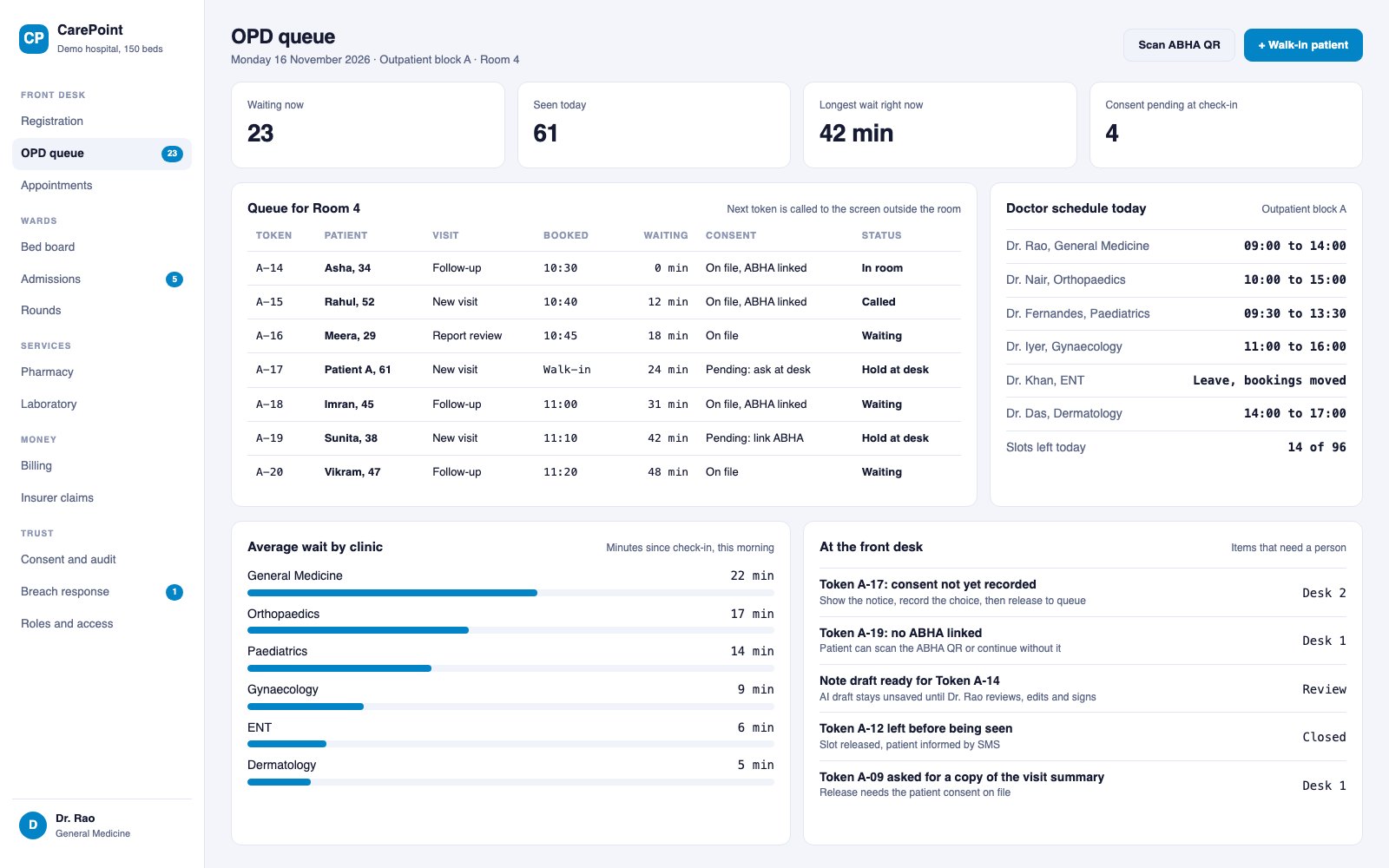
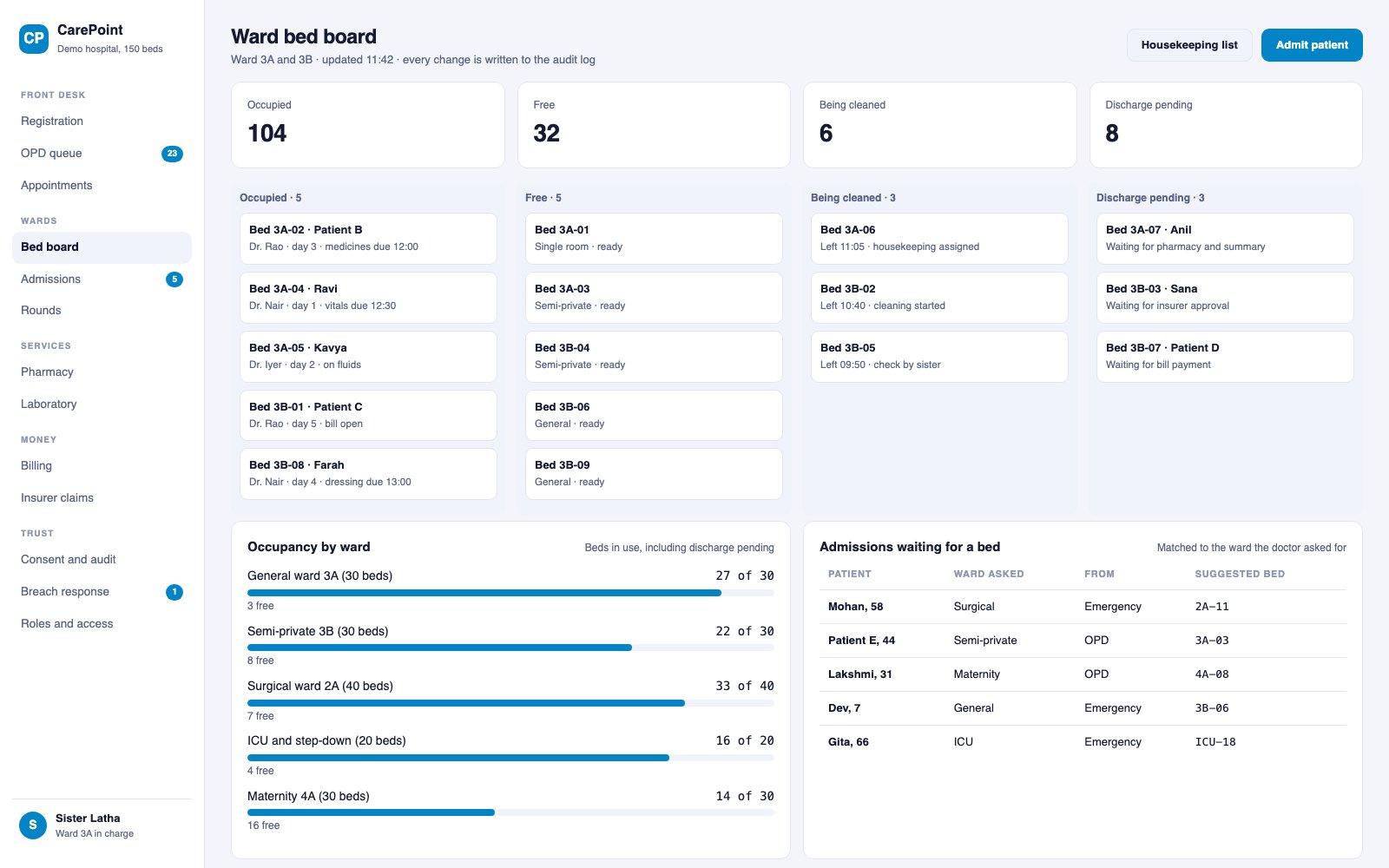
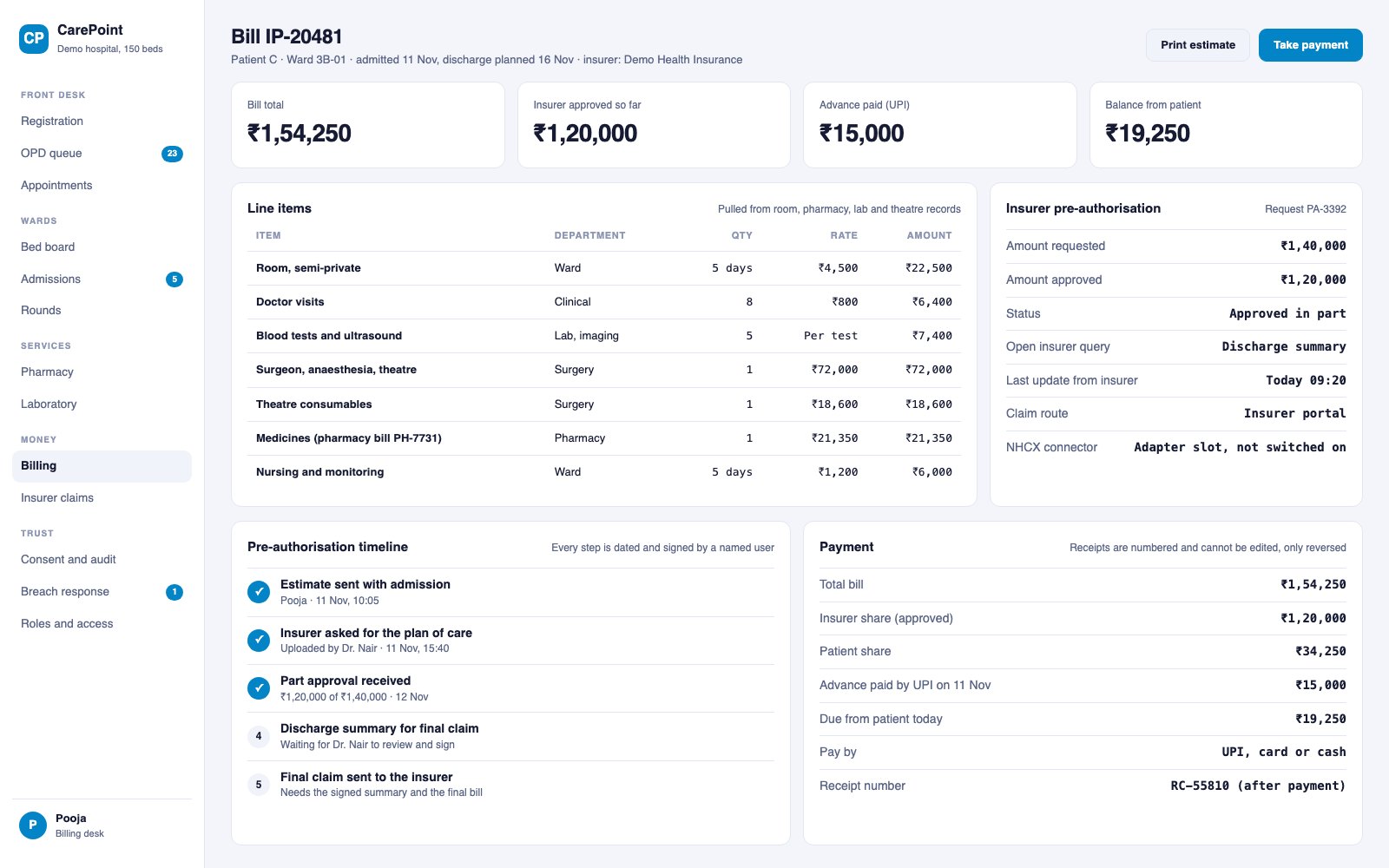
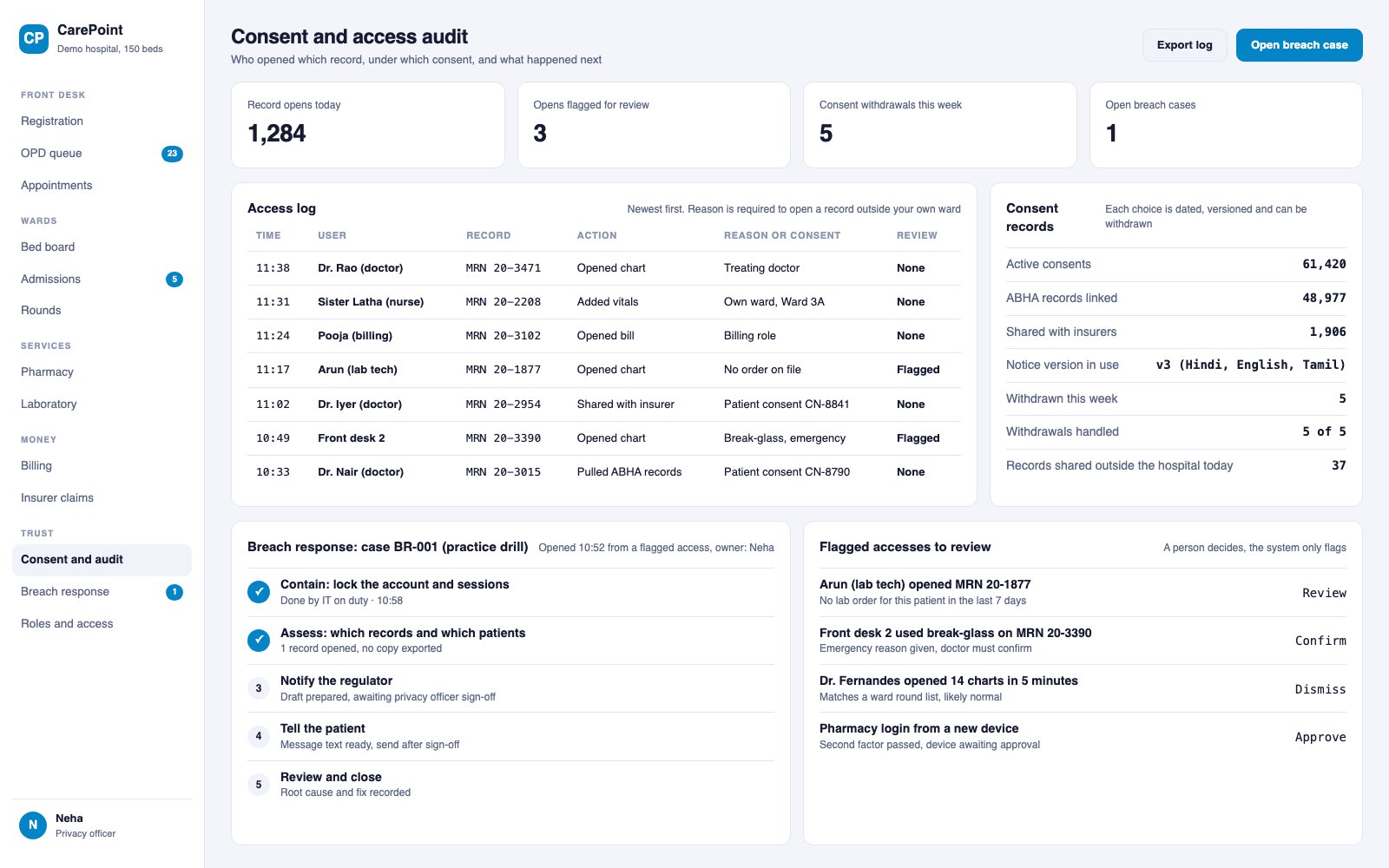
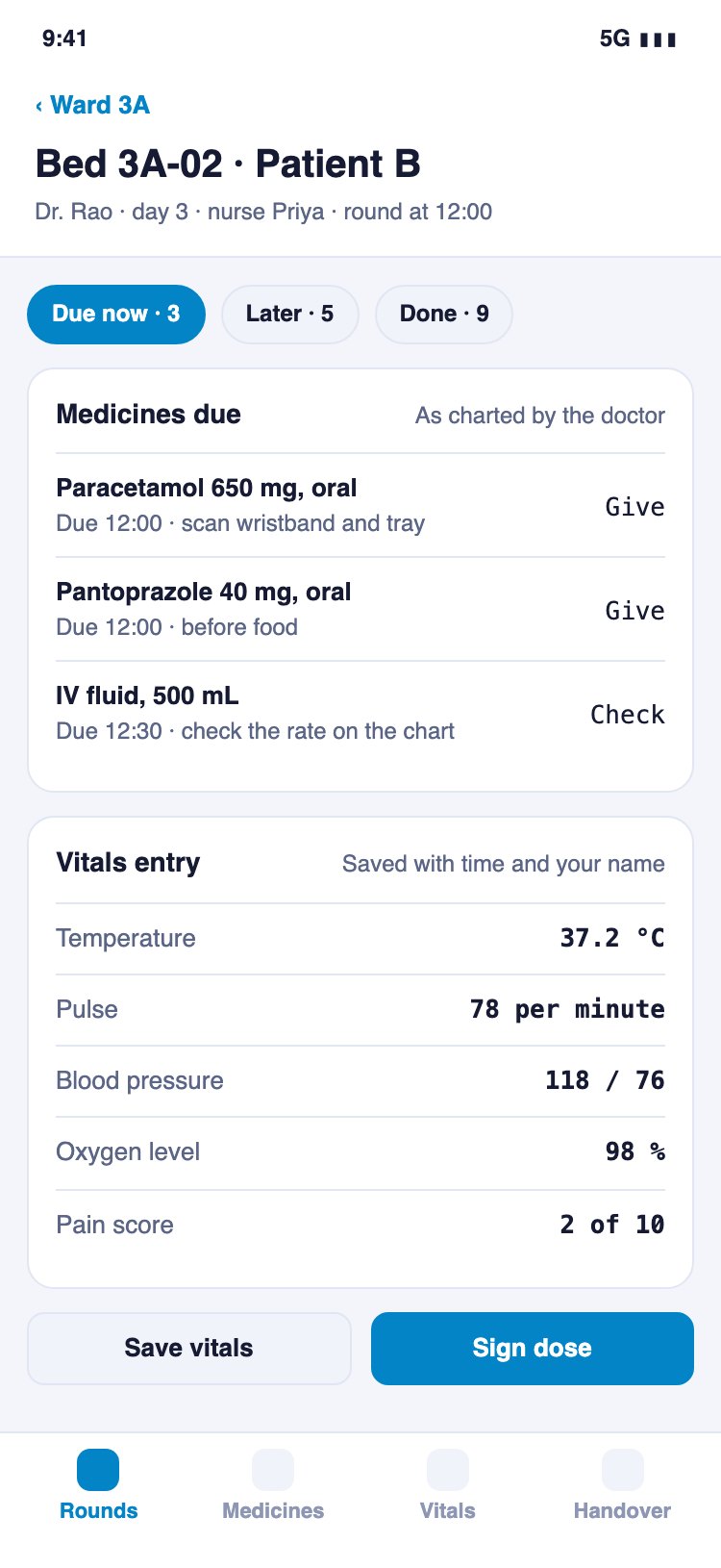
01 / 05 OPD queue and doctor schedule - see who is waiting, for how long, and whose consent or ABHA link still needs the front desk
Engineering Process
- Map OPD, IPD, pharmacy, lab and billing workflows with the hospital's doctors, nurses and front desk.
- Model the FHIR R4 resources and the consent and audit tables before any screens are built.
- Prototype the OPD queue, bed board and rounds app and test them with ward staff on real tablets.
- Build registration with ABHA scan-and-share against the ABDM sandbox, plus outpatient flows.
- Build admissions, the bed board, pharmacy, lab and billing with pre-authorisation tracking.
- Add role-based access, the audit log, consent screens and the breach-response workflow, then run a practice drill.
- Pilot one ward, fix what staff find, then widen to the whole hospital in stages.
Production Tech Stack
| Layer / Component | Production Technologies |
|---|---|
| Web app | Next.jsTypeScriptTailwind CSS |
| Tablet and Android | React Native with Expolocal SQLite cache for offline charting |
| Backend and FHIR | Node.js with TypeScriptHAPI FHIR server for R4 resources |
| Database | PostgreSQL with row-level security and an append-only audit table |
| Identity | Keycloak for sign-inroles and second-factor checks |
| Infrastructure | DockerGitHub Actionshosting in an Indian cloud region or the hospital's own data room |
What the design aims for
CarePoint aims to connect a mid-size hospital's front desk, wards, services and billing around one record, with consent, audit and clinician sign-off on the screens staff already use.