PayRoute
A Merchant Payments Hub for UPI, Cards, Payouts and Reconciliation
A concept study: we worked up this product, its architecture and its screens as an example of how we would approach it. The screens use fictional demo data and are design concepts, not screenshots of a live product, and this is not a client project.
About the Project
PayRoute is a design concept for a merchant payments hub for an Indian business that collects money by UPI (Unified Payments Interface), cards and payment links. It would run on the rails of a licensed payment partner and would not hold or move money by itself. Its job is the merchant's view: status, fees, settlement and exceptions in one place.
A UPI payment, a card payment and a payment link normally appear in three files and settle on different days with fees taken out. PayRoute keeps its own double-entry ledger, so every payment event becomes balanced entries and the dashboard and the export read the same numbers. A matching engine compares the ledger with partner settlement files and bank statements and sends anything that does not match to an exceptions queue with a probable reason.
Rules move, so fees and limits sit in dated rate cards with a preview, not in code. The design accounts for rules from NPCI (National Payments Corporation of India) and the RBI (Reserve Bank of India) through the partner, and does not claim to satisfy them. A small model only suggests reasons for breaks. A person confirms every adjustment, and no model decides on money movement.
Why This Matters Now
Market, rule and technology context for this kind of product, checked on 16 November 2026. Each item names its source.
- IANS, via Free Press Journal, reported that UPI handled about 25.47 billion transactions worth Rs 31.53 lakh crore in Oct 2026, based on NPCI data, and that NPCI postponed merchant fees on select payments until after Diwali.IANS via Free Press Journal, 2 Nov 2026
- TeamLease RegTech reports that NPCI issued a consolidated UPI circular on 18 Sep 2026 covering API use, merchant QR, AutoPay, settlement, reconciliation and disputes, and withdrawing earlier circulars listed in an annex.TeamLease RegTech, 19 Sep 2026
- Inc42 reported a finance ministry notification of 14 Sep 2026 that lets the Centre set which payment modes are charge-exempt, keeping UPI up to Rs 2,000 and RuPay debit cards free of fees.Inc42, 15 Sep 2026
- KPMG reports that the RBI authentication directions issued 25 Sep 2025 took effect on 1 Apr 2026, requiring two factors for covered digital payments, with at least one dynamic factor outside card-present cases.KPMG India, 25 Sep 2025
- The RBI master direction on payment aggregators, issued 15 Sep 2025 and updated 11 Nov 2026, sets net worth rules, separate escrow accounts and merchant checks, which shape how a merchant hub must hold and report settlement.Reserve Bank of India, 15 Sep 2025
Requirements & Objectives
- Show one timeline per payment across UPI, card and payment link, and keep pending as a real state until the partner confirms the final result.
- Keep a double-entry ledger where every payment event becomes balanced entries, past entries are never edited and corrections are new entries.
- Create payment links and dynamic QR codes with amount, expiry and reference, and take payments through a hosted checkout and an API with a test mode.
- Import partner settlement files and bank statements, match them to the ledger in ordered passes and list every break with a probable reason.
- Store fees, caps and exemptions as rate cards with effective dates, and preview the effect of a change before it goes live.
- Support single and bulk payouts where the maker and the checker are different people and a beneficiary name check runs before money moves.
- Handle refunds and chargebacks as cases with deadlines, evidence upload and status, within each user's limit.
- Give owners an Android and iOS app to read collections and approve payouts with biometric confirmation, and log every rate card change, payout and refund.
The Engineered Solution
1One timeline for every payment
Each attempt, state change, fee, refund and settlement lands on a single timeline, whether the customer paid by UPI, card or link. Support can answer "did my payment go through?" from one screen.
2A ledger that cannot disagree with itself
Partner events become balanced, append-only entries. Dashboard totals, settlement views and exports all read these entries, so a number on one screen is the number on every screen.
3Fees and rules as dated data
A rate card holds fees, caps and exemptions with an effective date. Finance adds the next card and previews its effect, while older payments keep the card that applied on their day.
4Exceptions with a reason attached
Each unmatched item shows the rule that ran and a probable cause: fee difference, timing, duplicate or missing file line. A person accepts it with a note before any adjustment entry is posted.
Design Concept Screens
Design concepts with fictional demo data. They show how the product could look and work, not a live release.
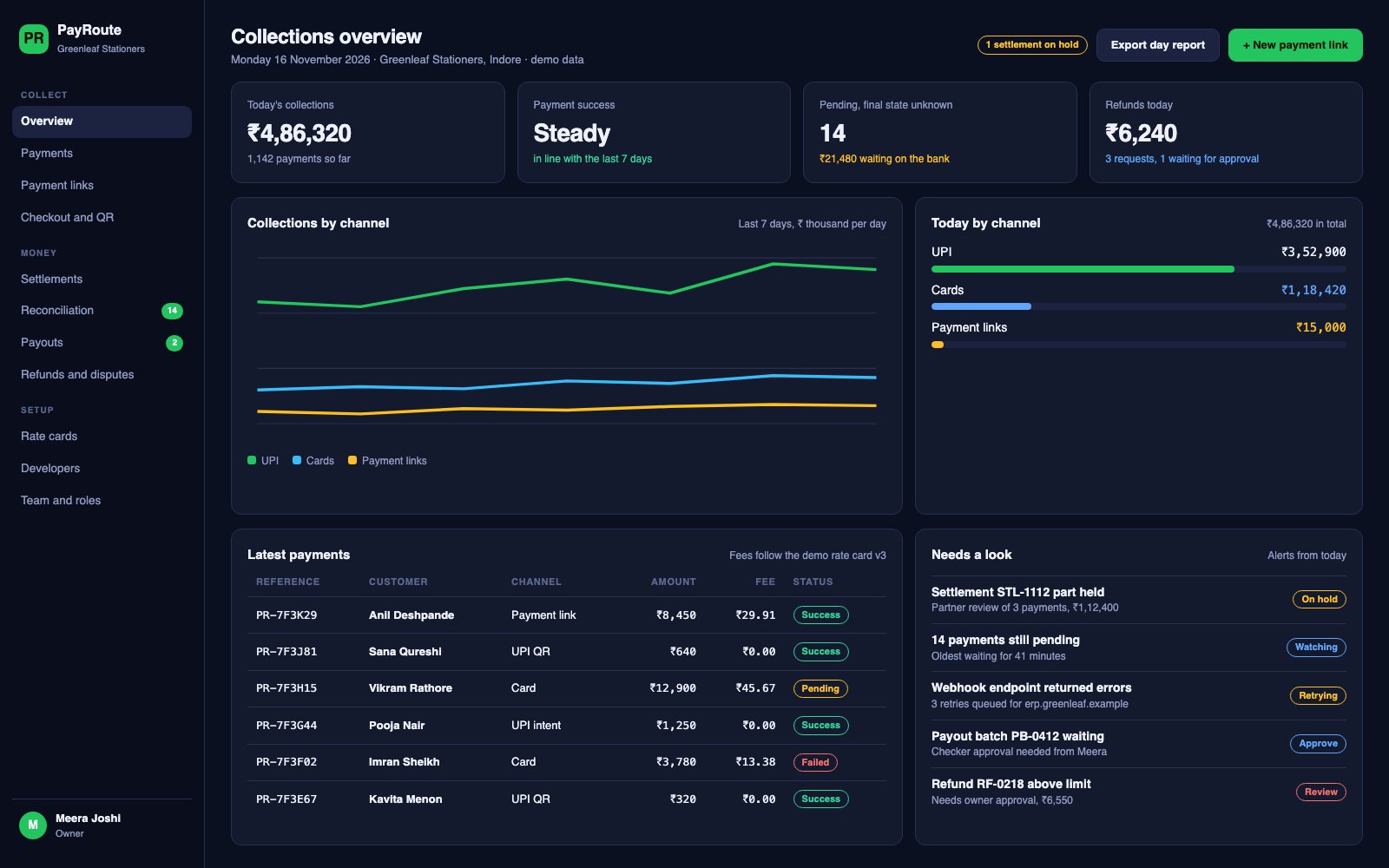
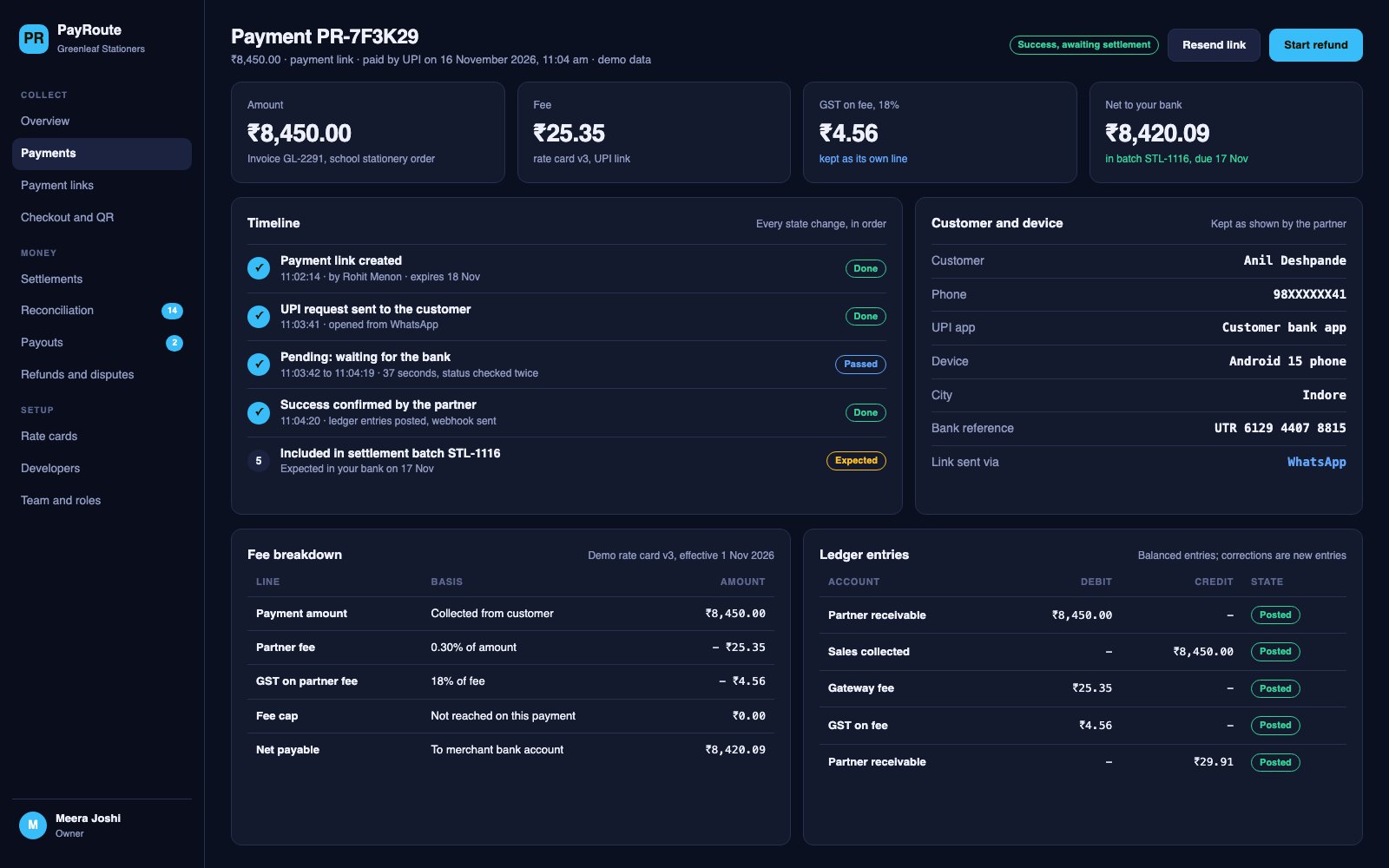
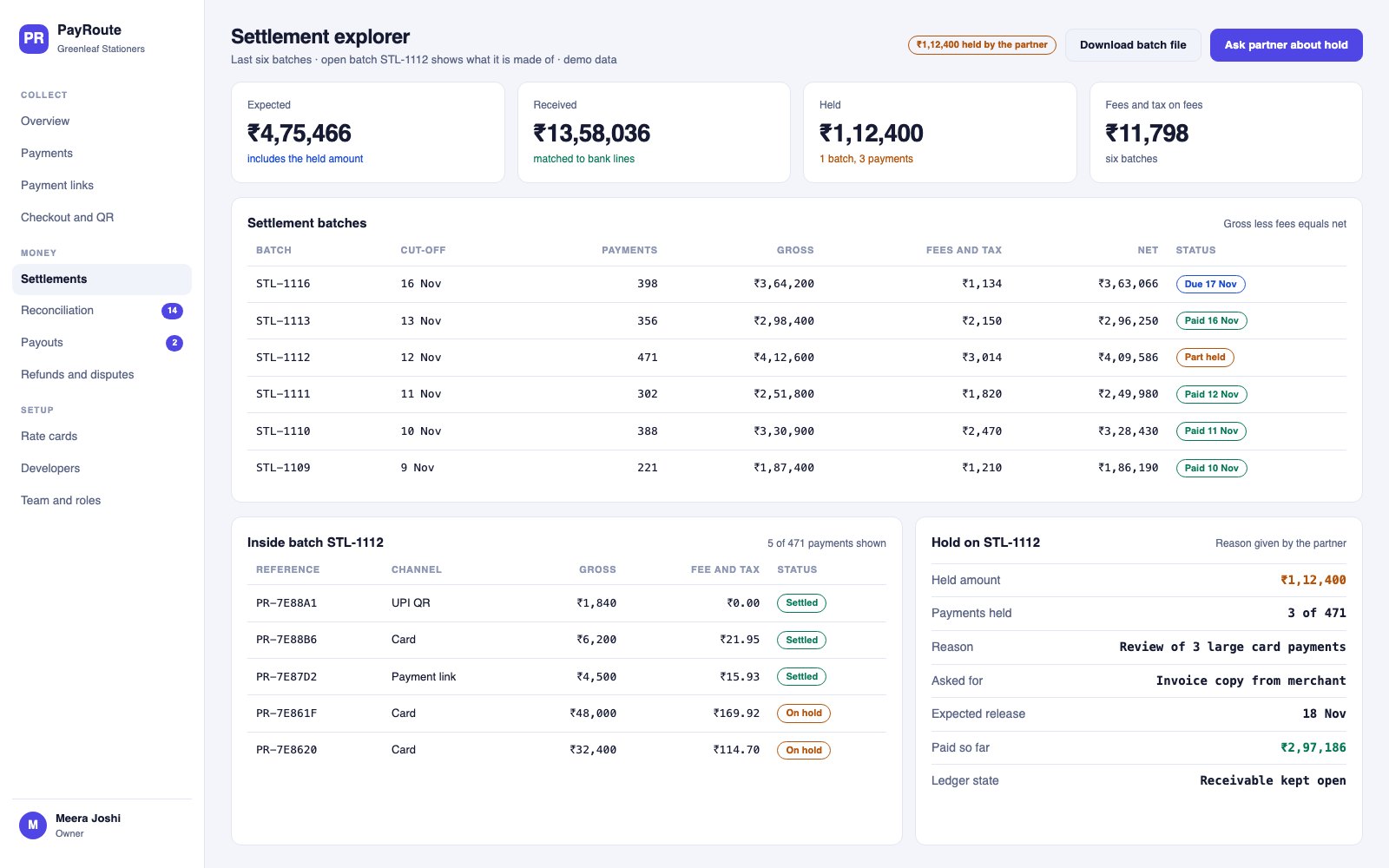
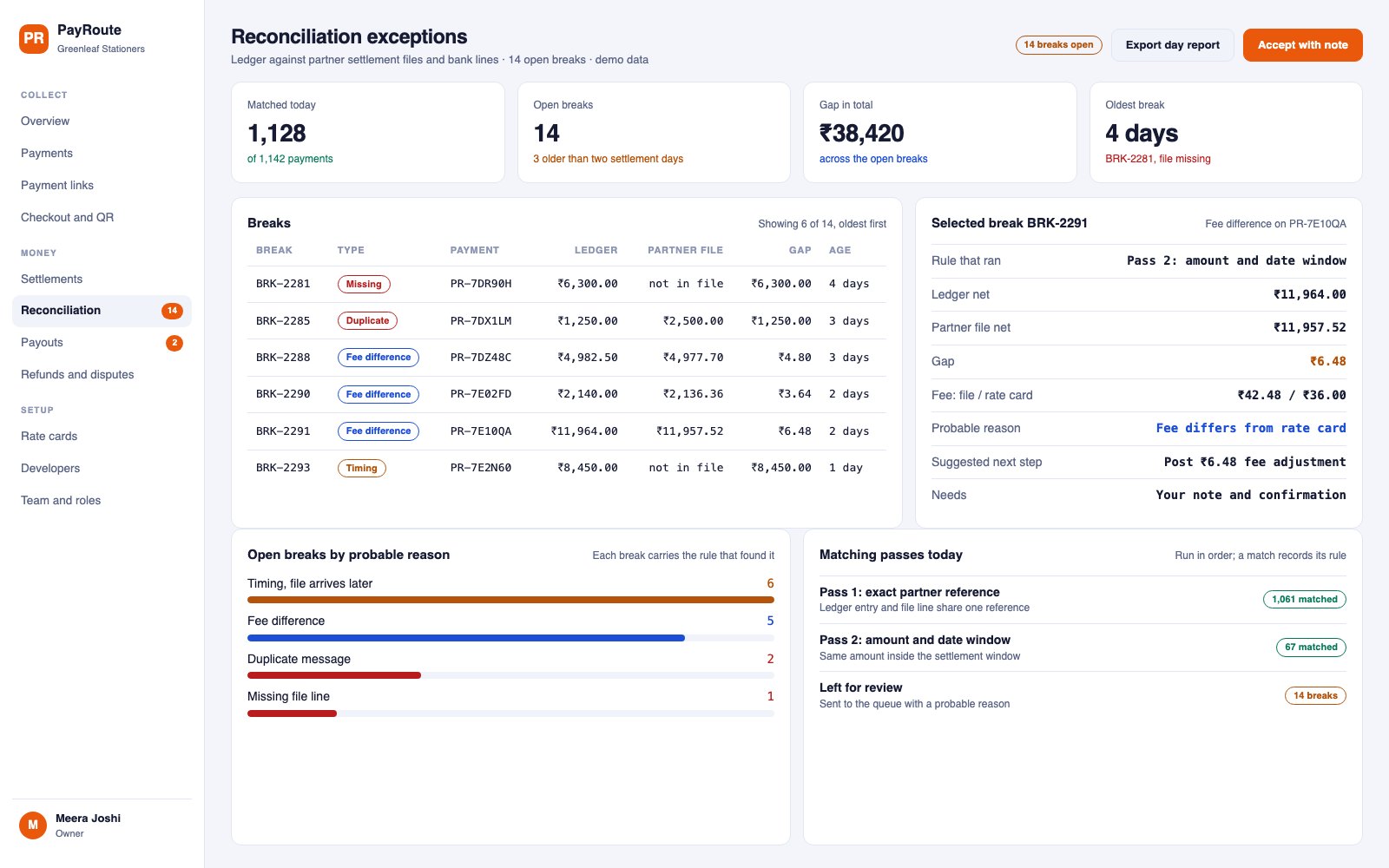
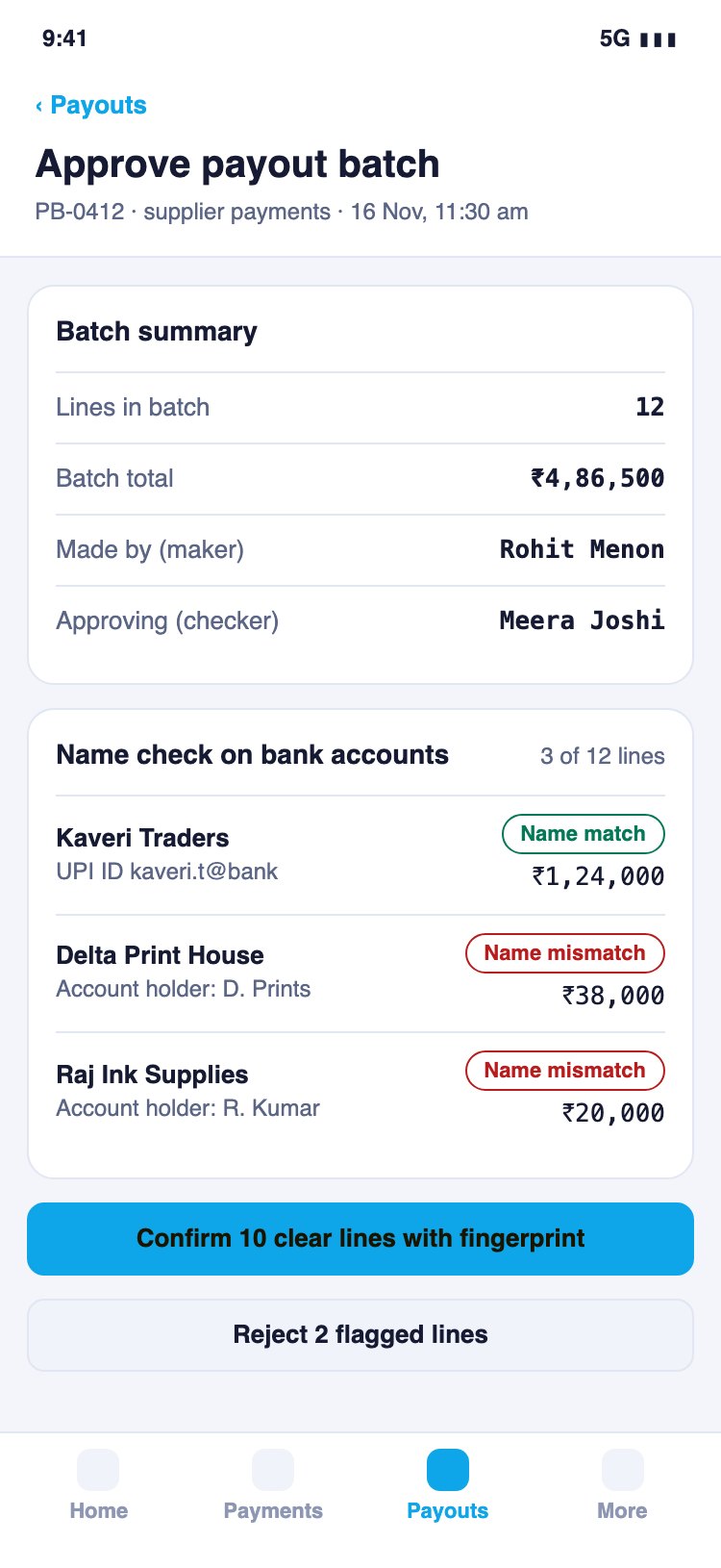
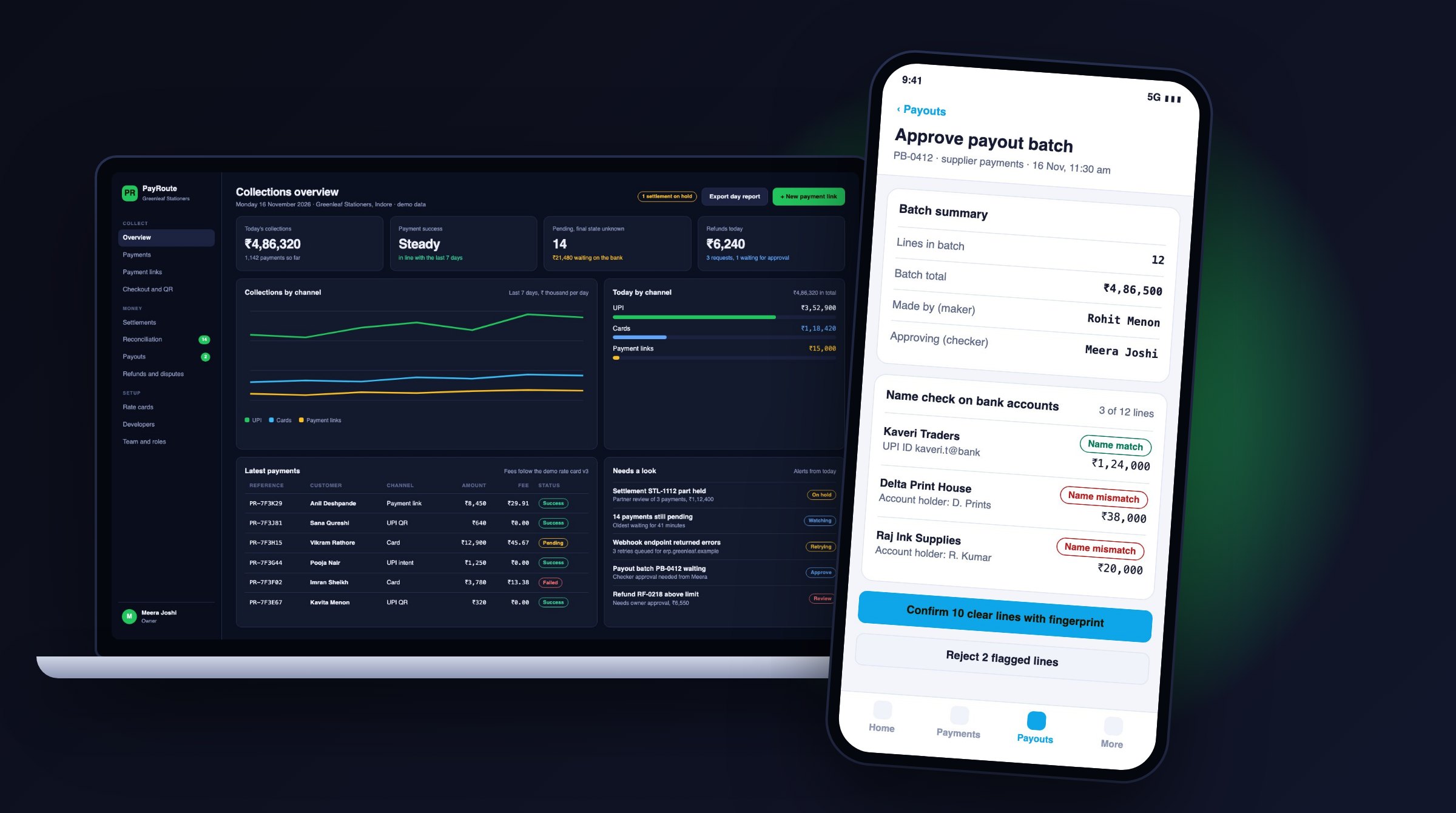
01 / 05 Collections overview - see today's money by channel, the latest payments and what needs attention
Engineering Process
- Map one day of a merchant's sales across UPI, card and link reports with the owner, finance and support staff, using their own files.
- Model the ledger: accounts, balanced entries, partner references, rate cards with effective dates and settlement batches.
- Prototype the timeline, settlement explorer and exceptions queue with finance staff, using sample partner files and a clickable design.
- Build the ledger, the first partner adapter, hosted checkout, payment links, signed webhooks and test mode.
- Build settlement import, the ordered matching passes, the exceptions queue and refunds, and check them against real partner files.
- Add payouts with maker and checker approval, then the Android and iOS approval app with device binding.
- Rehearse festival-day load, review security and failure handling, support the partner's onboarding checks and hand over with runbooks.
Production Tech Stack
| Layer / Component | Production Technologies |
|---|---|
| Web app | Next.js (App Router)TypeScriptTailwind CSSshadcn/uiTanStack Table with server-side pagination |
| Services | NestJS on Node.jsZod input validationan outbox pattern that publishes events after each database commit |
| Ledger and data | PostgreSQL with serialisable ledger writes and row-level security per merchantRedis for idempotency keysobject storage for settlement files |
| Mobile app | React Native with Expobiometric confirmation and device binding for approvals |
| Reports and AI | BigQuery or ClickHouse for reportsa small classifier that proposes a probable reason for each break and shows the rule it used |
| Cloud | AWS Mumbai region on ECS with SQSKMS and a WAFTerraform and GitHub Actions |
What the design aims for
PayRoute aims to trace every rupee from a customer's payment to the settlement in a merchant's bank account, with each mismatch explained line by line.