LearnPath
Adaptive Practice for Schools and Coaching Institutes: Offline Student App, Teacher View, Parent Updates
A concept study: we worked up this product, its architecture and its screens as an example of how we would approach it. The screens use fictional demo data and are design concepts, not screenshots of a live product, and this is not a client project.
About the Project
LearnPath is a design concept for adaptive practice in Indian schools and coaching institutes, starting with maths and science for Classes 6 to 12. In a class of forty, every student sits at a different level, yet homework and tests are the same for all. Teachers see marks after a test, when it is late to fix a gap.
Each question is tagged to a small curriculum skill, such as adding fractions with unlike denominators. After every answer, a simple and explainable estimate of mastery for that skill is updated, and the next question comes from it. Old skills return at spaced intervals. The student app downloads a pack of questions and hints while online and then runs everything on the phone, so a ten-question session works on a bus with no signal and syncs at home.
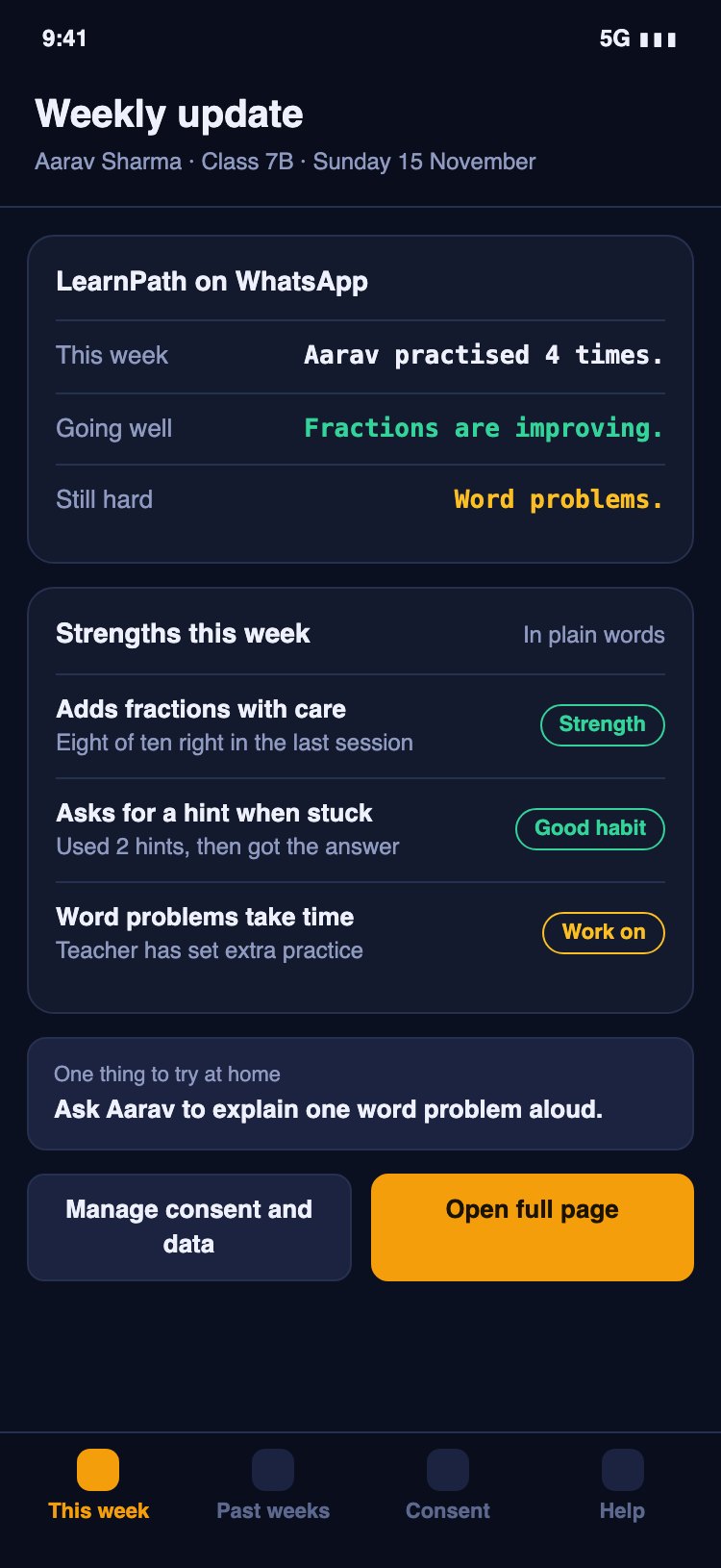
Teachers stay in charge. They choose the topics, see why a question was picked, and approve every hint an AI helper drafts. A class view shows who is stuck on which skill. Parents get a short weekly message with one thing to try at home and no ranking. Children's data gets strict defaults: only what learning needs, consent checked before a session opens, and export or deletion by the school. The design accounts for India's data protection rules and does not claim to meet them.
Why This Matters Now
Market, rule and technology context for this kind of product, checked on 16 November 2026. Each item names its source.
- CBSE will introduce a computational thinking and AI curriculum for Classes 3 to 8 in 2026-27 and set the teacher training theme to match, according to Free Press Journal citing CBSE's 9 April notice.Free Press Journal (news, citing CBSE notice), 10 Apr 2026
- CBSE board minutes say APAAR ID becomes a mandatory field for registration and candidate lists in 2026-27, after it found under half of students had one in 2025-26 (reported by Careers360).Careers360 (news, citing CBSE minutes), 19 Feb 2026
- A law-firm summary says most DPDP Rules obligations, including verifiable parental consent, start on 12 May 2027, and consent manager rules start on 12 November 2026.AZB & Partners (law firm), 14 Nov 2025
- India's Ministry of Education said it would add AI and computational thinking from Grade 3 in 2026-27 under NEP 2020, with teacher training through NISHTHA (reported by Careers360).Careers360 (news), 30 Oct 2025
Requirements & Objectives
- Tag every question to a curriculum skill and level, with a worked solution, so practice and reports use the school's own language.
- Choose the next question from the student's current skill estimates, mix in review of older skills, and show a teacher why each question was chosen.
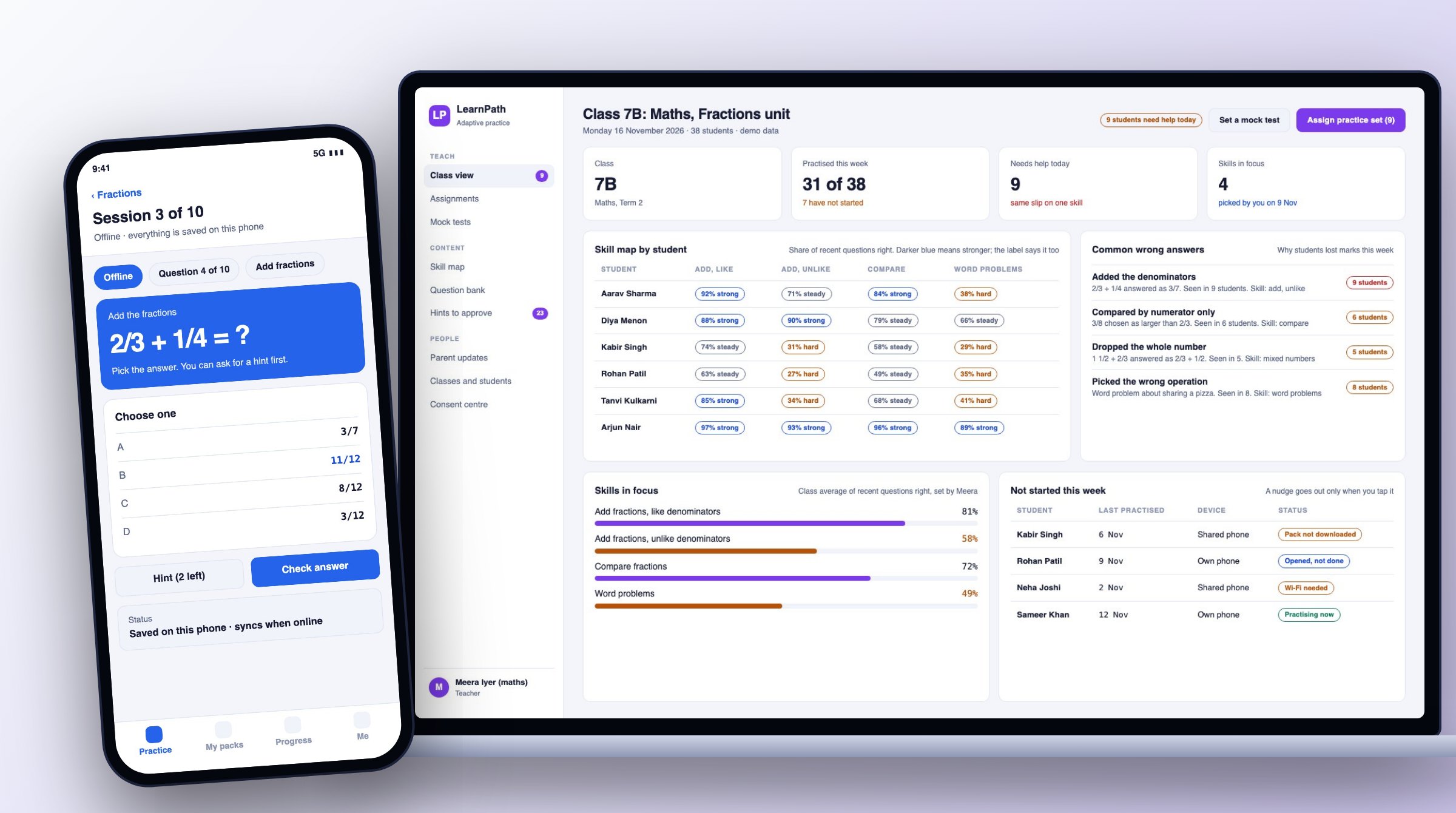
- Download a weekly pack of questions, hints and images so a student can practise with no signal, then sync the answers safely when the phone reconnects.
- Let two students share one phone, each with a separate local store opened by their own PIN.
- Show a teacher a skill map by student, the common wrong answers and who has not started, with one-tap assignment of a targeted practice set.
- Send parents a short weekly message in English or a regional language, with one thing to try at home and no ranking of children.
- Draft hints with an AI helper, check the maths with a symbolic tool, and show nothing to a student until a teacher or editor approves it.
- Record parent consent for every student, block sessions without it, and let a school admin export or delete a student's data.
The Engineered Solution
1Practice that adjusts to each student
Short sessions of about ten questions pick each next question from a simple mastery estimate per skill. Older skills return at spaced intervals, and a plain line tells the student and the teacher why a question was chosen.
2Works without a connection
The phone holds a weekly pack and runs the same small learning library the server uses. Every answer is an event with its own id, so a flaky connection that uploads twice does not double count.
3A class view built for Monday morning
Teachers see a skill map by student, the wrong answer most students gave, and the students who have not started. They assign practice to just those students and approve or edit each AI-drafted hint.
4Parents and consent in plain words
A weekly WhatsApp message says what the child practised, what improved and what is hard. Consent is a record on every student, checked before a session opens, and withdrawing it starts deletion.
Design Concept Screens
Design concepts with fictional demo data. They show how the product could look and work, not a live release.
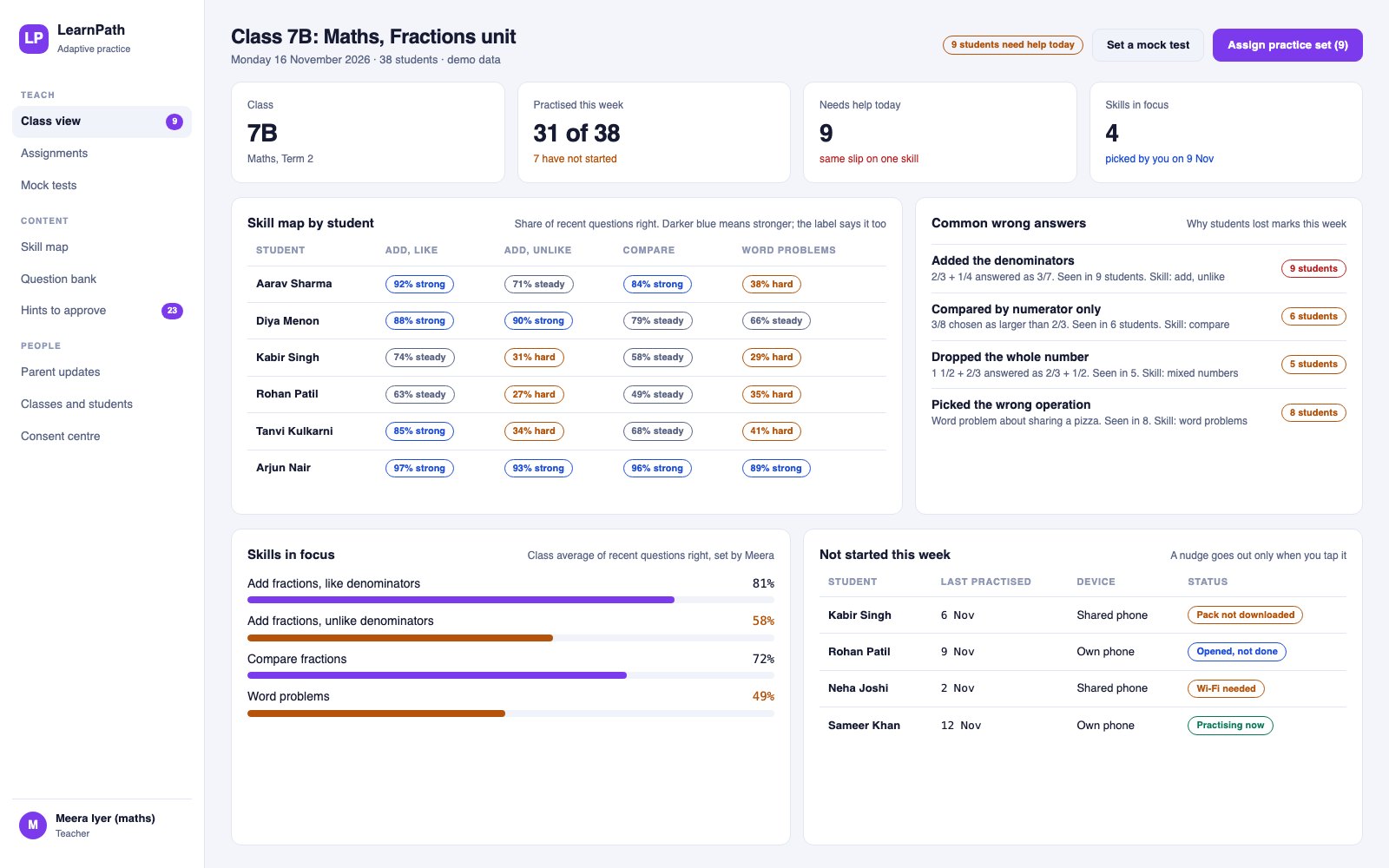
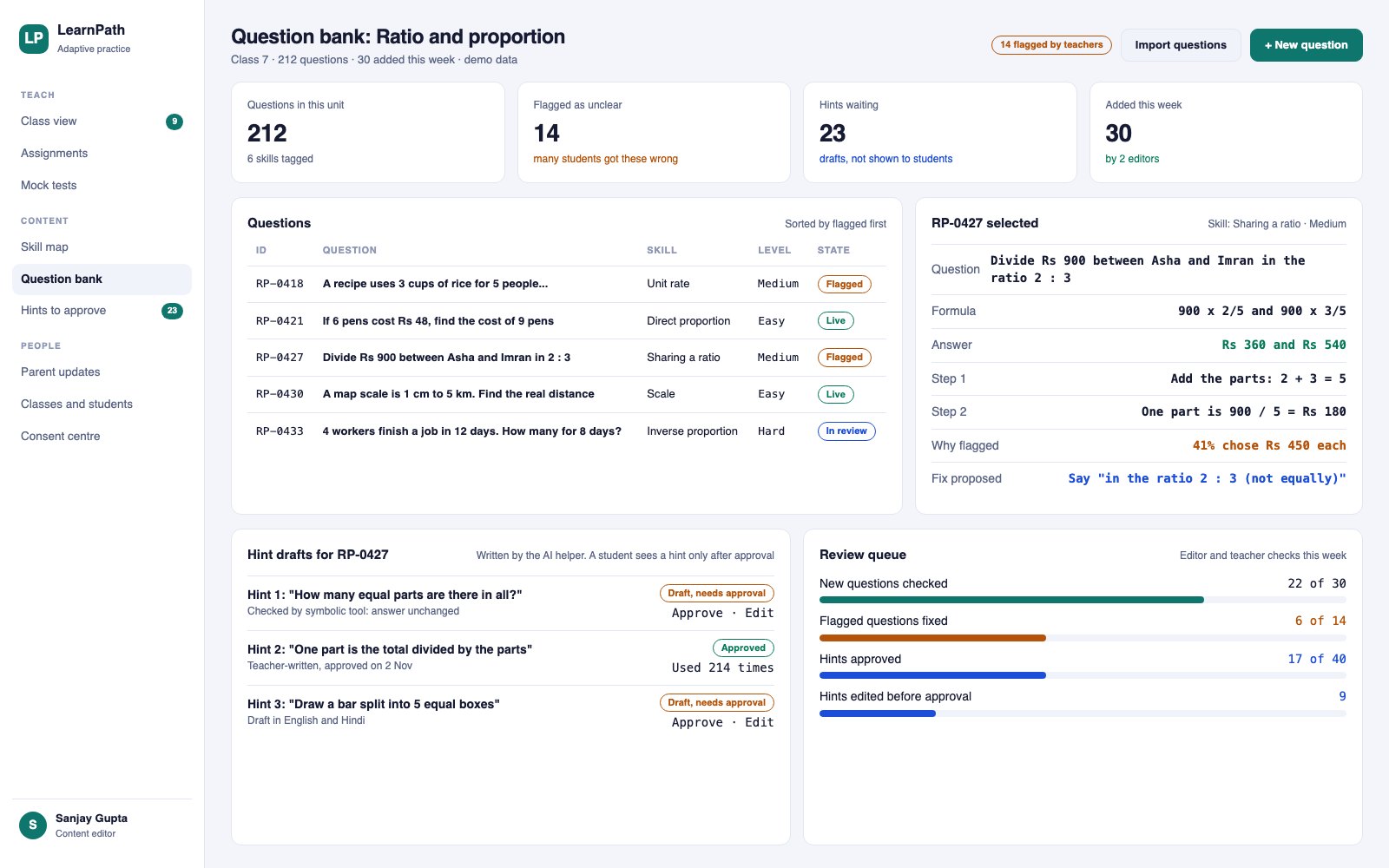
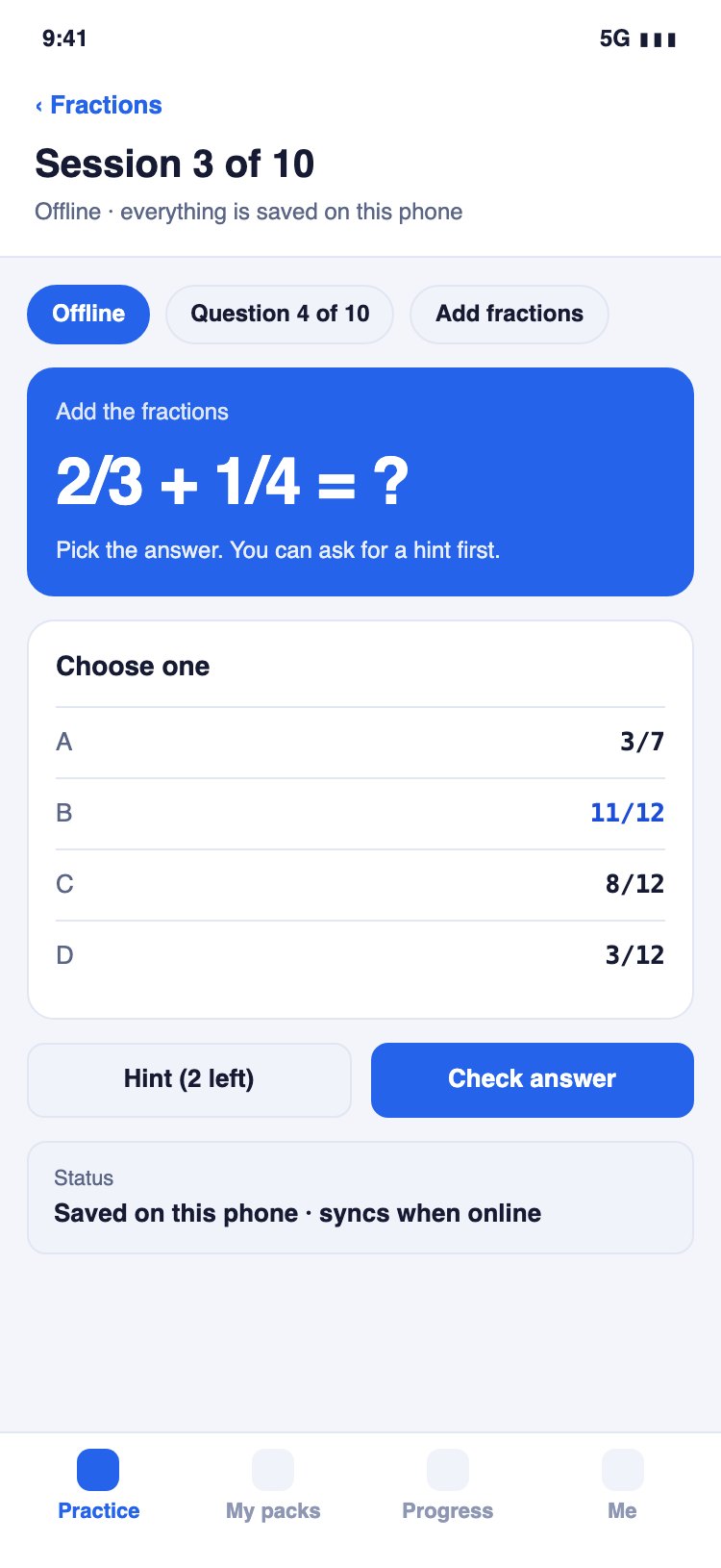
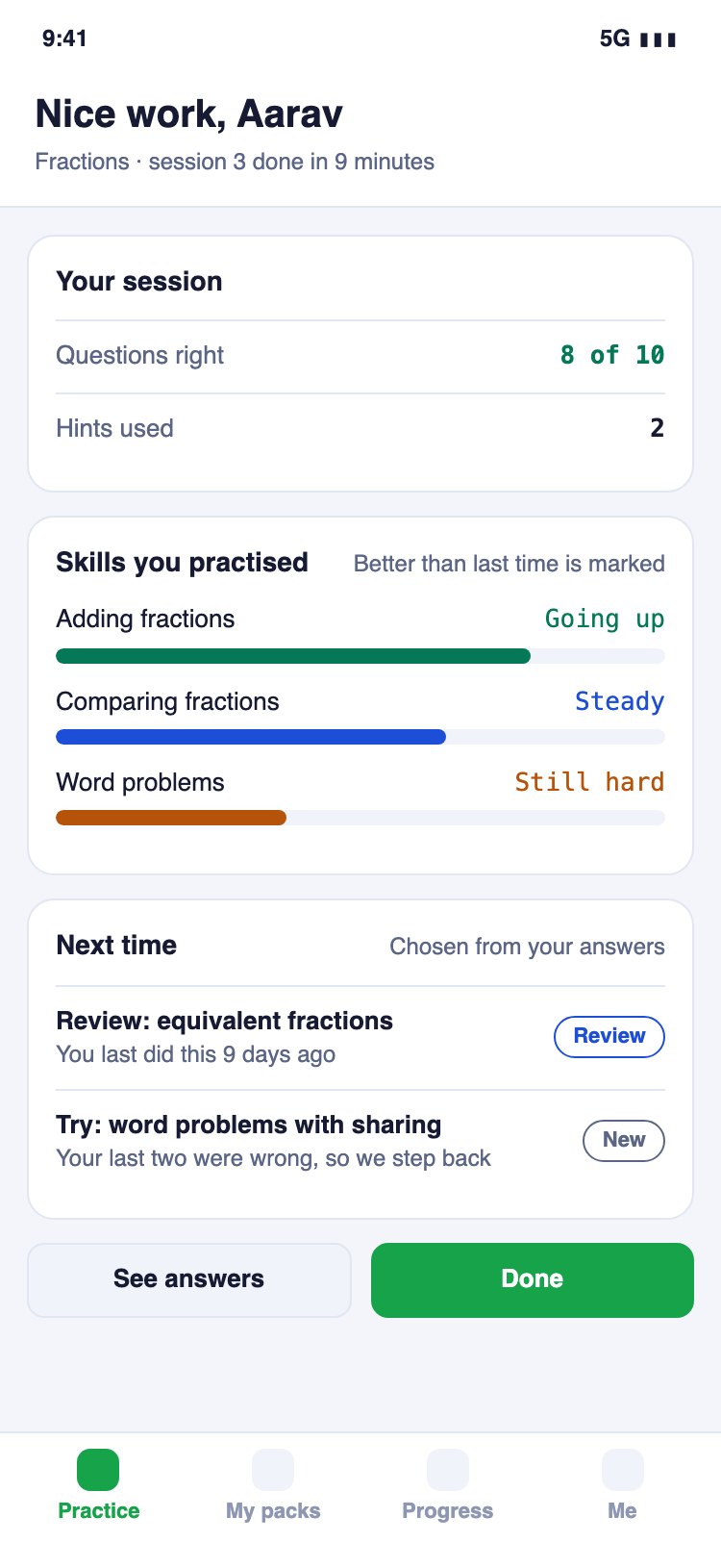
01 / 05 Teacher class view - spot who is stuck on which skill, read the common wrong answers and assign a practice set
Engineering Process
- Map the school's curriculum into skills with teachers, and write the question schema, difficulty levels and worked solutions around it.
- Prototype the student session, the class view and the parent message, and test them with teachers and students on low-cost phones.
- Build the mastery model and the offline learning library once, then test it against logged practice from both phone and server.
- Build the student app with weekly packs, a local database, an answer outbox and separate PINs for shared phones.
- Build the teacher web app, the content editor with formulas, and the parent weekly digest with WhatsApp and SMS templates.
- Add AI hint drafting behind teacher approval, check each draft with a symbolic maths tool, and measure how often hints are edited.
- Review children's data handling with the school's legal adviser, then run a pilot with one subject and one class band.
Production Tech Stack
| Layer / Component | Production Technologies |
|---|---|
| Teacher web app | Next.jsTypeScriptTailwind CSSshadcn/uiTipTap with KaTeX for formulasnext-intl for Hindi and English |
| Student app | React Native with Expoexpo-sqlite for the pack and answer outboxKaTeX rendering on the device |
| Backend | Node.js with NestJS for usersclassescontent and sync; Python FastAPI for the learning engine and reports |
| Database | PostgreSQL with row-level security per school and an append-only attempts tableRedis for queuesS3 and CloudFront for packs |
| Messaging | WhatsApp Business Platform and an SMS gateway with DLT templatesFirebase Cloud Messaging for app alerts |
| AI and hosting | An LLM provider under a data-processing agreement for hint draftsSymPy to check mathsAWS Mumbai region with ECS FargateTerraform and GitHub Actions |
What the design aims for
LearnPath aims to steer each student to the next question that fits, from a phone that works without signal, while teachers decide what is taught and parents hear about progress in plain words.