VitalLoop
A Chronic-Care App for Patients and Their Clinic
A concept study: we worked up this product, its architecture and its screens as an example of how we would approach it. The screens use fictional demo data and are design concepts, not screenshots of a live product, and this is not a client project.
About the Project
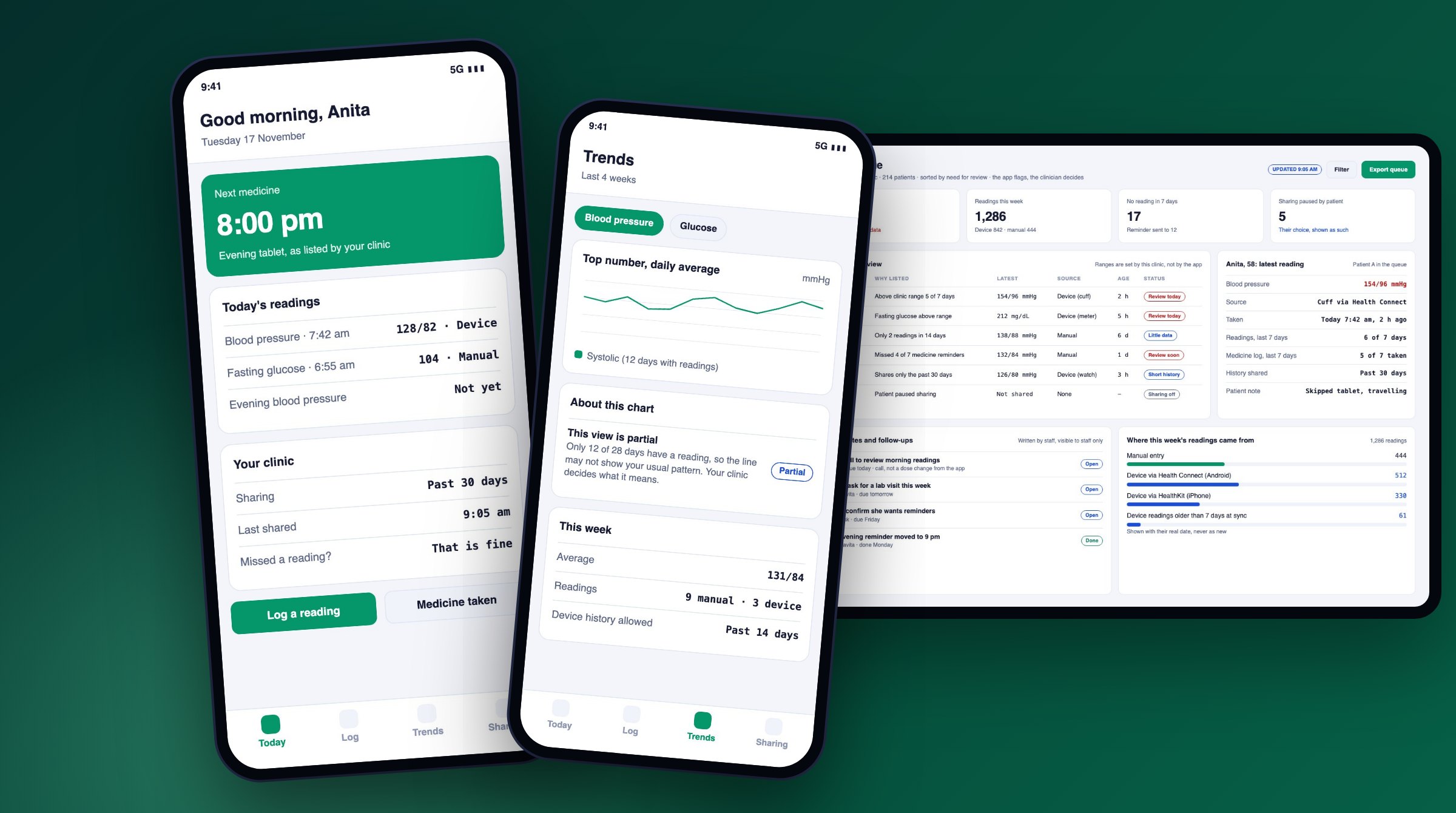
VitalLoop is a design concept for people living with high blood pressure or diabetes, and for the clinic that looks after them. In the patient app, a person logs a reading by hand or brings it in from a connected device through Health Connect on Android or HealthKit on iPhone. The app sends medicine reminders, draws a simple trend, and shares a summary with the clinic.
Clinic staff use a web dashboard that lists the patients who may need a review. Every reading shows where it came from (manual or device, and which kind of device) and how old it is. Clinicians make every treatment decision. The app never diagnoses, never suggests a dose and never changes one. The clinic sets its own alert ranges, and the app only applies them.
The design assumes that health data arrives in pieces. Platforms now let a person share only recent history, or only some data types, so every chart and queue is built to work with partial history and with permissions that are denied or limited. The app asks for access only when a feature needs it, and keeps consent and sharing choices on a screen of their own.
Why This Matters Now
Market, rule and technology context for this kind of product, checked on 16 November 2026. Each item names its source.
- iOS 27, released 14 Sep 2026, adds a second step to the Health permission sheet where people pick Past 30 Days or All Recorded Data, and apps can detect the limit, according to the developer blog of Sahha, a health-data vendor.Sahha (vendor blog), 10 Nov 2026
- India's Ayushman Bharat Digital Mission (ABDM) Scan and Share service passed 25 crore outpatient (OPD) registrations across about 30,800 facilities, according to a report on the All India Radio news site.News on AIR (All India Radio), 8 Aug 2026
- Google Play updated its Health and Fitness data rules for Android 16 granular permissions and new Health Connect data types, and does not allow sensitive health data to be used for employment or insurance eligibility.Google Play Console Help, 15 Apr 2026
- India's Digital Personal Data Protection (DPDP) Rules phase in: consent-manager registration from 13 Nov 2026, and notice, consent and security duties from 13 May 2027, as summarised by the law firm AZB & Partners.AZB & Partners (law firm update), 19 Nov 2025
- Health Connect Jetpack 1.1.0 went stable with background reads, historical sync and personal health records, and a consumer medical device type for devices such as blood pressure cuffs and glucose monitors was announced for a later release.Android Developers Blog, 3 Nov 2025
- IMARC Group, a market research vendor, puts India's remote health monitoring market at USD 255.1 million in 2025 and USD 1,368.6 million by 2034. Other estimates differ widely because the market is defined in different ways.IMARC Group (vendor report), Undated report page
Requirements & Objectives
- Let a patient log blood pressure and glucose by hand in a few taps, and mark each reading as manual.
- Import readings from Health Connect on Android and HealthKit on iPhone only after the patient turns on that feature, and mark each one as a device reading with its device type.
- Work with partial history: a patient who shares only the past 30 days, or who denies a data type, still gets a working app and a clear note about what is missing.
- Send medicine reminders from the clinic's list that still fire without a network, and let the patient record taken or skipped without a reason.
- Show a simple four-week trend that states plainly when there are too few readings to read as a pattern.
- Give the patient one screen to choose which data types the clinic sees, how far back, and to pause or stop sharing at any time.
- Give clinic staff a review queue sorted by need for review under clinic-set ranges, showing the source and age of each reading, with staff notes.
- Keep an audit trail of who viewed or exported a patient's data, and never present a flag as a diagnosis or a dose suggestion.
The Engineered Solution
1Readings that carry their source
Every reading is stored with its origin (manual, or a device through Health Connect or HealthKit), its device type, when it was taken and when it arrived. Late device syncs keep their real date, so an old reading never looks new.
2Permission-aware sync
The app asks for health data only when the patient opens the feature that needs it. It reads the history window the person granted, handles denied or limited access without error screens, and keeps manual logging fully usable.
3Clinic review queue
A web dashboard lists patients by need for review using ranges the clinic sets. Each row says why the patient is listed, shows the latest reading with its source and age, and holds staff notes. Clinicians decide every next step.
4Visible consent
A sharing screen shows what the clinic can see, from which date, and when data was last shared. Pausing is one tap. The same choices are written to a consent record, built so that notice, consent and withdrawal duties under India's DPDP Rules can be added without a redesign.
Design Concept Screens
Design concepts with fictional demo data. They show how the product could look and work, not a live release.
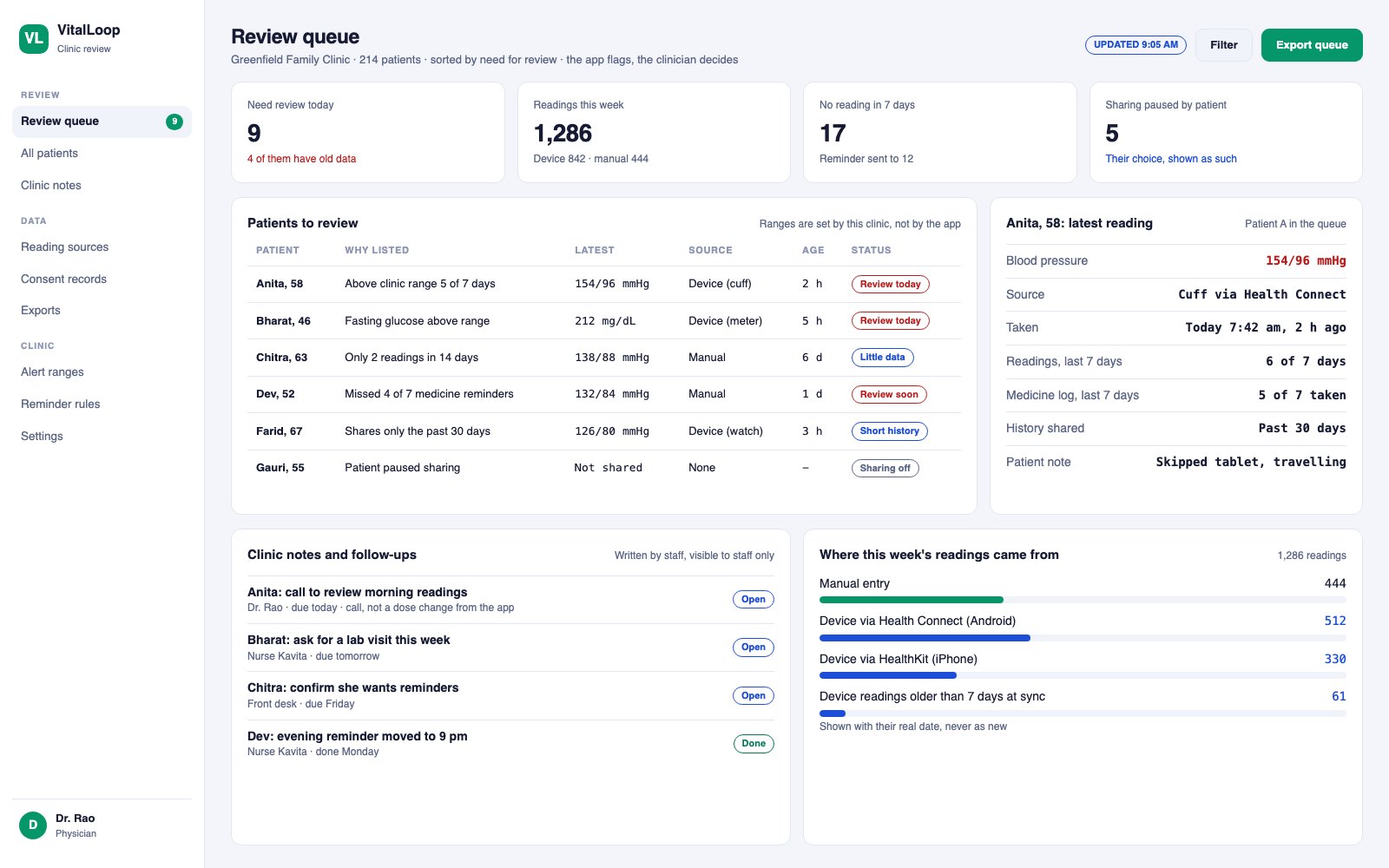
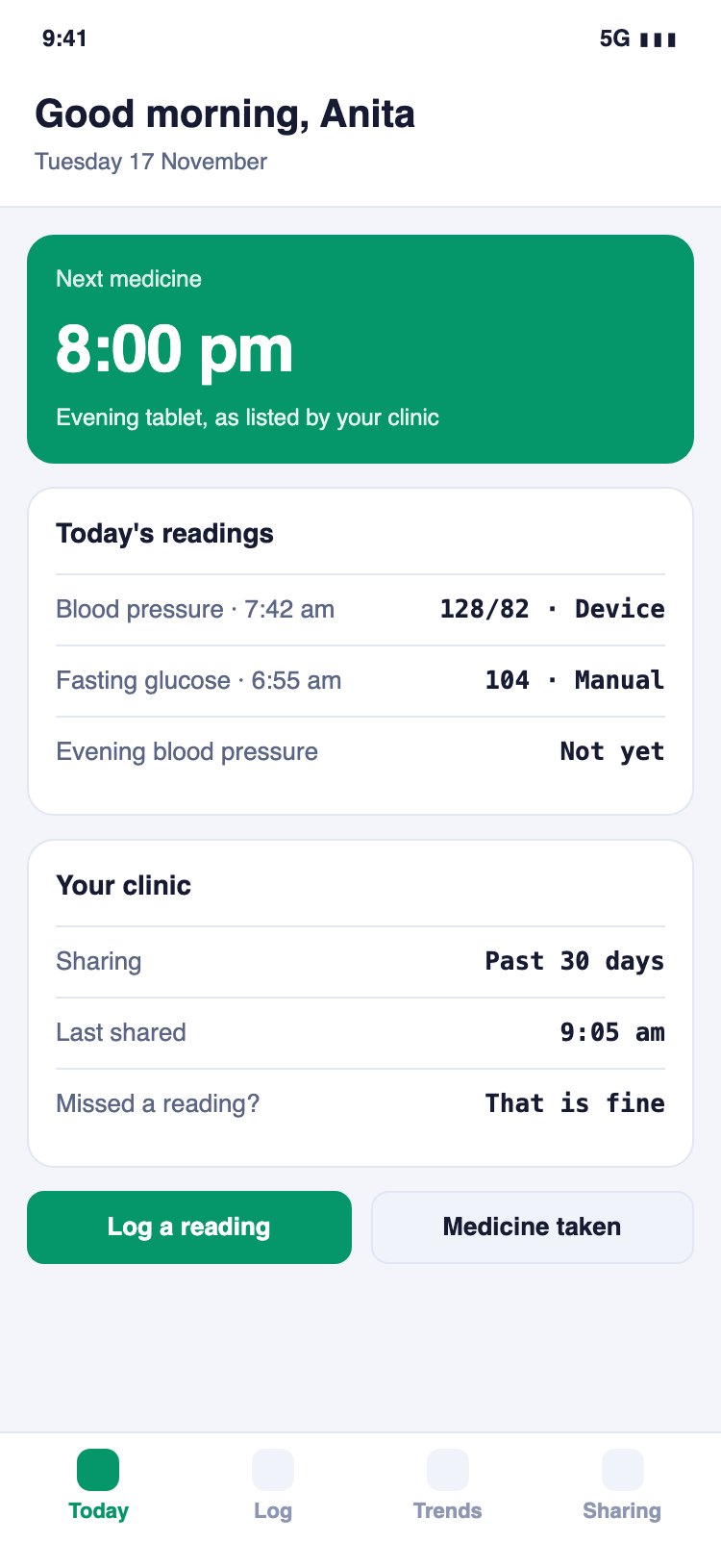
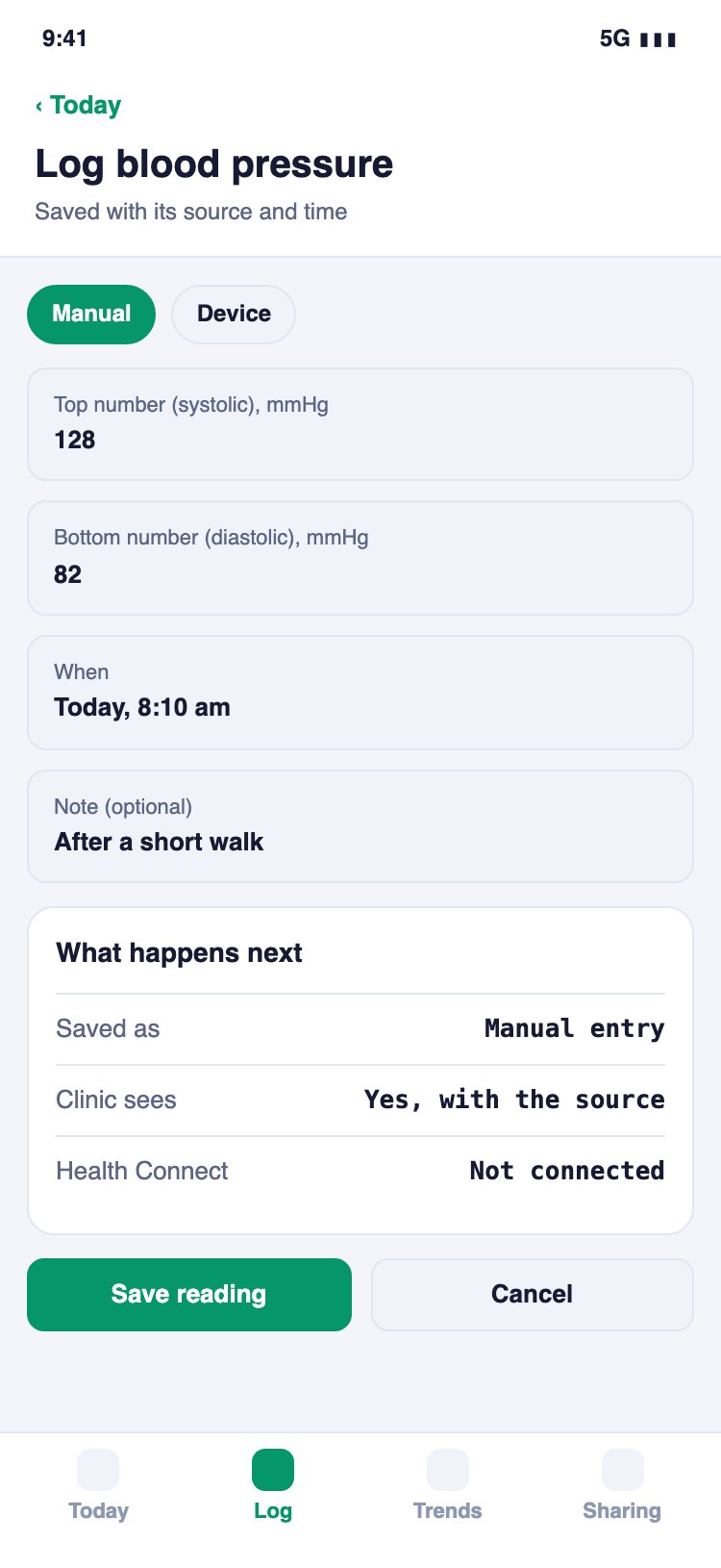
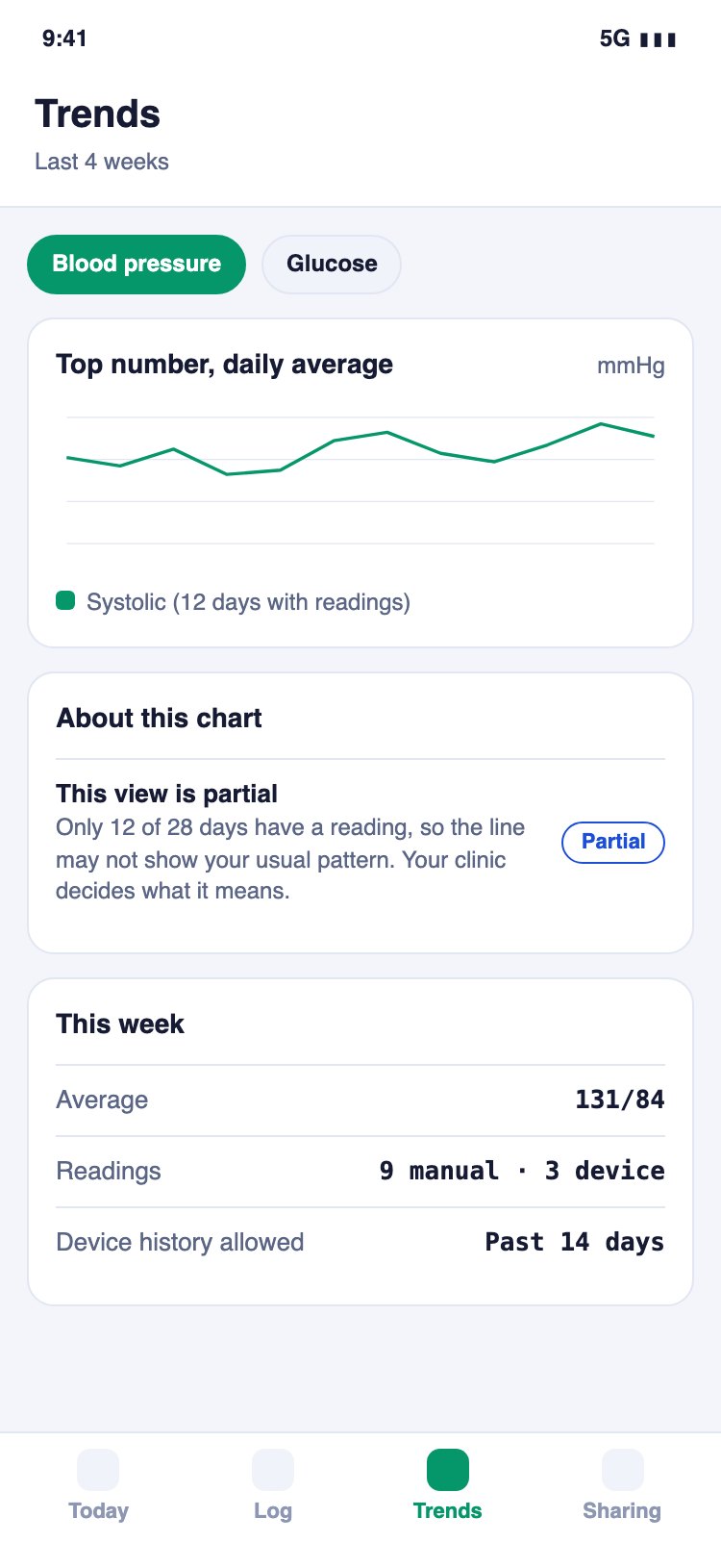
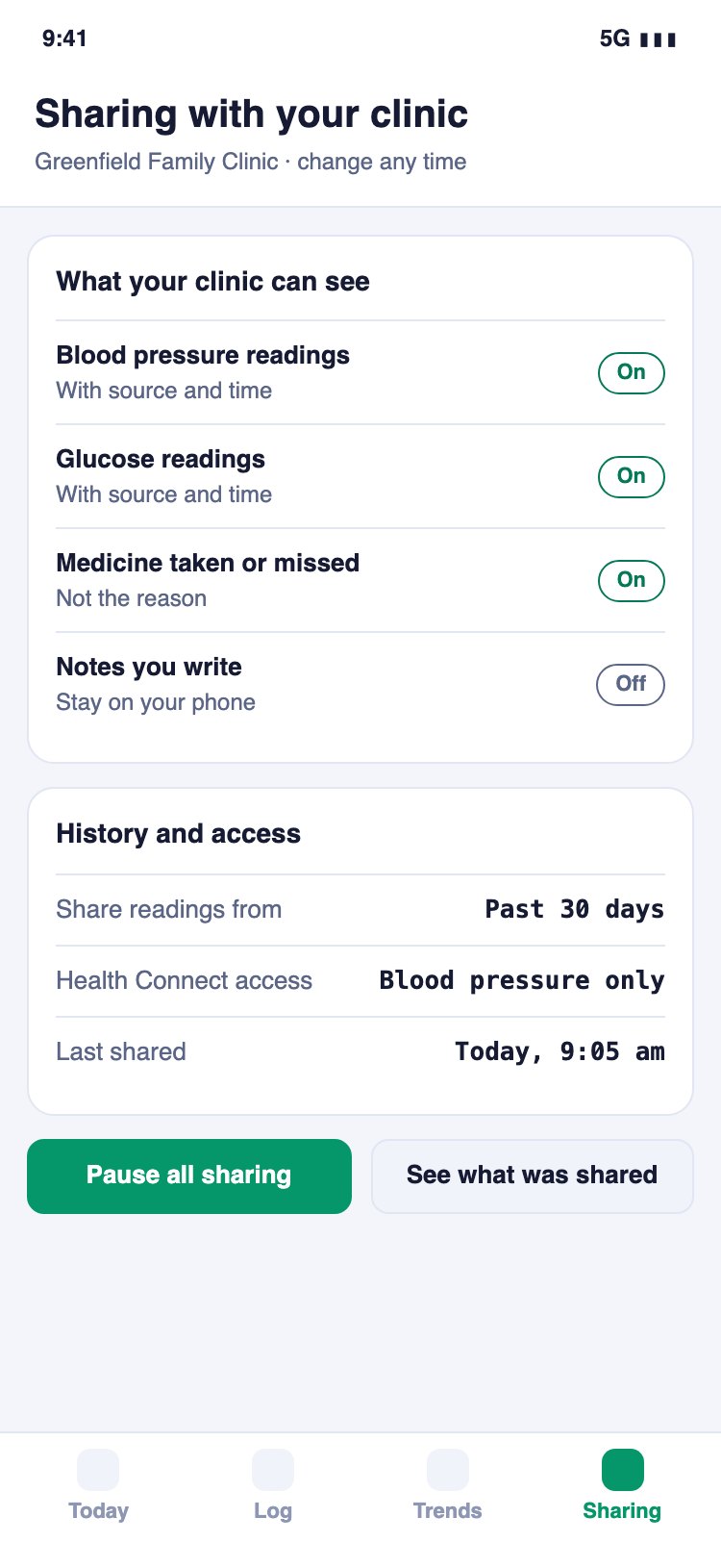
01 / 05 Review queue - clinic staff see which patients may need a look, with the source and age of every reading, and decide what to do
Engineering Process
- Map the patient and clinic routines with a small clinic, including which readings staff review today and how they are recorded.
- Draft the clinic's alert ranges and the wording of every flag with a physician, so the app only reports and never advises.
- Prototype the five core screens on a phone and the review queue on a desktop, and test them with patients who have little data.
- Build the patient app in Expo with native modules for Health Connect and HealthKit, and test limited-history and denied-permission cases on real devices.
- Build the dashboard and API with role-based access, an audit log and a consent record, and connect them to the app.
- Test reminders, offline logging and late sync, then check the store health-data declarations against the privacy copy in the app.
- Run a closed pilot plan with the clinic, review the flags with clinicians, and prepare store submission and a launch checklist.
Production Tech Stack
| Layer / Component | Production Technologies |
|---|---|
| Mobile app | Expo (React Native)TypeScriptwith native modules for Android Health Connect and Apple HealthKit |
| On-device storage | SQLite for offline logging and a sync queuelocal notifications for medicine reminders |
| Web dashboard | Next.jsTypeScriptTailwind CSSshadcn/ui |
| Backend | Node.js API with Zod input validation and role-based access |
| Database | PostgreSQL with row-level securityin an India region |
| Auth and messaging | Phone-number sign-in for patientsemail with two-step sign-in for staffFCM and APNs for push |
What the design aims for
VitalLoop aims to show clinics each patient's readings with the source and age of every number, while the patient decides what is shared.