Yes, if you publish Android apps to the public. Google's developer verification began on 30 September 2026 in three countries and goes global in 2027. As we read Google's page on 15 November 2026, the three are Indonesia, Singapore and Thailand, and India is not named. This post sticks to what Google's two pages say, flags what they do not say, and ends with a checklist.
What does Google's developer verification say about dates?
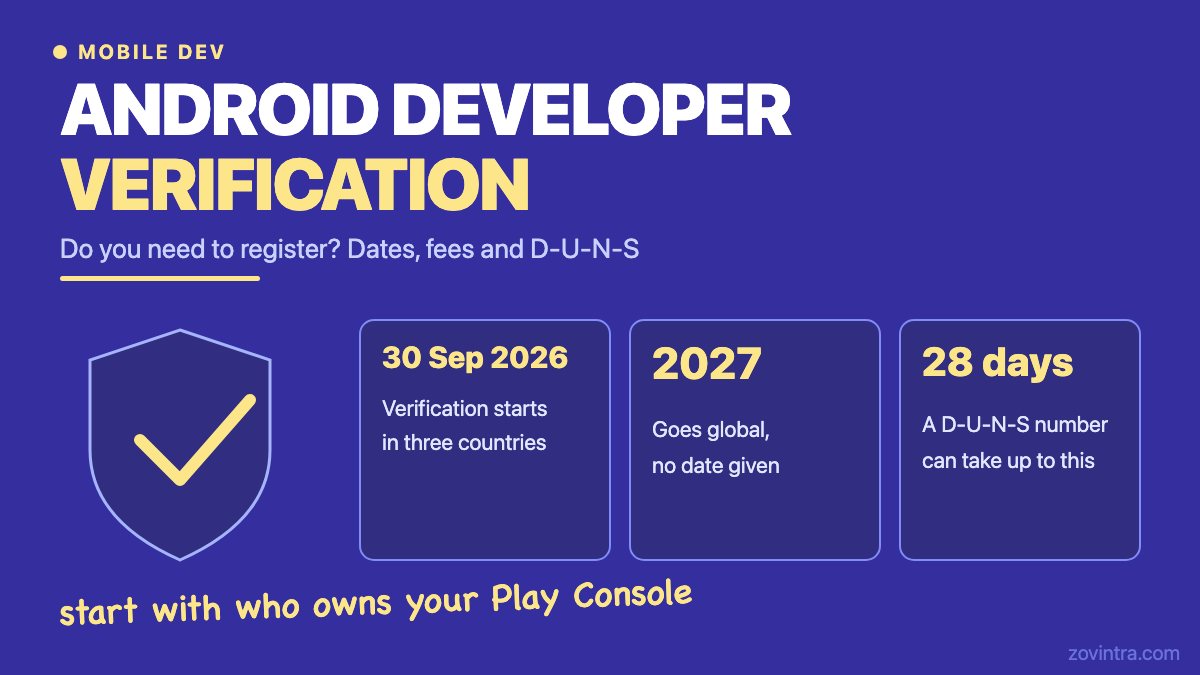
The Android developer verification page says verification is effective 30 September 2026 for users in Indonesia, Singapore and Thailand. It asks developers to be sure to verify their identity and register their apps by the September 2026 deadline. Apps from developers who miss it will be unavailable for new installation on certified Android devices in the applicable countries.
It says verification will expand to more app stores over time and will become global for all apps on certified Android devices in 2027. It does not give a 2027 date. The page also says mobile and tablet form factors start in September 2026.
One oddity: the page says four countries but names three. Other websites add a fourth country. Google's page does not, so check it again before you rely on any list. As we read it on 15 November 2026, the first phase has started.
Does it apply to apps on Google Play?
Yes. Google Play is the first store on the list of stores whose installs will be verified. The others named are the HONOR App Market, OPPO App Market, Samsung Galaxy Store, Palm Store, V-Appstore and Xiaomi GetApps.
The Play policy deadline table has a row dated 2026-09-30 for Play Console requirements. It says you must register your Play apps in Play Console. It also says that while 99% of apps on Play have been registered automatically, you should check your Play Console Home page. So Play apps are not left entirely to chance. A small share was not registered automatically, and Google asks you to check. The row also says to register any remaining apps you want to keep distributing, to avoid global removal from Google Play.
The row adds that apps distributed outside Google Play can also be registered so they install on certified devices. The support page recommends registering all form factors if you distribute only outside Play.
What does developer verification need from an organisation?
The page describes two account types and one extra step for organisations.
- Full distribution account. A $25 fee, which the page says helps cover administrative costs. Google says it is working on more payment methods.
- Limited distribution account. No registration fee. Unlimited apps to up to 20 devices, no government ID. Aimed at students, hobbyists and teachers.
- Organisation registration. Needs a D-U-N-S number, a nine-digit business identifier from Dun & Bradstreet. The page says it is free and can take up to 28 days, and warns about third-party services that charge high fees.
The 28-day wait is the practical risk. If your company does not have a D-U-N-S number yet, ask for it now.
What does the page not say?
- The exact 2027 date, and the full list of countries before then. It says only that verification becomes global in 2027.
- Whether the $25 fee is separate from the fee you may already have paid for a Play Console account. The page does not compare the two.
- What happens to an app that was registered automatically but sits in an account with an unverified identity. The pages do not walk through that case.
- Whether Flutter, or any framework, changes the process. The pages do not mention frameworks.
- Any further organisation requirement beyond the D-U-N-S number, in the part of the page that was read.
The page also says sideloading is not ending. Advanced users can install apps from unverified developers after acknowledging the risks and completing a one-time setup. Android Debug Bridge (ADB) stays available for building and testing on your own devices. Apps distributed through an organisation's own store on managed devices do not need to complete verification, although Google still encourages registering apps that may reach other devices.
What should an app owner do?
Google's pages do not mention frameworks, so nothing there suggests a Flutter app is treated differently. The work is about accounts and records, not code. The App Store and Play Store readiness checklist covers the rest of a submission. Who holds the Play Console account matters here, which the code and account ownership checklist explains. Separately, Google Play lists policy changes dated 27 January 2027: the checklist.
When can you skip this?
You can skip it if you build only for iOS, or if your Android app is used only inside your own company on managed devices through its own store, which the page says is exempt. You can also skip the account-type decision if you share a hobby app with up to 20 devices, where a limited distribution account has no fee. If you publish on Play to a public audience, do not skip the Console check.
If you are unsure who owns your store accounts, or you inherited an app and want the release and account setup checked, Zovintra's Launch and Rescue service starts with an audit of your existing code, tools and setup, and the ownership checklist above covers the accounts. You can also contact us and Zovintra will tell you plainly whether you need help at all.
Common questions
Do I need to register my Android app with Google?
Google's page asks developers to verify their identity and register their apps by the September 2026 deadline, and says apps from developers who miss it become unavailable for new installation on certified devices in the applicable countries. Google's Play table says 99% of Play apps were registered automatically, so check your Play Console Home page.
Does my company need a D-U-N-S number?
Yes, to register as an organisation. The page describes it as a free nine-digit identifier from Dun & Bradstreet that can take up to 28 days to arrive.
Is sideloading going away?
Google's page says no. It describes an advanced flow for installing apps from unverified developers, and says verified developers can distribute directly or through any app store.
Sources
Building something similar?
Talk to our engineering team about your architecture, roadmap, and delivery timeline.
Request a Technical Review →
We design, engineer, and deploy high-performance web platforms, mobile applications, and intelligent cloud systems.