Watchtower
Security Posture and Alert Triage for Growing Companies
A concept study: we worked up this product, its architecture and its screens as an example of how we would approach it. The screens use fictional demo data and are design concepts, not screenshots of a live product, and this is not a client project.
About the Project
Watchtower is a design concept for a web product that sits on top of the security tools a 50 to 500 person company already uses. It reads from cloud accounts, identity systems, laptops, code repositories and scanners, and answers three questions each morning: what do we own, what is most likely to hurt us, and who must do what by when. It does not replace antivirus, endpoint protection or a security team. It helps a small team decide.
Every finding is tied to a real asset, an owner and a due date. The ranking looks past the severity score: it asks whether a flaw is already being exploited, whether the asset faces the internet and whether it holds important data, and it shows each reason so people can trust or challenge the order. Access is read-only in the first release, so the product advises and people act. Managed service providers (MSPs) that look after several small companies could switch between client workspaces.
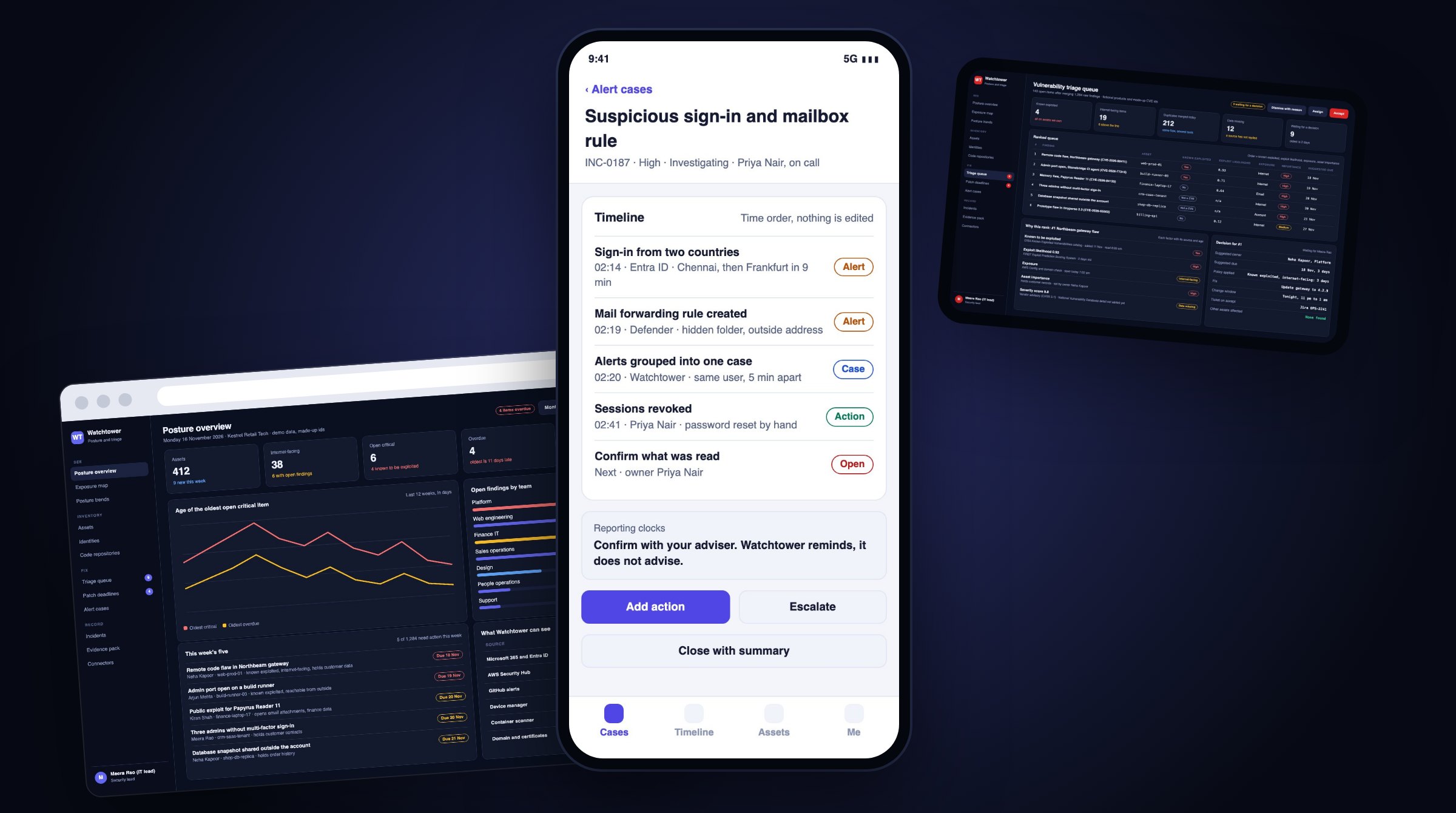
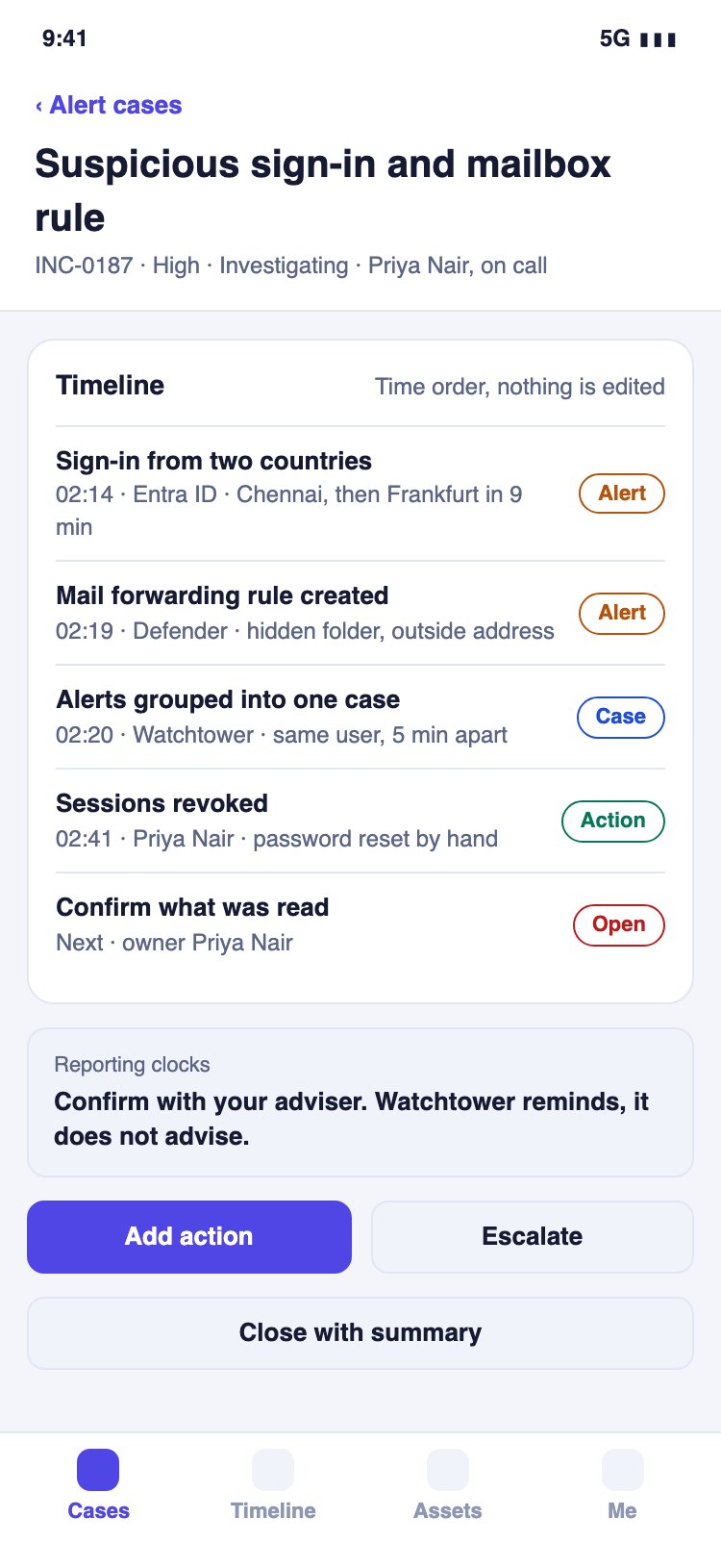
When something goes wrong, an on-call person opens a grouped case on a phone, adds actions to a shared timeline and escalates. The record is append only. Reporting clocks appear as reminders that the company's own advisers confirm. The screens use made-up companies, people, assets and vulnerability ids, and the page gives no security advice.
Why This Matters Now
Market, rule and technology context for this kind of product, checked on 16 November 2026. Each item names its source.
- CISA said on 30 October 2026 that its directive BOD 26-04 binds only US federal agencies, but it encourages all organisations to adopt risk-based vulnerability management and fix known exploited flaws first.CISA (KEV catalog bulletin), 30 Oct 2026
- Law firm King, Stubb & Kasiva wrote on 14 August 2026 that India's DPDP Rules were notified on 13 November 2025, with security safeguards and breach notification duties applying from 13 May 2027.King, Stubb & Kasiva (published on Legal 500), 14 Aug 2026
- Legal 500 commentary says CERT-In issued non-binding guidance on 25 May 2026 on defending against AI-assisted exploitation, urging risk-based patching and continuous monitoring of internet-facing systems.Legal 500 India (commentary on a CERT-In document), 25 May 2026
- Help Net Security, reporting on the Verizon 2026 breach report, says exploited vulnerabilities overtook stolen credentials as the top way in for the first time and that fewer known exploited flaws were fully fixed than a year earlier.Help Net Security (on Verizon DBIR 2026), 20 May 2026
- Help Net Security reported that NIST will now enrich only the highest-risk CVEs in the National Vulnerability Database, because submissions outgrew its capacity.Help Net Security, 16 Apr 2026
Requirements & Objectives
- Build an inventory of laptops, servers, cloud resources, domains, SaaS apps, repositories and identities from read-only connectors, each with an owner, environment and data sensitivity.
- Match the same asset across tools by serial number, cloud id, hostname and owner, show the match confidence and let a person merge or split.
- Merge scanner, package and cloud findings, remove duplicates and rank them by known-exploited status, exploit likelihood, exposure and asset importance, with every factor shown.
- Show a source and an age beside each score input, and show data missing when a source has not replied instead of guessing.
- Give each accepted finding an owner and a due date from a patch policy the company writes, with reminders, extensions that need a reason and an overdue view.
- Group related alerts into one case and keep a time-ordered incident record that cannot be edited afterwards, usable from a phone.
- Offer a read-only evidence pack and a monthly summary built from stored records, with time-limited links for auditors and customers.
- Keep tenants apart, store connector credentials encrypted with read-only scopes, and log every read of sensitive data.
The Engineered Solution
1Start from the asset
No finding exists without an asset behind it. Connectors feed an identity-matching step, so one laptop seen by three tools becomes one record with an owner and a data label.
2A ranking that explains itself
The queue orders findings by whether a flaw is known to be exploited, how likely exploitation is, whether the asset faces the internet and how important it is. A panel lists each factor with its source and age.
3Deadlines people see
A written policy turns each accepted finding into a due date and an owner. Reminders go to chat and email, and an extension needs a reason and an approver.
4A written record of every incident
Related alerts become one case. The phone view lets an on-call person add actions as they happen and escalate, and the append-only timeline can be exported for insurers and advisers.
Design Concept Screens
Design concepts with fictional demo data. They show how the product could look and work, not a live release.
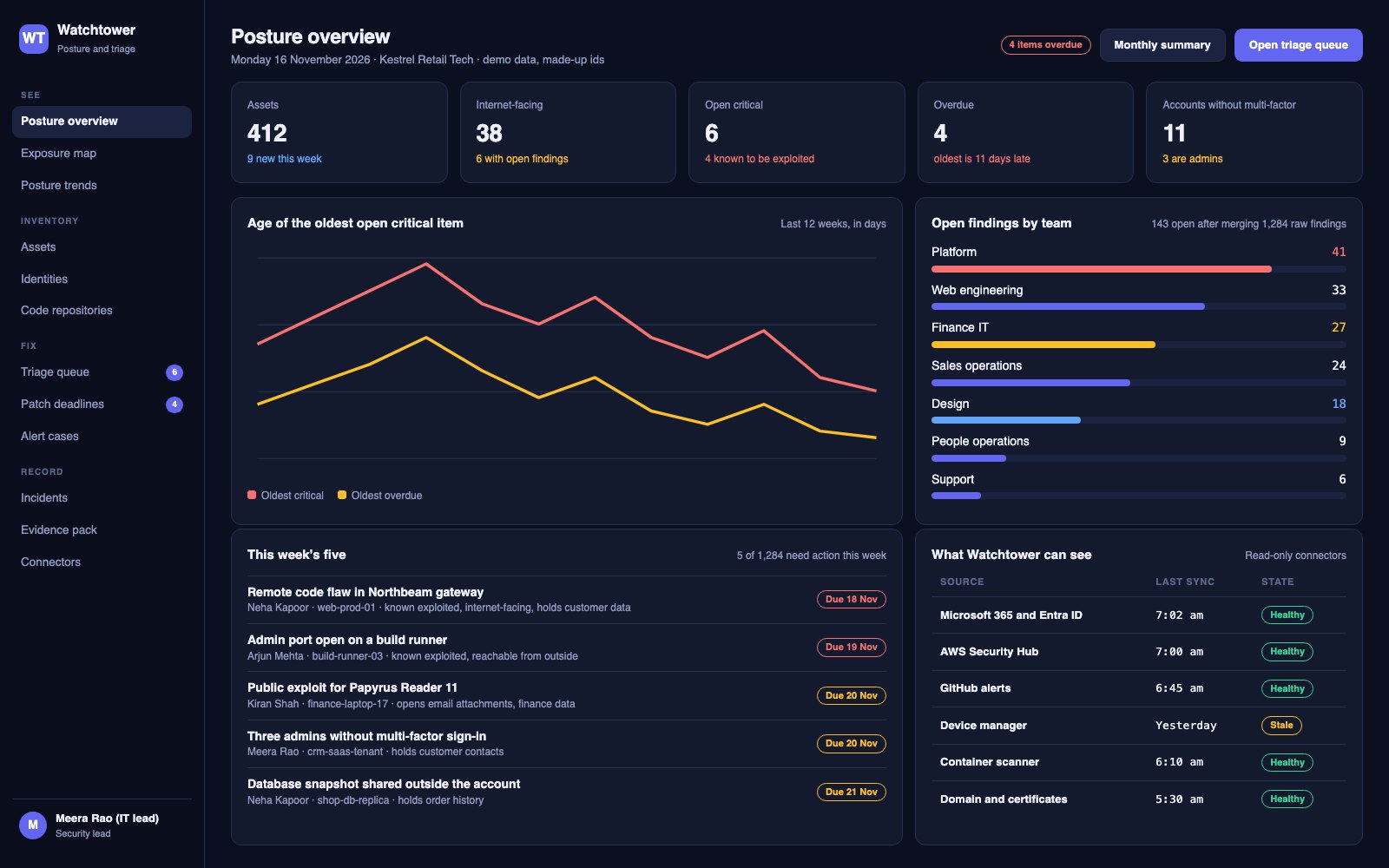
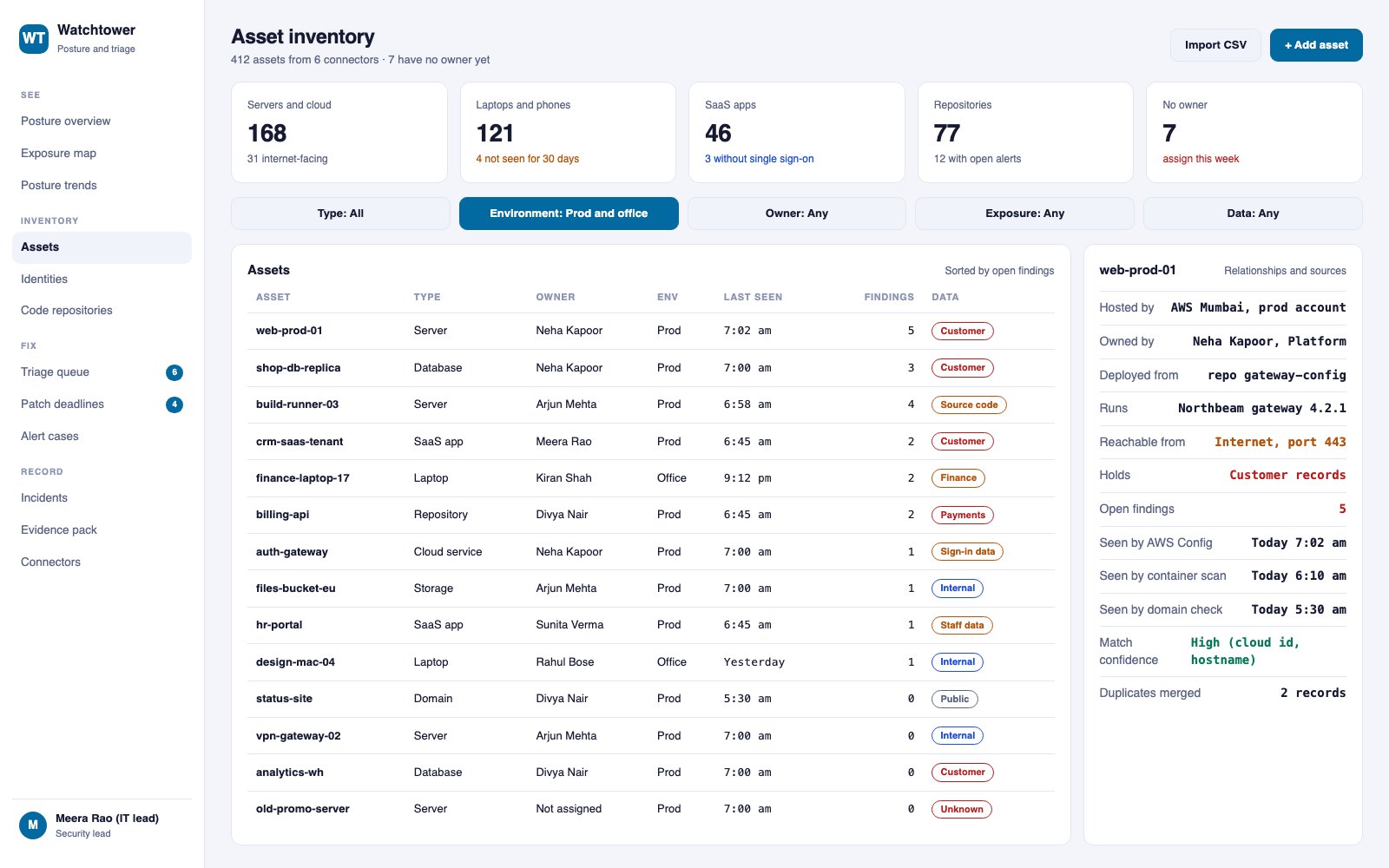
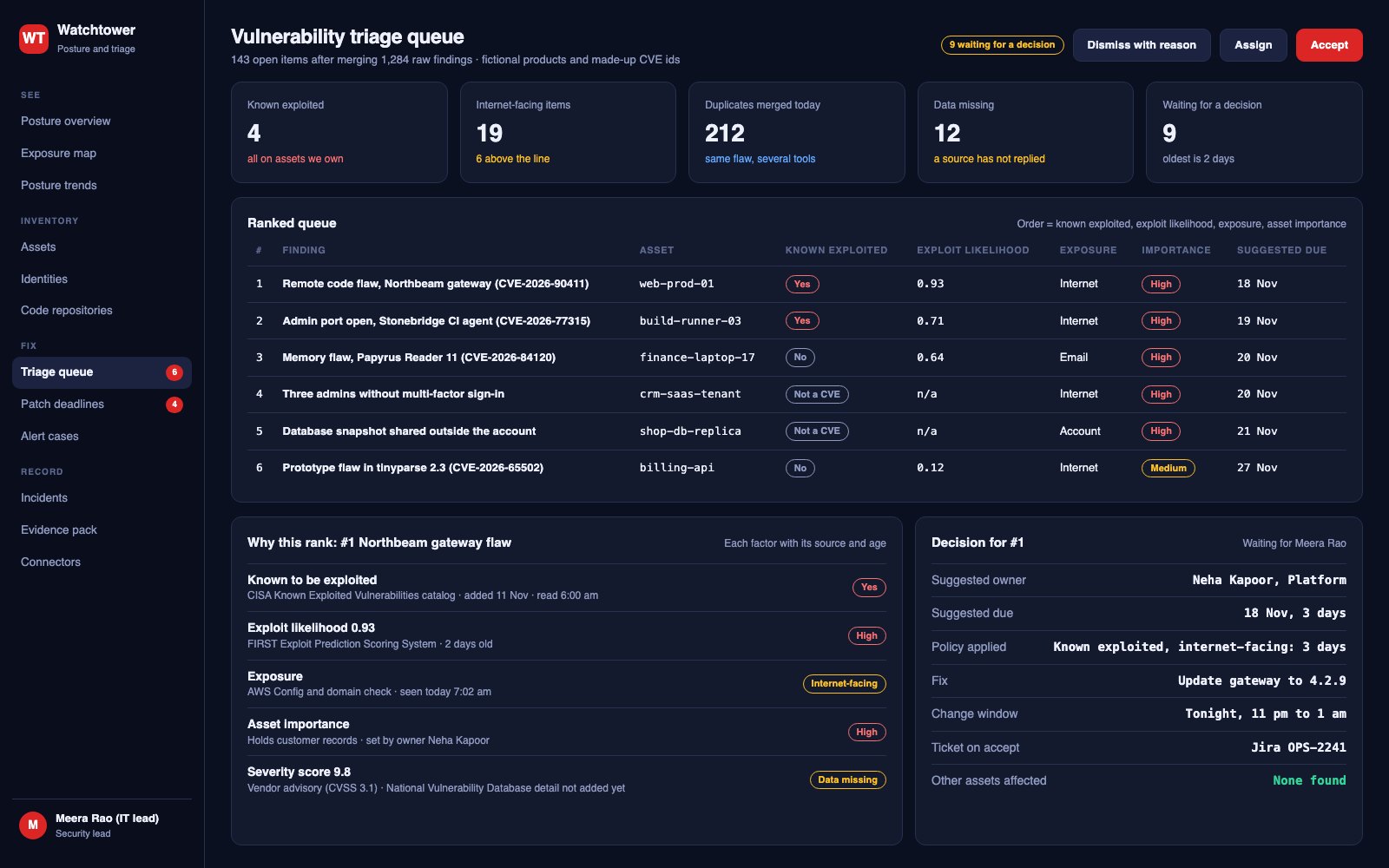
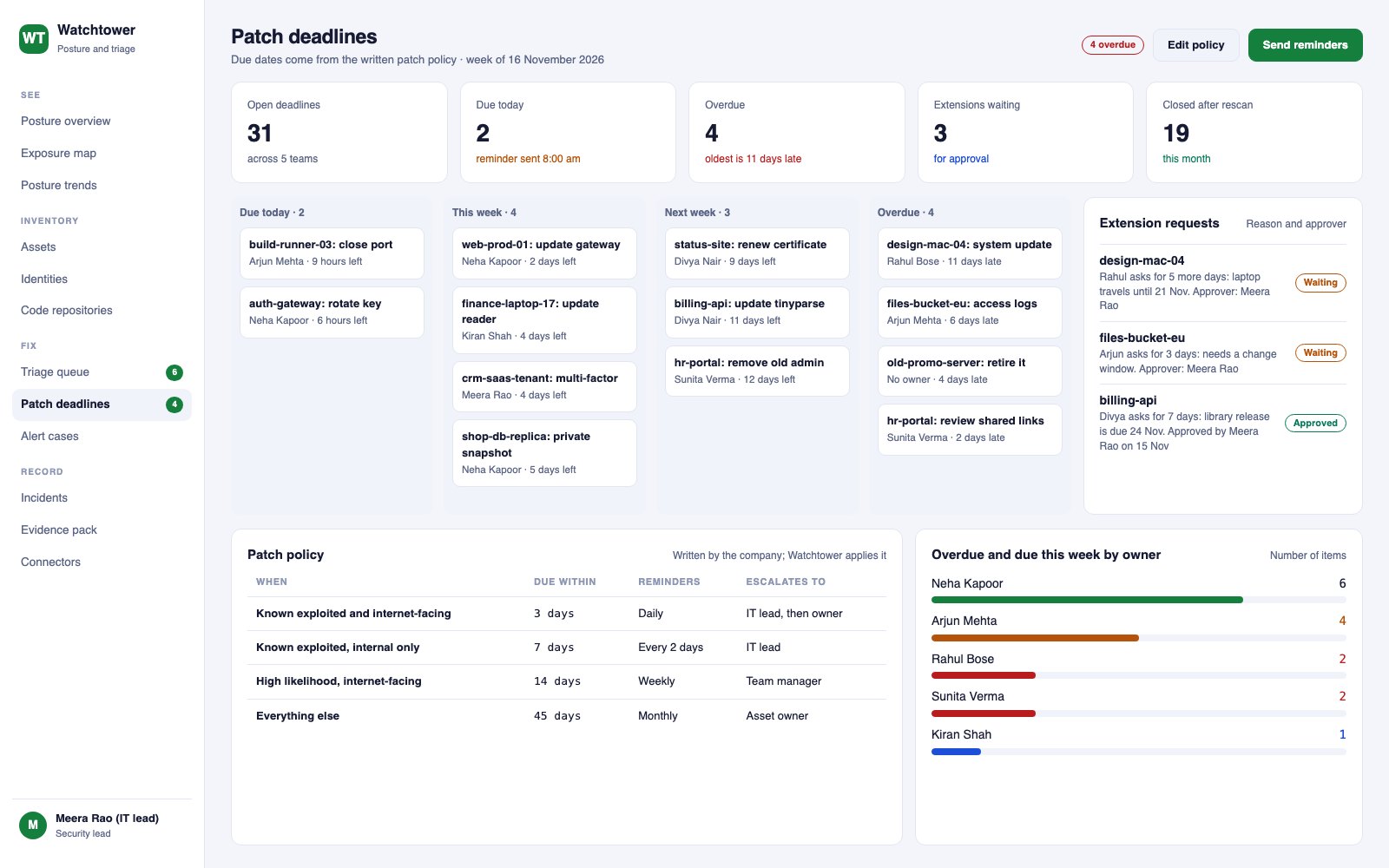
01 / 05 Posture overview - see what is most likely to hurt the company this week and who owns each fix
Engineering Process
- Interview IT leads, engineers and one managed service provider about how they sort findings today, and collect their spreadsheets and chat threads.
- Model the data: tenants, assets and their links, findings with history, cases, tasks, incidents and timeline events.
- Prototype the overview, triage queue, deadline board and phone incident view, and test them with a tired on-call person at night.
- Build the first connectors with read-only scopes, starting with the identity system, one cloud account, the code host and a device manager.
- Build the scoring service with the public risk feeds, and test the ranking against findings the team already knows well.
- Add alert grouping, case summaries that a person approves, the evidence pack and the phone view.
- Test tenant isolation, run a penetration test and a restore test, then onboard a pilot company and write the runbooks.
Production Tech Stack
| Layer / Component | Production Technologies |
|---|---|
| Web app | Next.jsTypeScriptTailwind CSSshadcn/uiTanStack TableApache ECharts |
| API and workers | Node.js with FastifyPython FastAPI connector workersZod validation of every payload |
| Database | PostgreSQL with append-only findings and timeline tablesrow-level security per tenant |
| Queues and timers | Amazon SQS with dead-letter queues for connectorspg-boss for deadlines and reminders |
| Connectors and feeds | Microsoft GraphAWS Security HubGitHub alertsTrivyCISA Known Exploited Vulnerabilities and EPSS feeds |
| AI and hosting | Anthropic Claude API for case summaries with no tool accessWorkOS sign-inAWS ECS FargateRDSS3 and KMSTerraform |
What the design aims for
Watchtower aims to rank what a small company should fix first, tying every finding to an asset, an owner and a due date, with each decision and incident step written down.