RelayHub
A Control Plane for AI Agent Workflows: Permissions, Approvals and an Audit Trail
A concept study: we worked up this product, its architecture and its screens as an example of how we would approach it. The screens use fictional demo data and are design concepts, not screenshots of a live product, and this is not a client project.
About the Project
RelayHub is a design concept for a control plane that a company would use once it runs more than one AI agent. Teams draw a workflow, give each step to an agent or a person, and run it with limits, approval gates and a full trace. The idea is to treat an agent like new staff on probation: a role, a narrow set of tools, a supervisor for risky steps and a record of everything it does.
The safety rules sit in the engine, not in the prompt. A run gets short-lived credentials that cover only the tools its current step needs, and they expire when the step ends. A policy layer checks every tool call before it runs. Deletes, payments and permission changes wait for a named person by default, and the person who started a run can never approve it. The design accounts for Indian guidance on agent identity and logging and for the DPDP (Digital Personal Data Protection) Act. A qualified adviser decides what each customer must do.
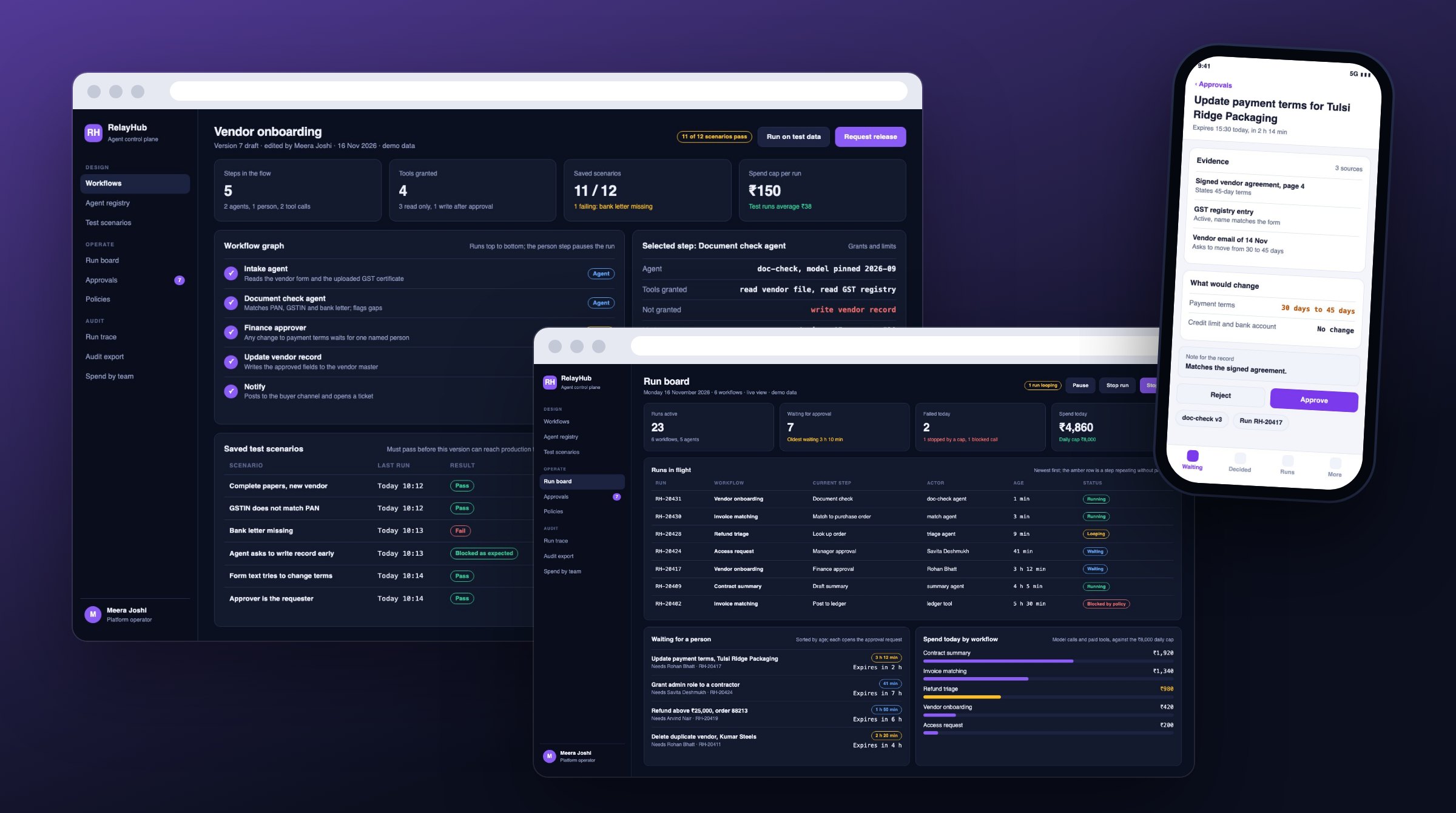
The concept covers a web app for designers and operators, a phone app for approvers, and approvals through Slack and email. Work that passes between agents built with different tools still appears as one run with one record, using MCP (Model Context Protocol) for tools and A2A (Agent2Agent protocol) for handoffs.
Why This Matters Now
Market, rule and technology context for this kind of product, checked on 16 November 2026. Each item names its source.
- Inc42 reports a CERT-In advisory that advises giving each agent run a separate short-lived identity, restricting its network access, keeping tamper-resistant logs, and retaining logs for at least 180 days.Inc42 (news), 16 Oct 2026
- The Model Context Protocol 2026-07-28 release made MCP Tasks an official extension for long-running work and added Enterprise Managed Authorization through the company identity provider.Agentic AI Foundation, 28 Jul 2026
- ServiceNow said its AI Control Tower can detect agents that exceed their permissions and shut them down in real time, and that Intelligent Approvals became generally available in May 2026.ServiceNow newsroom, 5 May 2026
- Information Age reported that a Cursor agent running Claude Opus 4.6 deleted PocketOS's production database and backups in about nine seconds after hitting a credential mismatch in staging.Information Age (ACS), 5 May 2026
- The Linux Foundation said the Agent2Agent protocol, now at version 1.0 with signed Agent Cards, is backed by more than 150 organisations and sits alongside MCP as a Linux Foundation project.Linux Foundation, 9 Apr 2026
Requirements & Objectives
- Let a team draw a workflow of agent, person, tool, branch and wait steps, and save each change as a numbered version.
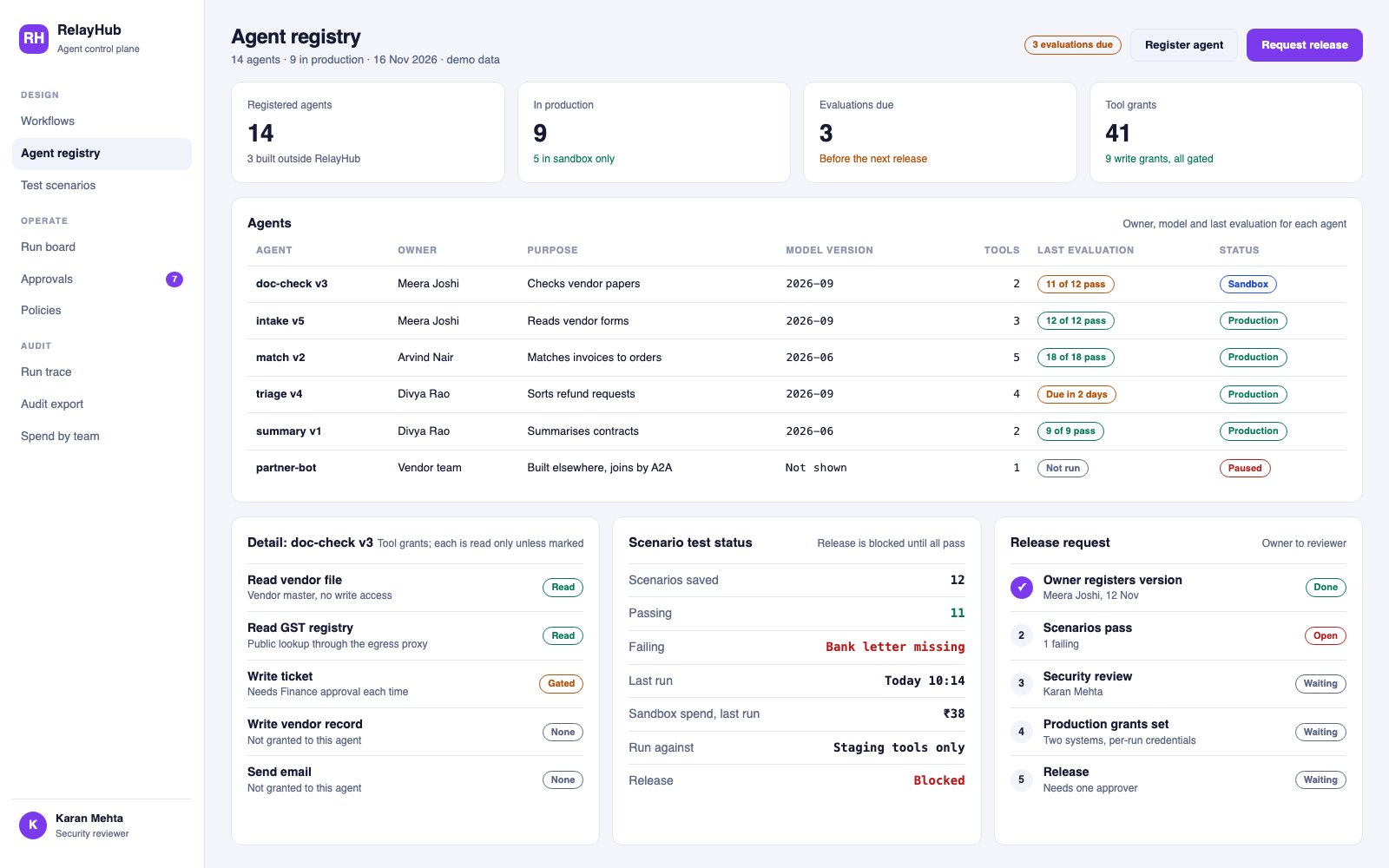
- Keep a registry of agents with an owner, purpose, allowed tools, model version and status, including agents built on other platforms.
- Issue short-lived credentials for each run, limited to the tools of the current step, and let them expire when the step ends.
- Check every tool call against plain rules by system, action, amount, data class and time, and block or flag what falls outside them.
- Pause any step for named approvers who see the evidence and a before and after change, and never let the person who started a run approve it.
- Record every model call, tool call, handoff and approval in order in an append-only log that shows tampering, and let a past run be replayed.
- Set caps on time, steps and spend for each run, and give operators a way to stop one run or every run of one agent.
- Run each new workflow or agent version against saved scenarios in a sandbox and block its release to production tools until they pass.
The Engineered Solution
1Agents on probation
Every agent has an owner, a purpose and a short list of tools. No agent holds a standing key. Credentials are made for a step and end with it, so a leaked or found credential has little to open.
2Approval as a normal step
A durable engine stores each step, so a run can wait days for a person and resume with its exact state. The approver sees the evidence and the change before choosing, on the web, in Slack or on a phone.
3Rules the model cannot argue with
Permissions come from the workflow, not from the agent's own output. Text fetched by a tool is marked as untrusted, and a policy layer blocks any call outside the step's grants, with the reason shown.
4One record across agents
A single trace id follows work through every agent and person. The log is append-only and hash chained, so a security reviewer can search it, export a period and replay a run.
Design Concept Screens
Design concepts with fictional demo data. They show how the product could look and work, not a live release.
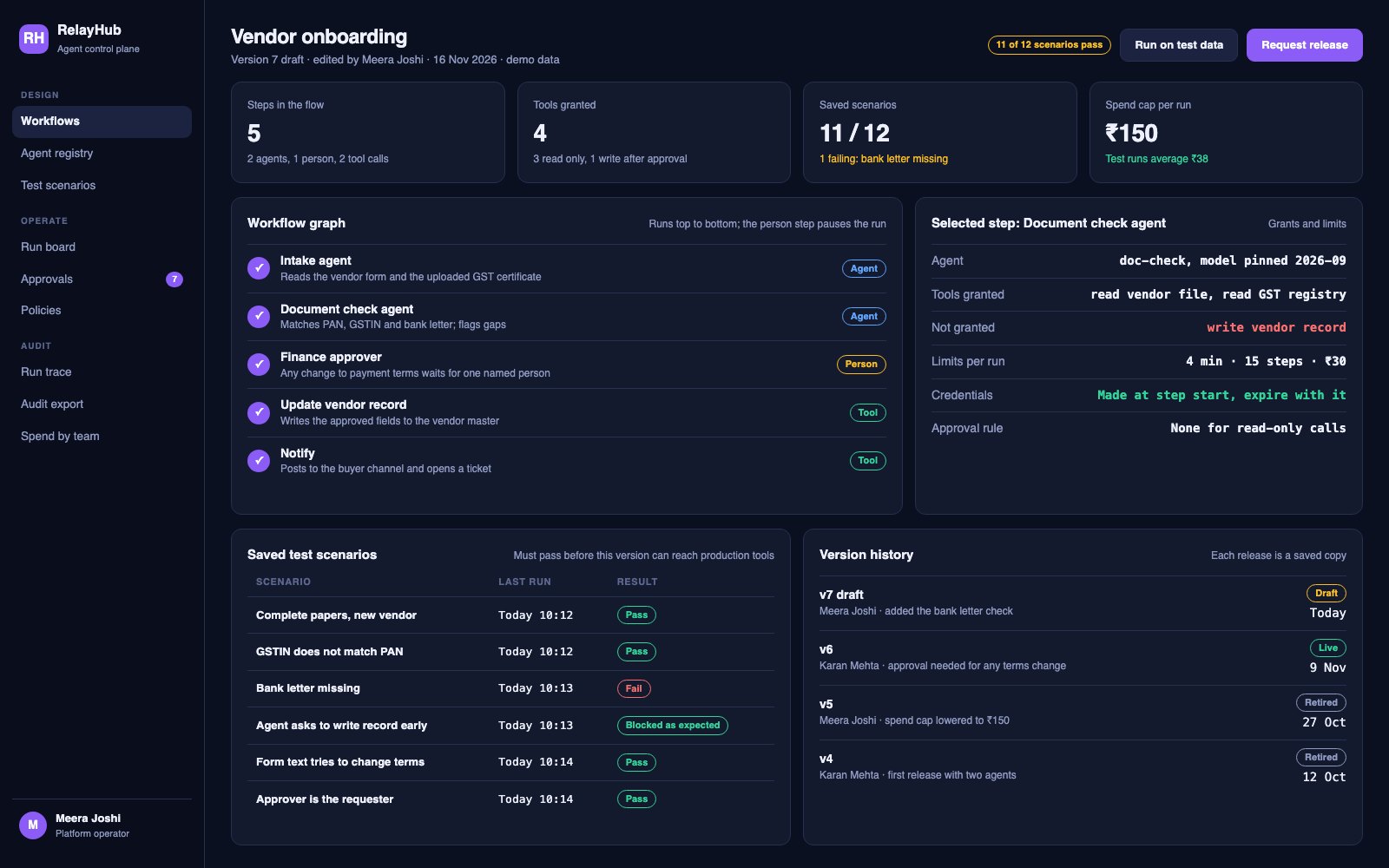
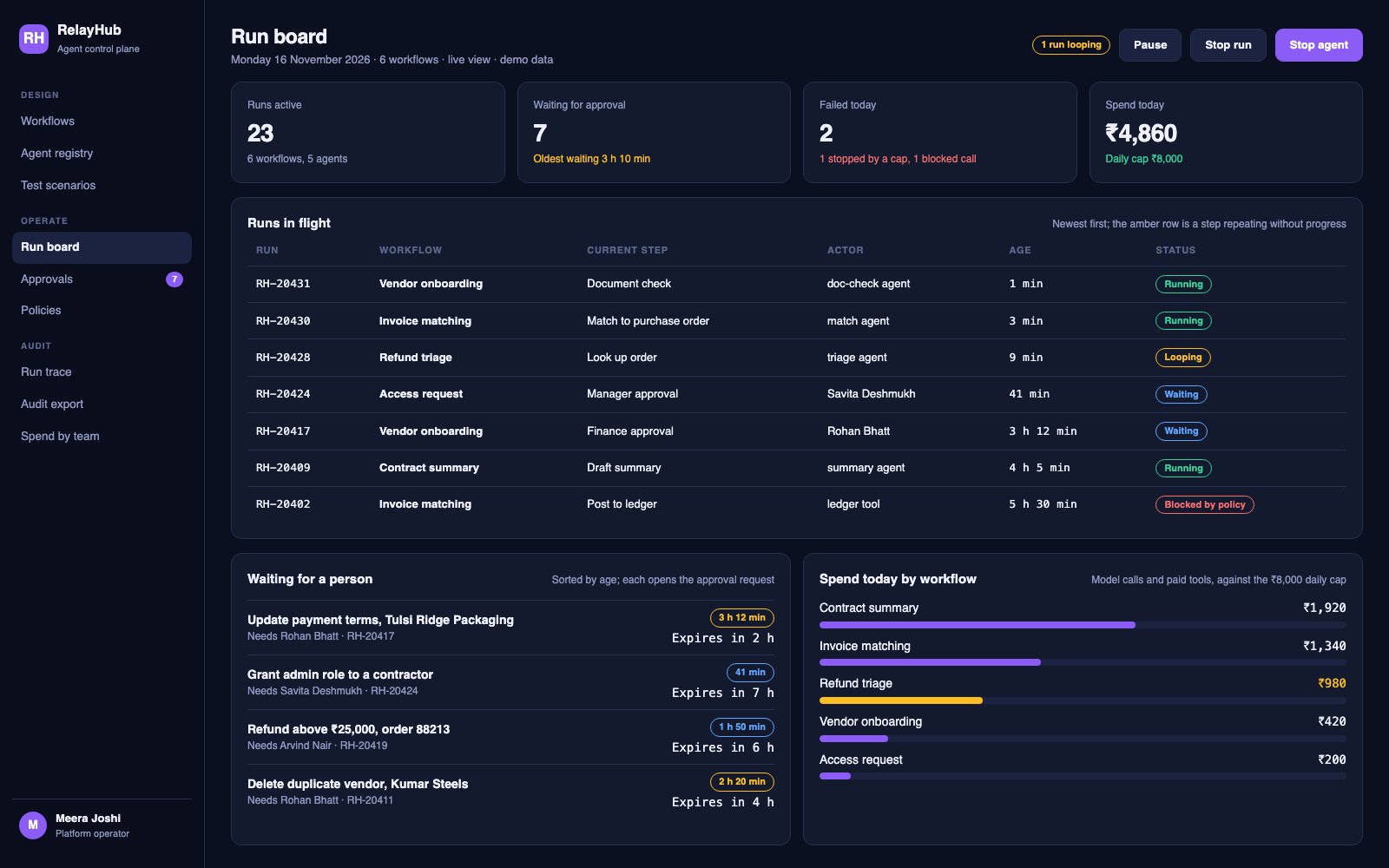
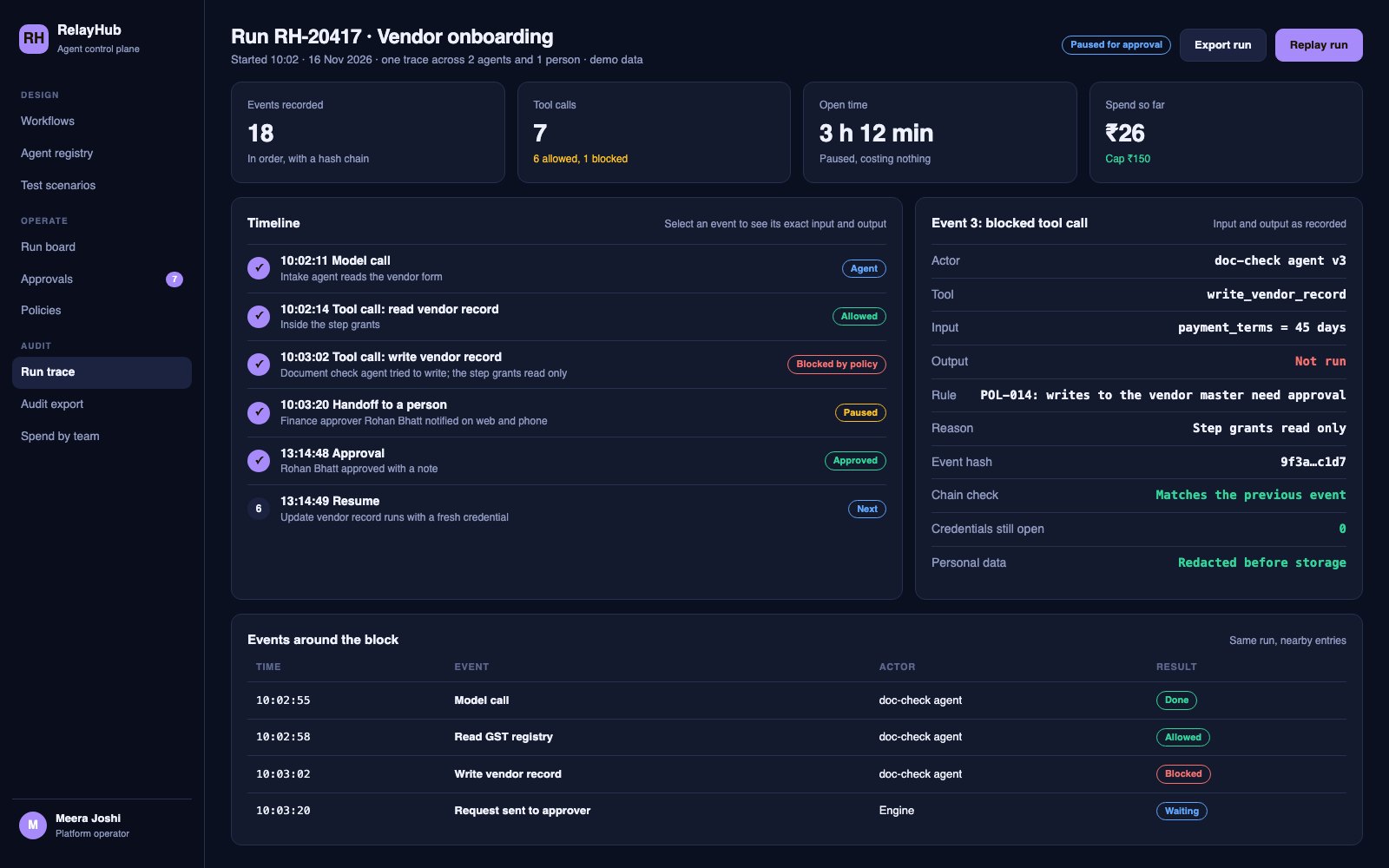
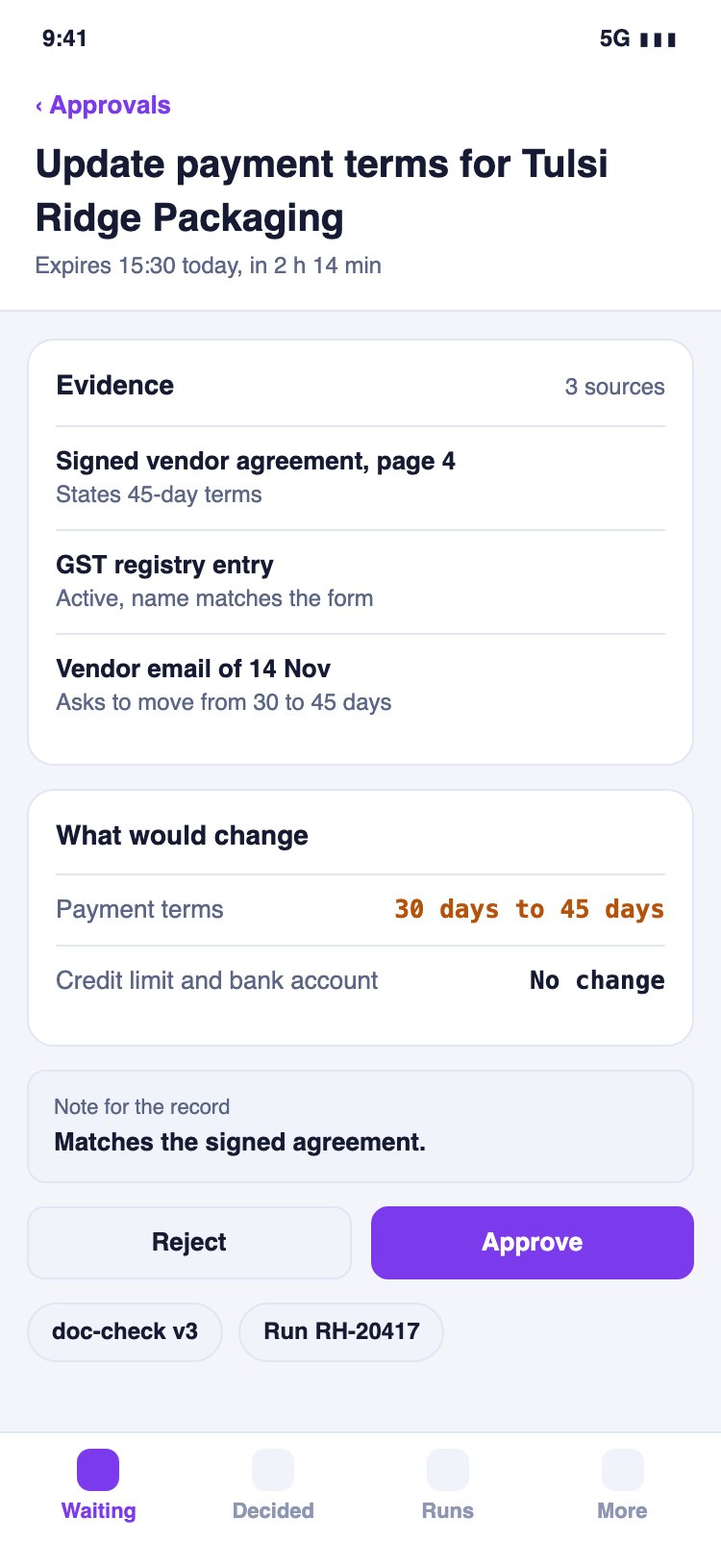
01 / 05 Workflow design - lay out agent, person and tool steps, set what each may use and run saved scenarios before release
Engineering Process
- Map the company's real agent workflows and the systems each one touches, with platform, security and operations staff.
- Model the data: workflows and versions, agents, tool grants, runs, steps, approvals, policy decisions and the event log.
- Prototype the canvas, run board, trace and approval screens, and test the approval screen on a phone with real approvers.
- Build the durable run engine, the policy service and per-run credentials for two systems, with MCP tools wrapped by the policy layer.
- Build approvals through the web and Slack, then the run trace with replay, caps and the kill switch.
- Add the scenario sandbox and the evaluation harness, and test for injected instructions and calls outside a step's scope.
- Pilot one real workflow, add audit export and redaction, write runbooks and train the operators.
Production Tech Stack
| Layer / Component | Production Technologies |
|---|---|
| Web app | Next.js (App Router)TypeScriptTailwind CSSshadcn/uiReact Flow for the canvasZustand |
| Phone app | Expo (React Native) with push notifications and biometric confirmation for high-risk approvals |
| Control plane | Node.js with TypeScriptZod validationversioned JSON workflow definitionsa separate policy service |
| Durable execution | Temporal for stepsapproval signals and timeoutson containers (AWS ECS or Kubernetes) |
| Data and identity | PostgreSQL with row-level security by tenantan append-only hash-chained event logSSO through OIDC or SAMLHashiCorp Vault for short-lived credentialsOpen Policy Agent for rules |
| Agents and observability | MCP and A2A for tools and handoffsprovider-neutral model calls with pinned versionsLangGraph or direct SDKsOpenTelemetry GenAI tracesSentryGitHub Actions |
What the design aims for
RelayHub aims to supervise AI agents the way a company supervises new staff, with narrow tools, a person approving risky steps and a record of every action.