MillWorks
An ERP for a Small Manufacturer: Production, Purchase, Stock and GST
A concept study: we worked up this product, its architecture and its screens as an example of how we would approach it. The screens use fictional demo data and are design concepts, not screenshots of a live product, and this is not a client project.
About the Project
MillWorks is a design concept for a web ERP (enterprise resource planning) system for a small Indian manufacturer, such as a 60-person maker of metal and plastic parts. One system would carry a job from the sales quote to the production order, the purchase of raw material, the stock batch, the GST invoice and the payment to the supplier.
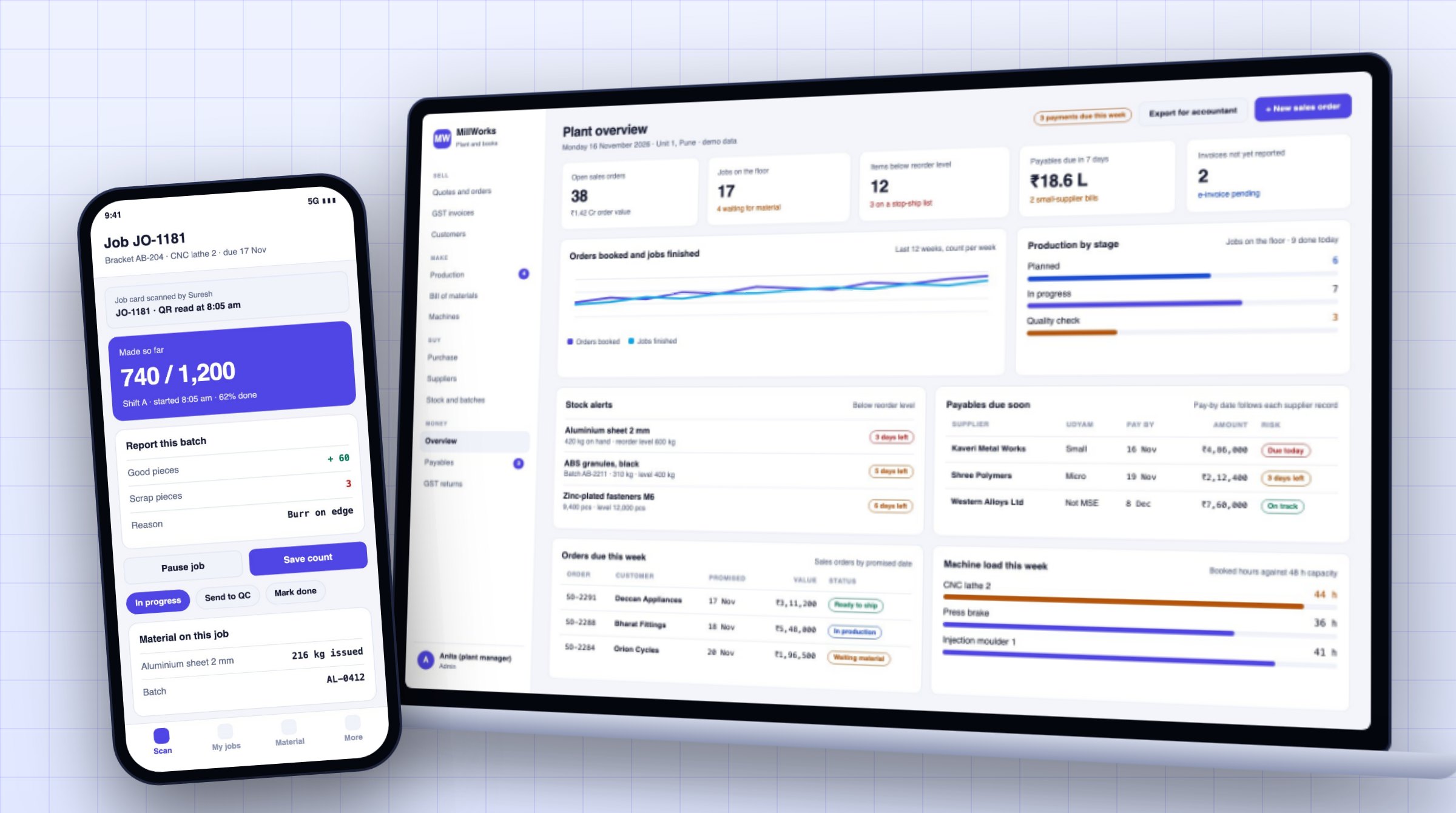
Compliance is treated as data, not as extra screens. Each supplier record holds its Udyam (micro and small enterprise) status, and each goods receipt holds its acceptance date. From these two facts the payables screen shows a pay-by date and the risk of paying late. Each invoice line keeps its HSN code, tax rate and reverse-charge flag, so the e-invoice and e-way bill states are read from the same clean data. The design accounts for these rules and does not claim to satisfy them.
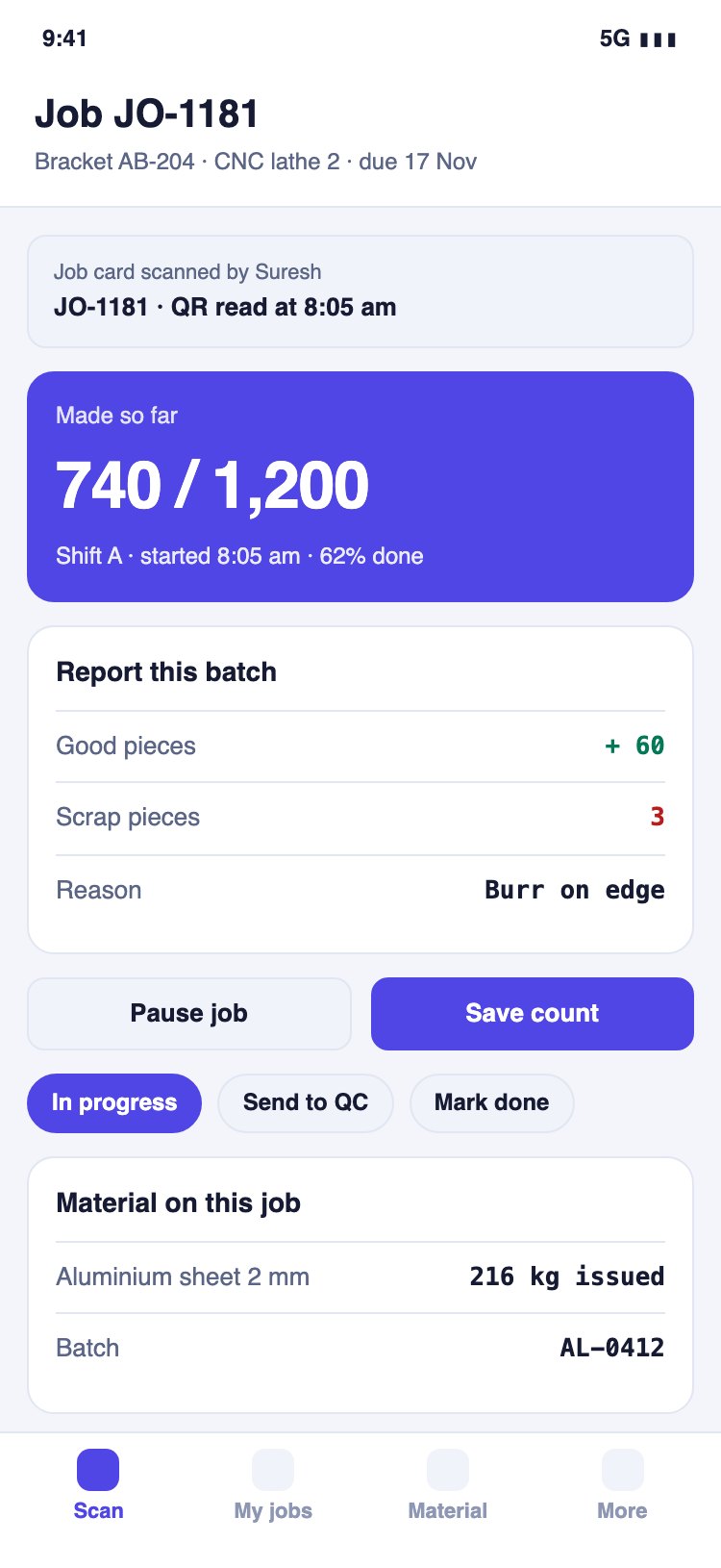
A companion Android app puts the shop floor in the same system. An operator scans a job card, reports pieces made and scrap, and sends the job to quality check. AI is offered only as drafts: suggested reorder levels and draft purchase orders that a person reviews, edits and approves.
Why This Matters Now
Market, rule and technology context for this kind of product, checked on 16 November 2026. Each item names its source.
- Sovos reports a GSTN advisory adding two e-invoice supply types for reverse-charge self-invoices, one domestic and one import. Both work in the IRP test environments, and no start date has been announced.Sovos (report on the GSTN advisory), 16 Oct 2026
- The 57th GST Council recommended e-invoicing for reverse-charge self-invoices at turnover of Rs 5 crore and above, and refund forms a system can read. These are recommendations and were not yet notified.Press Information Bureau, Government of India, 8 Oct 2026
- SAP added AI assistants and agents to its Autonomous Suite at SAP Connect. CIO's report presents this as a move for large companies, not for small manufacturers.CIO, 6 Oct 2026
- Odoo announced version 20 with AI that sets up automations from plain language, side-by-side bill of materials comparison, offline field service and AI-suggested minimum and maximum stock levels.Odoo, 24 Sep 2026
- TaxGuru reports that both houses of Parliament passed the MSMED (Amendment) Bill 2026, which adds online dispute resolution for MSME payment disputes. Presidential assent and the start date were not confirmed.TaxGuru (secondary report), 7 Aug 2026
- Zoho launched an AI-native ERP in India aimed at manufacturing and distribution firms, with a voice assistant, as reported by ERP Today.ERP Today, 23 Jan 2026
Requirements & Objectives
- Hold quotes, sales orders, bills of materials and routings so a sales order turns into production orders and purchase needs.
- Track production orders through planned, in progress, quality check and done, with machine, due date, material issue and scrap.
- Keep stock by batch, so material issued to a job and goods received from a supplier can be traced.
- Store each supplier's Udyam status and each goods receipt's acceptance date, and show a pay-by date and late-payment risk on the payables screen.
- Issue GST tax invoices with HSN, tax rate and reverse-charge flag on every line, and show e-invoice and e-way bill states.
- Give shop-floor staff an Android app to scan a job card and report quantity made and scrap, even when the Wi-Fi drops.
- Offer reorder level suggestions and purchase order drafts as drafts only, with a named person approving each one.
- Give managers a dashboard of orders, production status, stock alerts and payables due, with every change logged.
The Engineered Solution
1One flow from order to payment
A sales order creates production orders from the bill of materials and routing. Material needs become purchase orders, goods receipts add stock batches, and the finished goods flow into the invoice.
2Payment deadlines held as data
Supplier Udyam status and goods acceptance date sit on the records themselves. The payables screen computes the pay-by date and shows the risk of a late payment, so a person sees it before the date passes.
3Invoice data built for e-invoicing
Each invoice line stores HSN, tax rate and reverse-charge flag as separate fields. A queue shows invoices not yet reported, and the e-invoice and e-way bill states update from the GST network.
4Shop floor in the same system
The Android app scans a job card and records pieces made and scrap against the production order. It stores entries on the phone when the network drops and sends them when it returns.
Design Concept Screens
Design concepts with fictional demo data. They show how the product could look and work, not a live release.
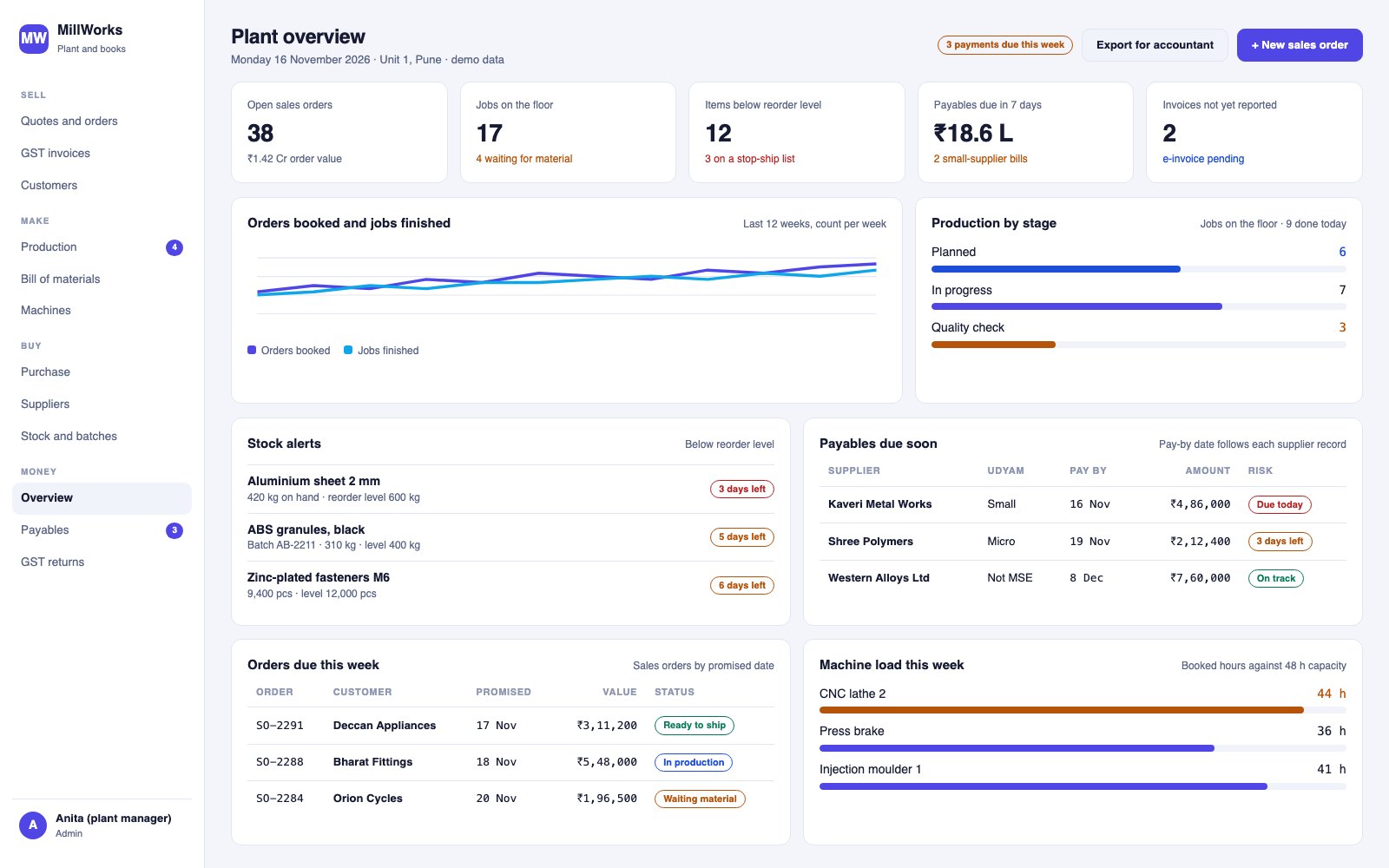
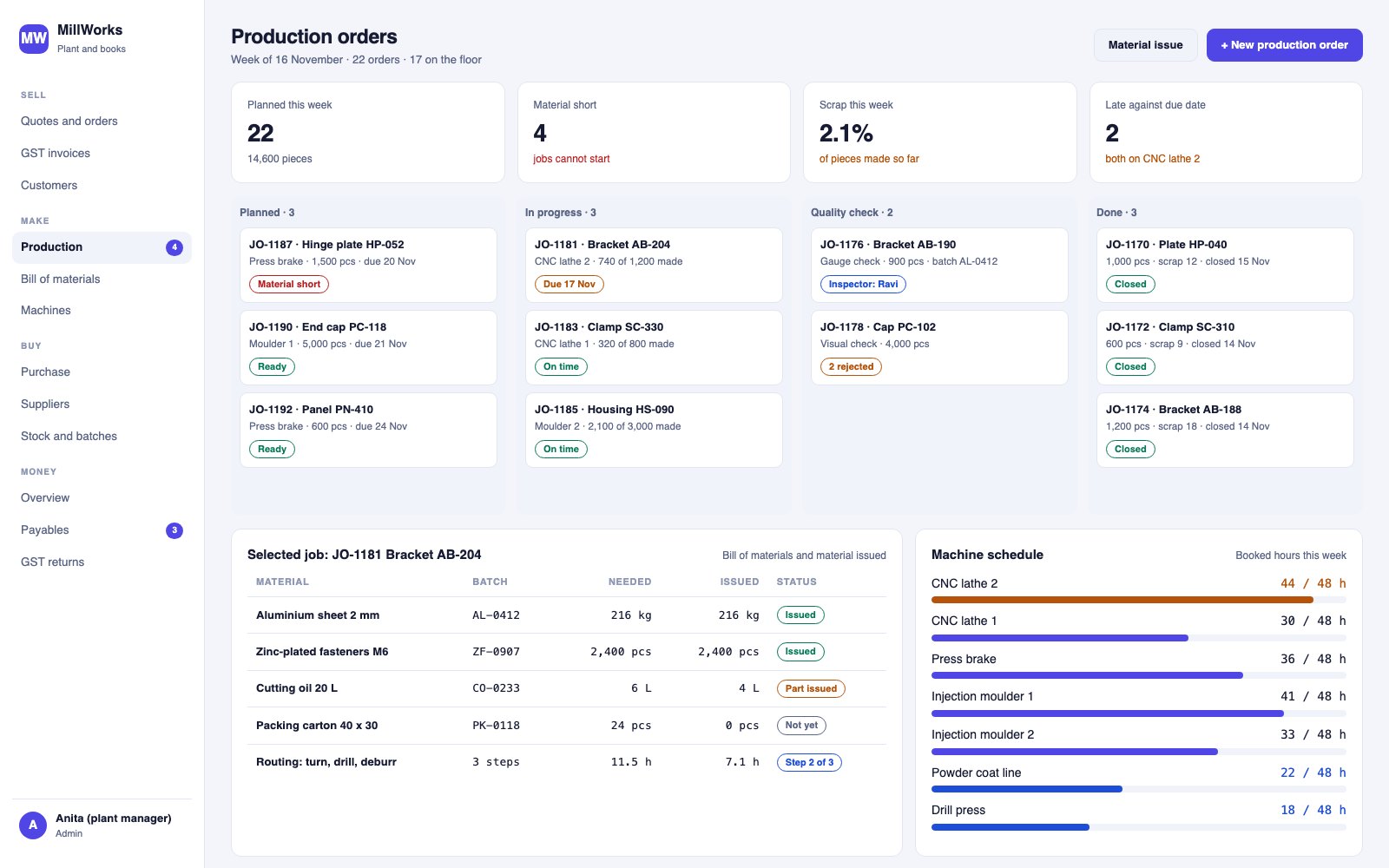
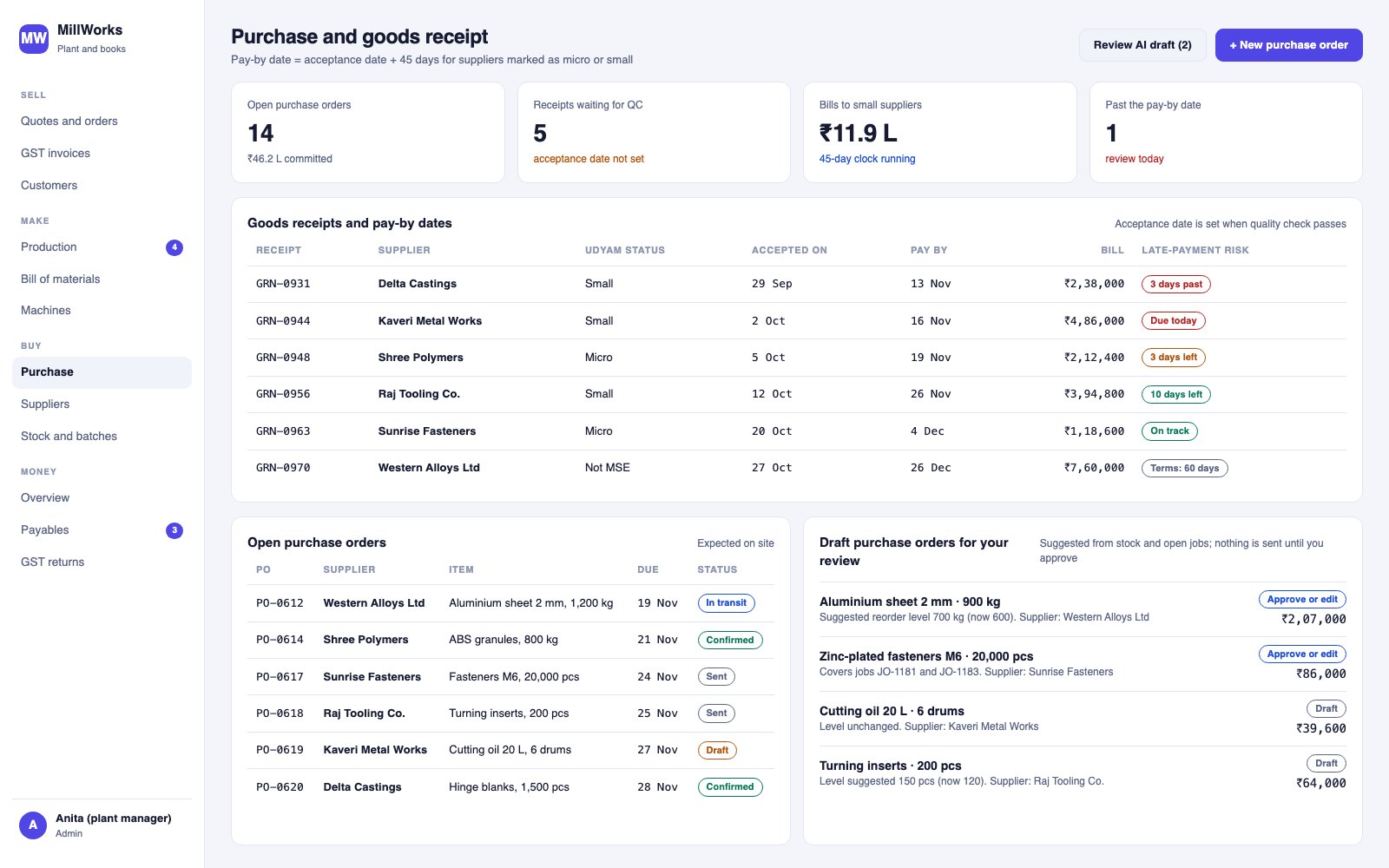
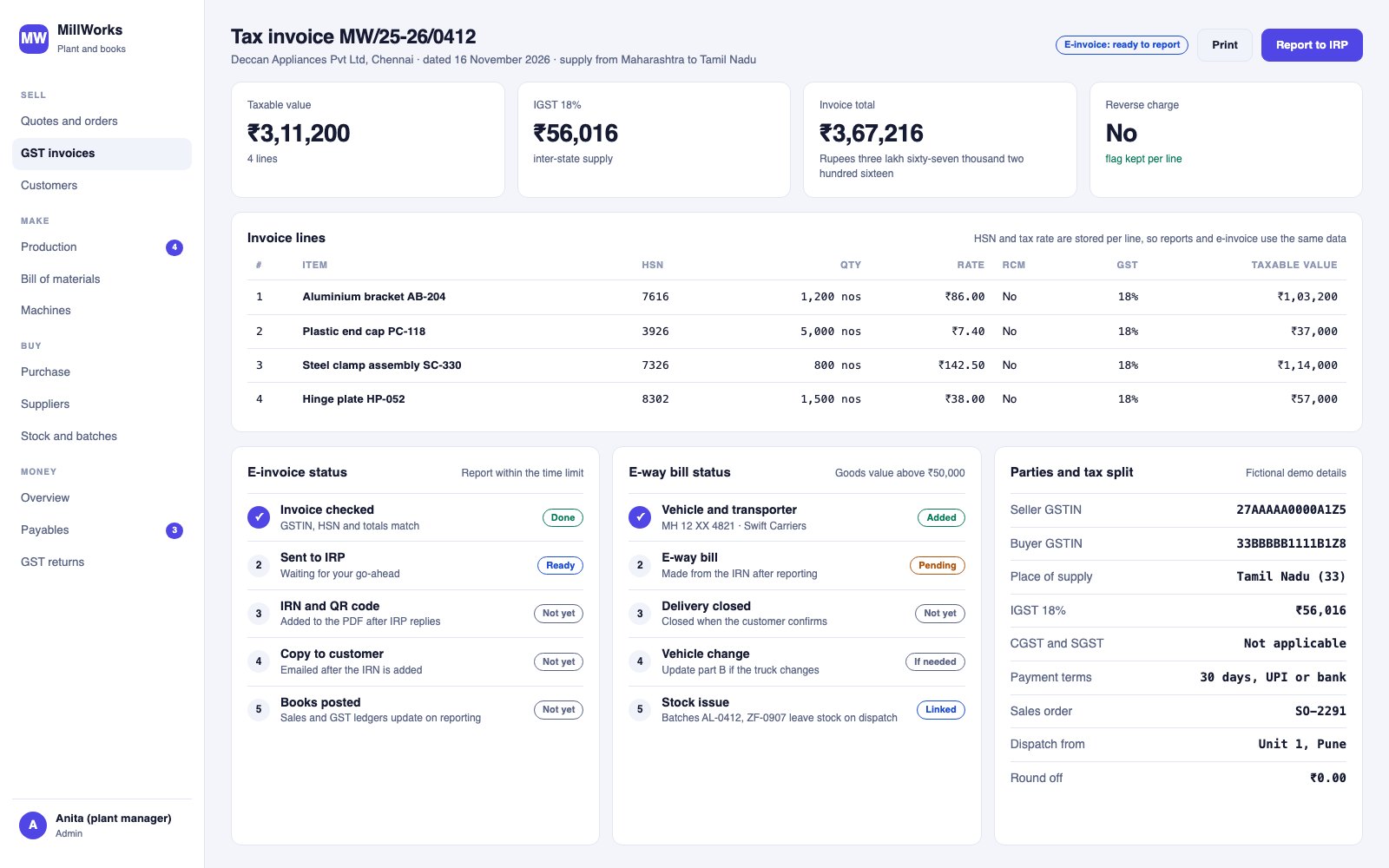
01 / 05 Plant overview - see orders, production, low stock and payments due on one screen
Engineering Process
- Map the plant's real flow from quote to payment with the owner, planner, store and accounts staff, using their own job cards and registers.
- Model the data: items, bills of materials, routings, batches, suppliers with Udyam status, receipts with acceptance dates, and invoice lines.
- Prototype the dashboard, production board, purchase and invoice screens and test them with plant staff on paper job cards first.
- Build the web ERP in slices, starting with stock and purchase, then production, then GST invoicing with a GST Suvidha Provider connection.
- Build the Android shop-floor app with job card scanning and an offline queue, and test it on the plant's own phones and Wi-Fi.
- Add the AI drafts for reorder levels and purchase orders behind a review step, and check each draft against real stock history.
- Migrate items, suppliers and open orders from spreadsheets, run the plant in parallel for a trial period, then train the team and go live.
Production Tech Stack
| Layer / Component | Production Technologies |
|---|---|
| Web app | Next.jsTypeScriptTailwind CSSshadcn/ui |
| Android app | Expo (React Native)expo-camera for QR scanningSQLite offline queue |
| Backend | Node.js with TypeScriptZod input validation |
| Database | PostgreSQL with row-level audit history |
| GST connection | A GST Suvidha Provider API for the e-invoice portal (IRP) and e-way billscalled from a pg-boss job queue with retries |
| AI and hosting | Anthropic Claude API for draftsDocker on AWS Mumbai regionGitHub Actions |
What the design aims for
MillWorks aims to let a small manufacturer plan production, buy material, track stock batches and raise GST invoices in one place, with payment deadlines and e-invoice states visible early.