Ledgerline
A Billing and Entitlements Console for Software Companies
A concept study: we worked up this product, its architecture and its screens as an example of how we would approach it. The screens use fictional demo data and are design concepts, not screenshots of a live product, and this is not a client project.
About the Project
Ledgerline is a design concept for a multi-tenant console where a software company defines its plans, meters customer usage, bills for it and decides what each customer may use. Most teams keep prices in one tool, usage counts in another and feature access in a third. When a customer upgrades or hits a limit, three systems must agree, and often they do not.
The idea is one versioned plan definition. A price, a meter, a limit and a feature flag all hang off the same plan version, so a change made once reaches the invoice, the product and the customer portal together. Customers stay on the version they signed. A pricing manager can test a new version against last quarter's usage before it goes live.
Every invoice line keeps a trace back to the usage events, rate and credit behind it, so support can explain a charge without asking engineering. Money logic is replayable: rating can be run again into a new draft without touching an invoice that was already sent. Invoices carry the GST fields, and payments stay with an existing gateway, so Ledgerline does not hold funds.
Why This Matters Now
Market, rule and technology context for this kind of product, checked on 16 November 2026. Each item names its source.
- Vertice, a software spend firm, reported that consumption-based pricing was the largest share of SaaS contracts in its preliminary Q3 2026 data, ahead of hybrid and per-user pricing.Vertice, Oct 2026
- At Sessions 2026 Stripe said it supports dimensional and hybrid pricing through Metronome, with credit balance alerts and auto top-ups, and previewed billing customizations and a read-only Postgres copy of Stripe data.Stripe, 29 Apr 2026
- Law firm King Stubb and Kasiva reports that the RBI e-mandate framework of April 2026 merges earlier circulars, allows recurring debits up to Rs 15,000 without extra authentication and requires notice before each debit.King Stubb & Kasiva (law firm), 21 Apr 2026
- Stripe announced that it completed its acquisition of Metronome, a metering and billing engine for usage-based models, and plans to integrate it with Stripe Billing.Stripe newsroom, 14 Jan 2026
- Law firm S.S. Rana reports that MeitY notified the final DPDP Rules on 13 Nov 2025, with consent manager duties after 12 months and core data fiduciary duties after 18 months.S.S. Rana & Co. (law firm), 13 Nov 2025
Requirements & Objectives
- Store plans, add-ons, seat prices, tiers and credit packs as versions with an effective date, so each customer stays on the version they signed.
- Accept usage events through an API with an idempotency key, reject repeats, flag late events and roll events up per customer, meter and billing period.
- Answer whether a customer has a feature, a seat or enough credits left, using the same plan version that sets the price, with a defined rule for when the service is unreachable.
- Run the subscription lifecycle (trial, upgrade, downgrade, pause, add-on, proration, cancellation) from rules stored on each plan version.
- Draft invoices that show every line with its meter, window, rate, credit and the events behind it, and let a reviewer approve a batch.
- Carry GST fields on invoices (CGST, SGST, IGST and place of supply) and leave a field for an e-invoice reference number.
- Give each customer a portal with live usage against limits, invoices, seats and plan options, limited to that customer's own record.
- Write an audit entry with the actor and a reason for every price, credit and entitlement change.
The Engineered Solution
1One plan version, three outcomes
The plan version holds the price, the meter and the limit. Rating reads it to charge, the entitlement service reads it to allow or deny, and the portal reads it to display. Nothing is copied, so nothing can drift.
2Explainable invoices
Each draft line opens into a trace: the meter, the window, the running total, the rate and any credit. Late events are held for review, so a sent invoice is never changed without a person seeing it.
3Plan changes tried before launch
A pricing manager runs a new version against last quarter's usage and sees which customers would pay more or less. The version is then scheduled for a date, with grandfathered cohorts kept on their old terms.
4Access checks near the product
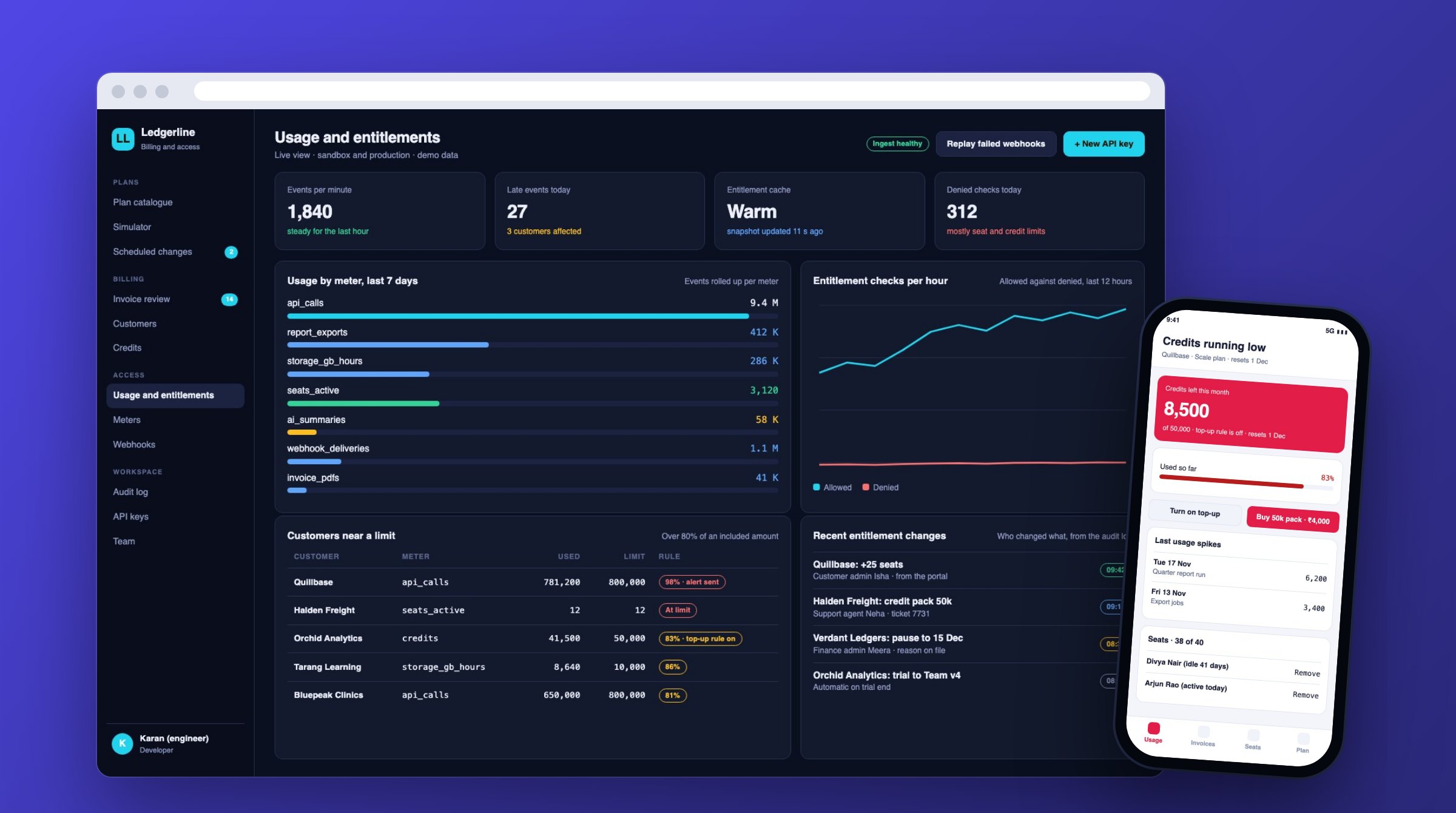
A server SDK reads a cached snapshot of each customer's entitlements, kept fresh by events. The product never waits on the billing database, and a stale-allowed rule decides what happens if the service is down.
Design Concept Screens
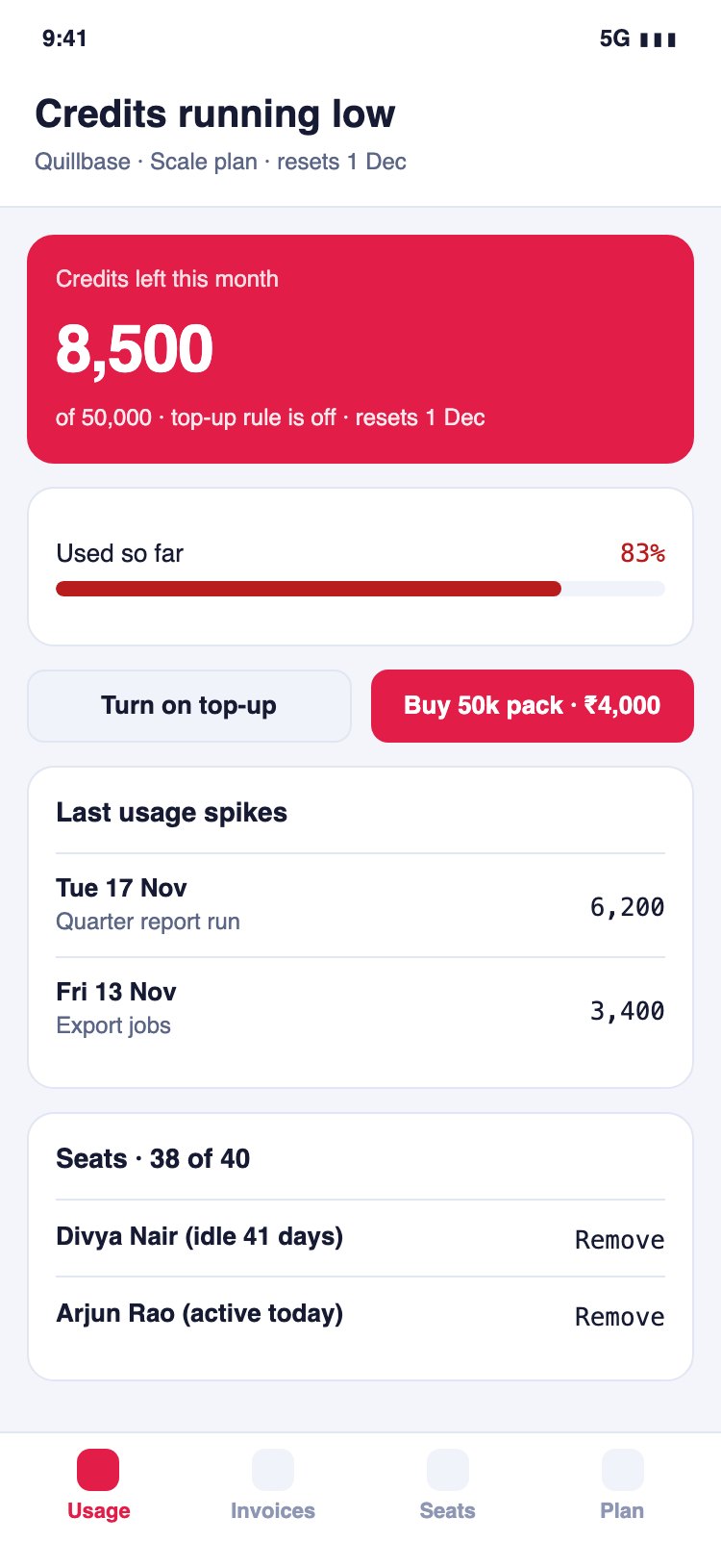
Design concepts with fictional demo data. They show how the product could look and work, not a live release.
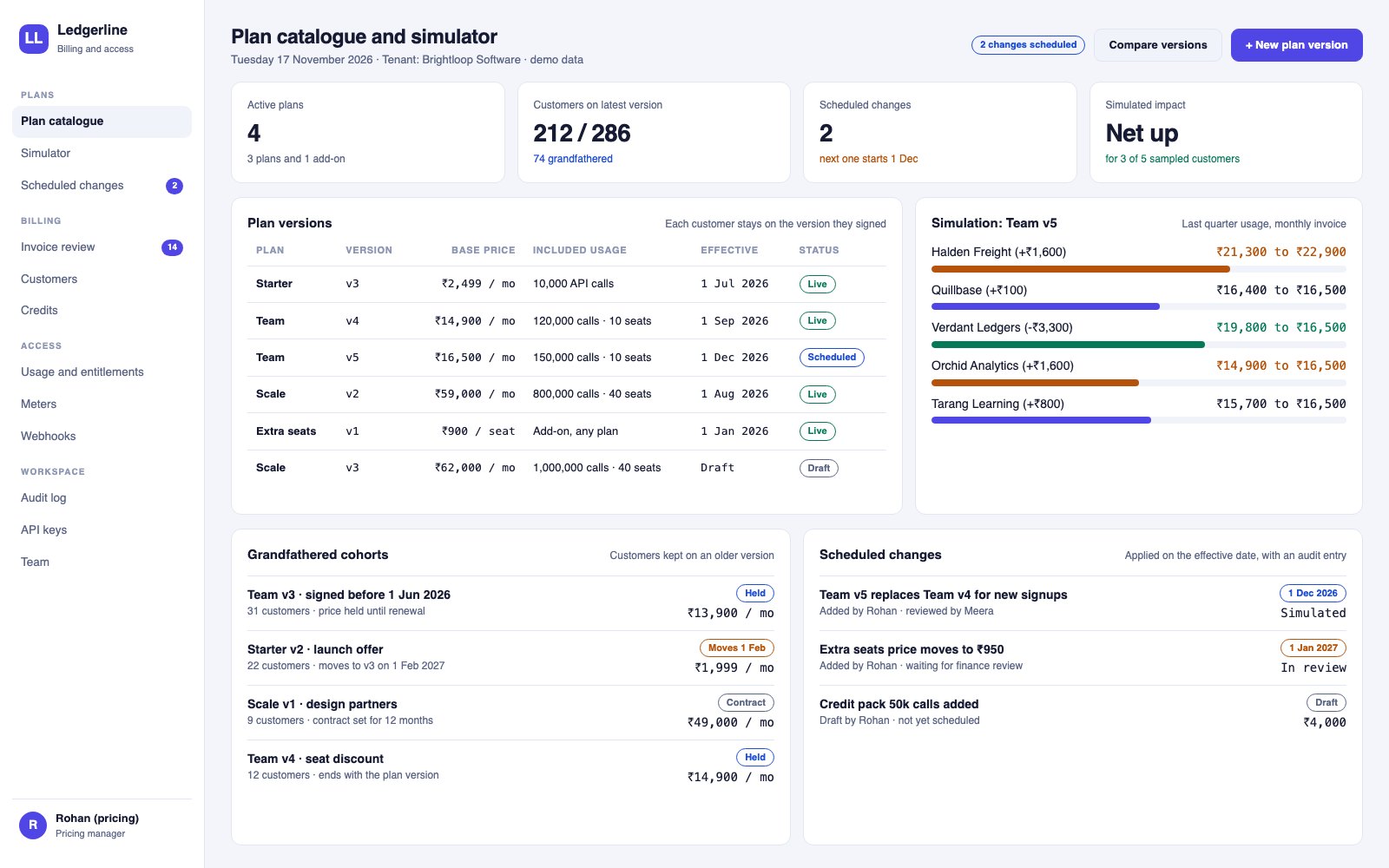
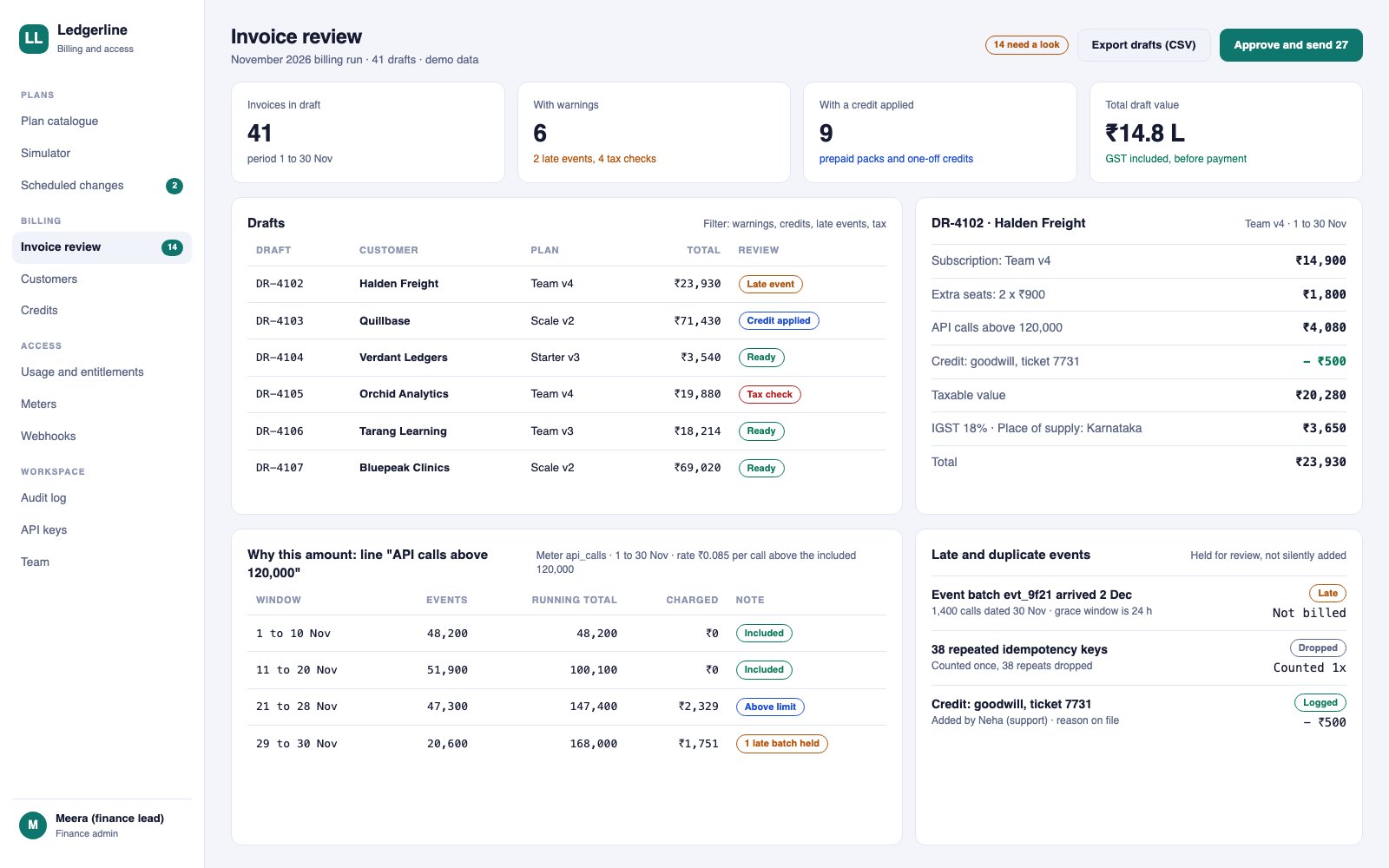
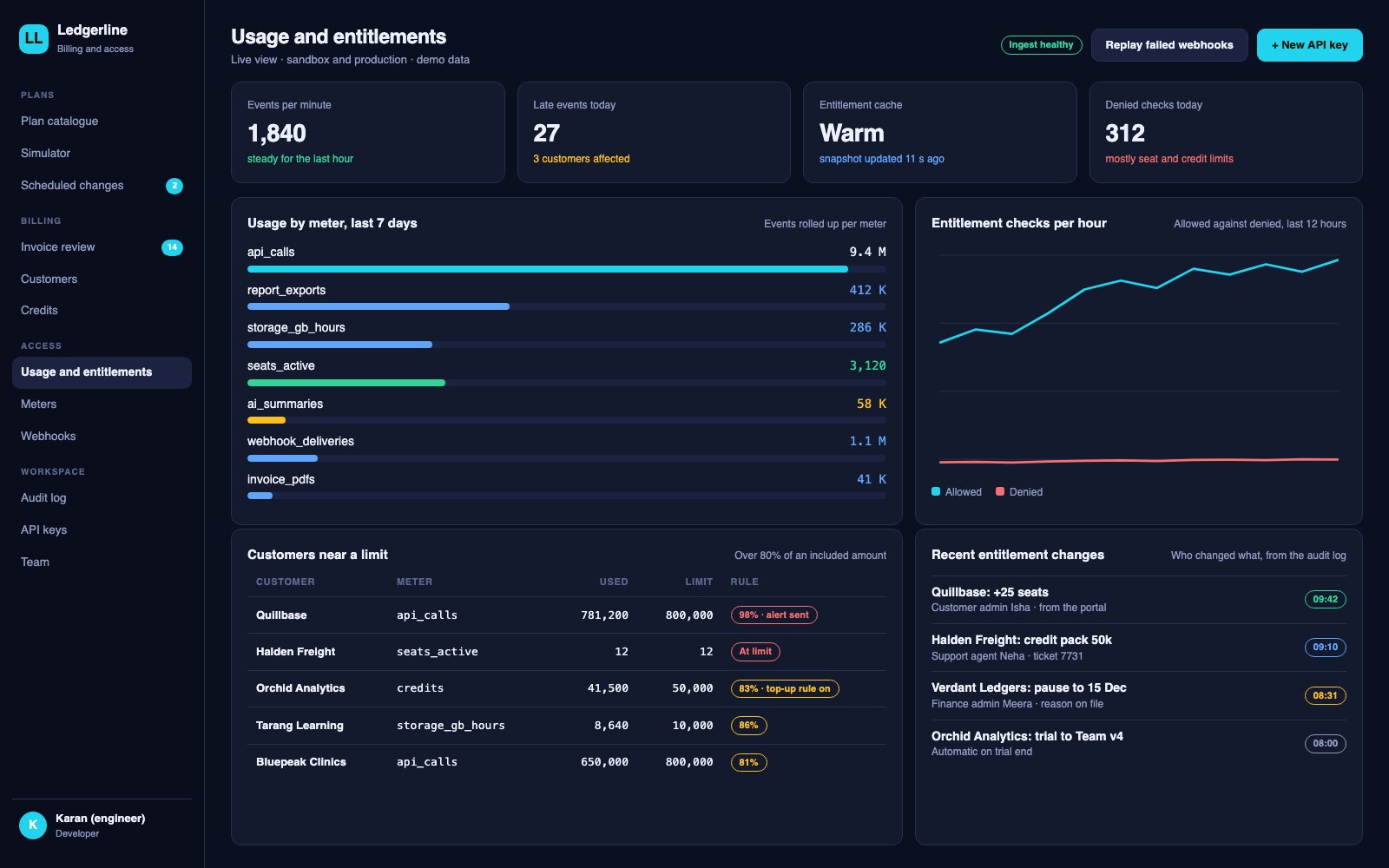
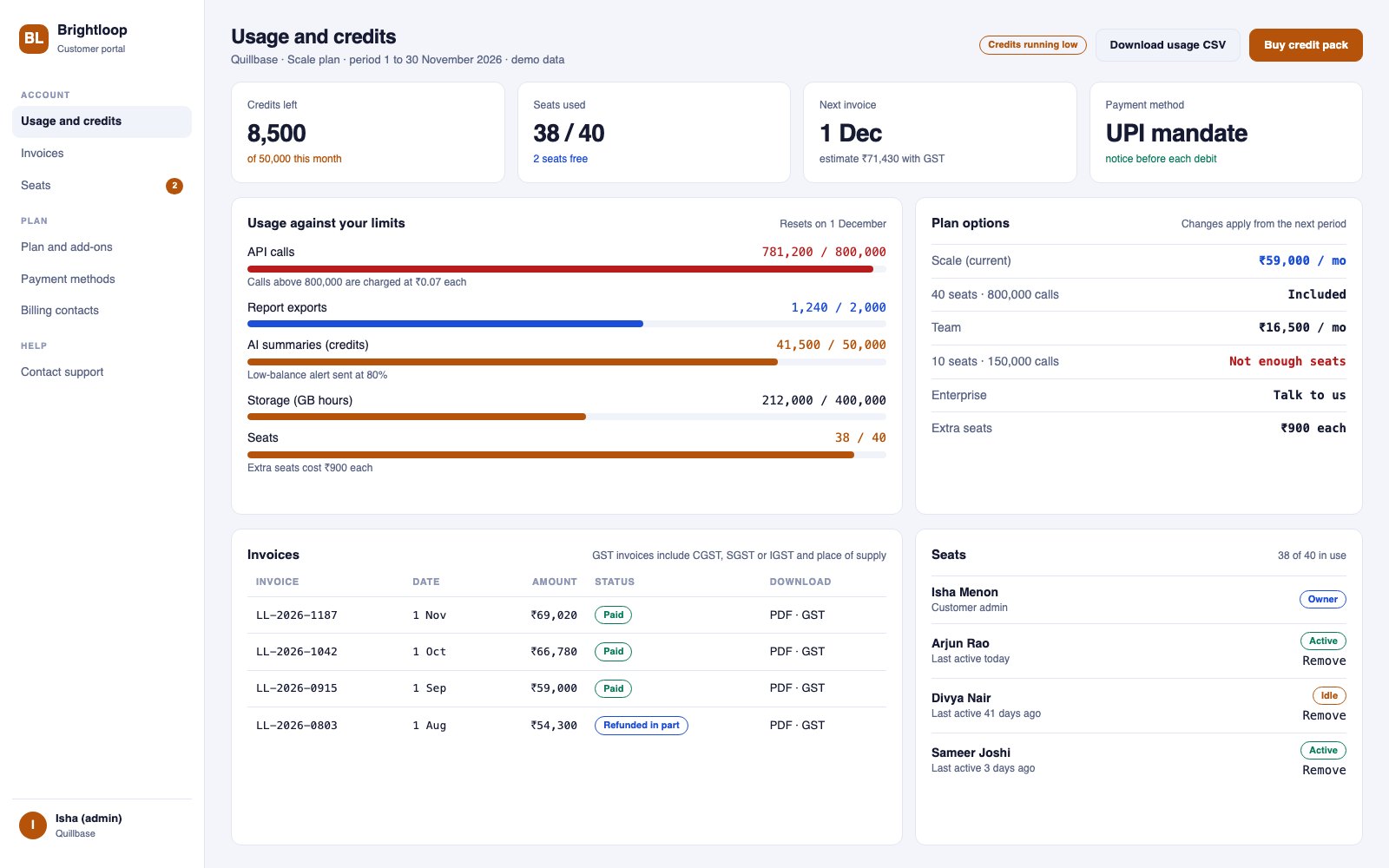
01 / 05 Plan catalogue - draft a plan version, simulate it on past usage and schedule it by date
Engineering Process
- Map how pricing, usage and access are handled today with finance, product and support, and list every place a plan rule is written twice.
- Model the data: tenants, plan versions, meters, subscriptions, usage events, invoice lines and the audit log.
- Prototype the plan catalogue, invoice trace and customer portal in a clickable design and test them with finance and support staff.
- Build the ingest service and rating job first, then check them by replaying a past period and comparing the draft to the real invoices.
- Build the entitlement service and server SDK, and test cache and fallback behaviour with a sandbox tenant.
- Connect the payment gateway adapter, the GST fields, dunning rules and the accounting export.
- Run a load rehearsal, harden access rules and the audit log, and hand over with API docs and a runbook.
Production Tech Stack
| Layer / Component | Production Technologies |
|---|---|
| Console and portal | Next.js (App Router)TypeScriptTailwind CSSshadcn/uiTanStack TableRecharts |
| Services | Node.js and TypeScript: a Next.js API layeran ingest service and a worker service for ratinginvoicing and webhookswith Zod validation and an OpenAPI REST API |
| Data | PostgreSQL (Supabase) with row-level security keyed to the tenantClickHouse for raw usage events and rollupsRedis for the entitlement cache |
| Payments | Stripe Billing as the first gateway adapterbehind an interfaceplus an India adapter for UPI and card recurring mandates |
| Cloud | Vercel for the web appsAWS Mumbai region with SQS and containers for ingest and workersTerraformGitHub Actions |
| Access and monitoring | Supabase Auth or Clerk with SAML single sign-on for staffSentry for errorsPostHog for product analytics |
What the design aims for
Ledgerline aims to align what a software company charges, what each customer may use and what the customer sees, by drawing all three from one versioned plan.