FreightWatch
A Shipper-Side Control Tower: One Record per Shipment, Predicted Arrivals and Exceptions
A concept study: we worked up this product, its architecture and its screens as an example of how we would approach it. The screens use fictional demo data and are design concepts, not screenshots of a live product, and this is not a client project.
About the Project
FreightWatch is a design concept for a web product that collects status from ocean lines, airlines, trucking firms, rail operators and parcel carriers into one shipment record. It is built for the shipper: an importer, manufacturer, retailer or distributor that uses many carriers and has to explain a late container to its own customers. It is not a fleet app, which is a different product.
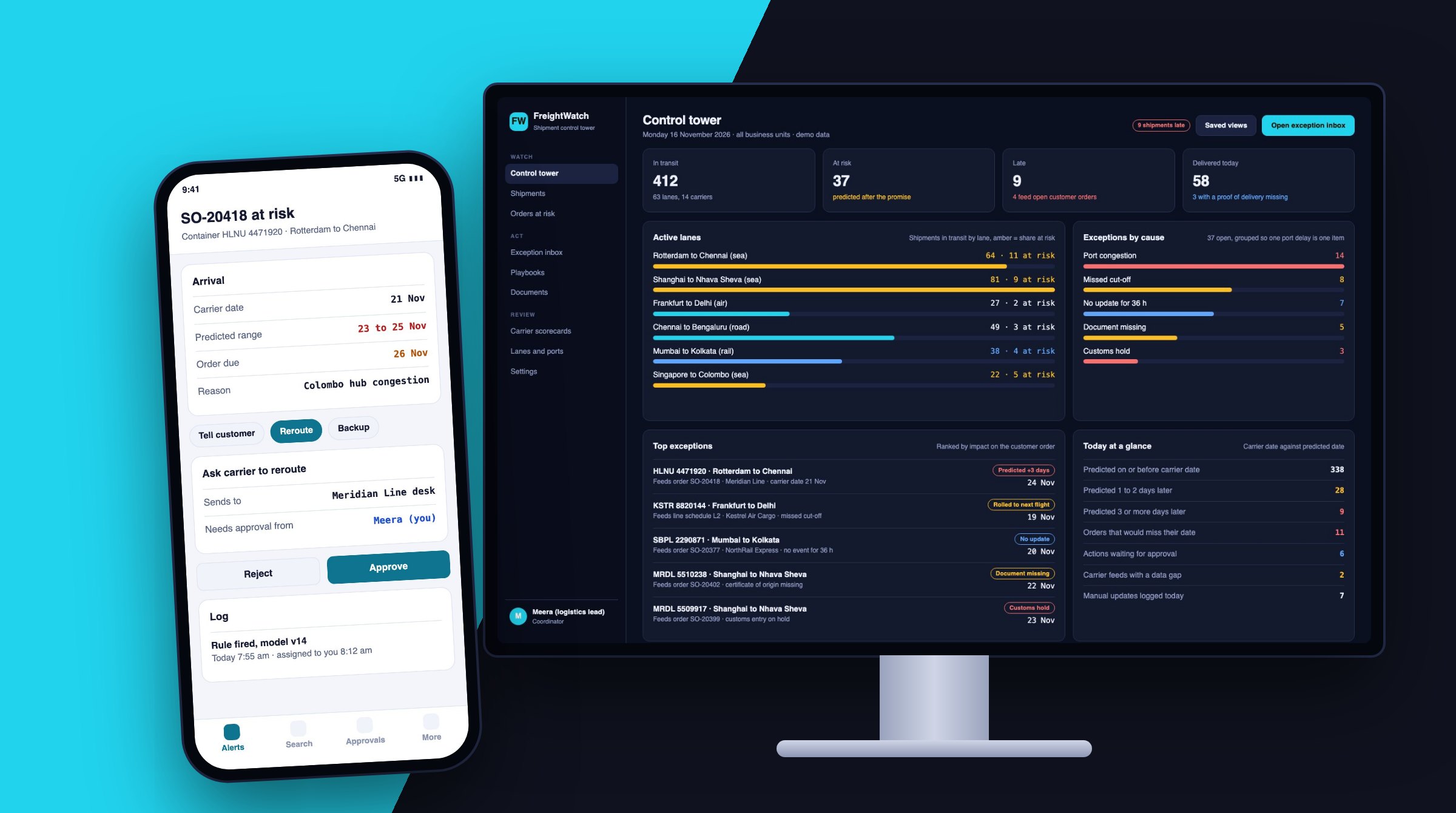
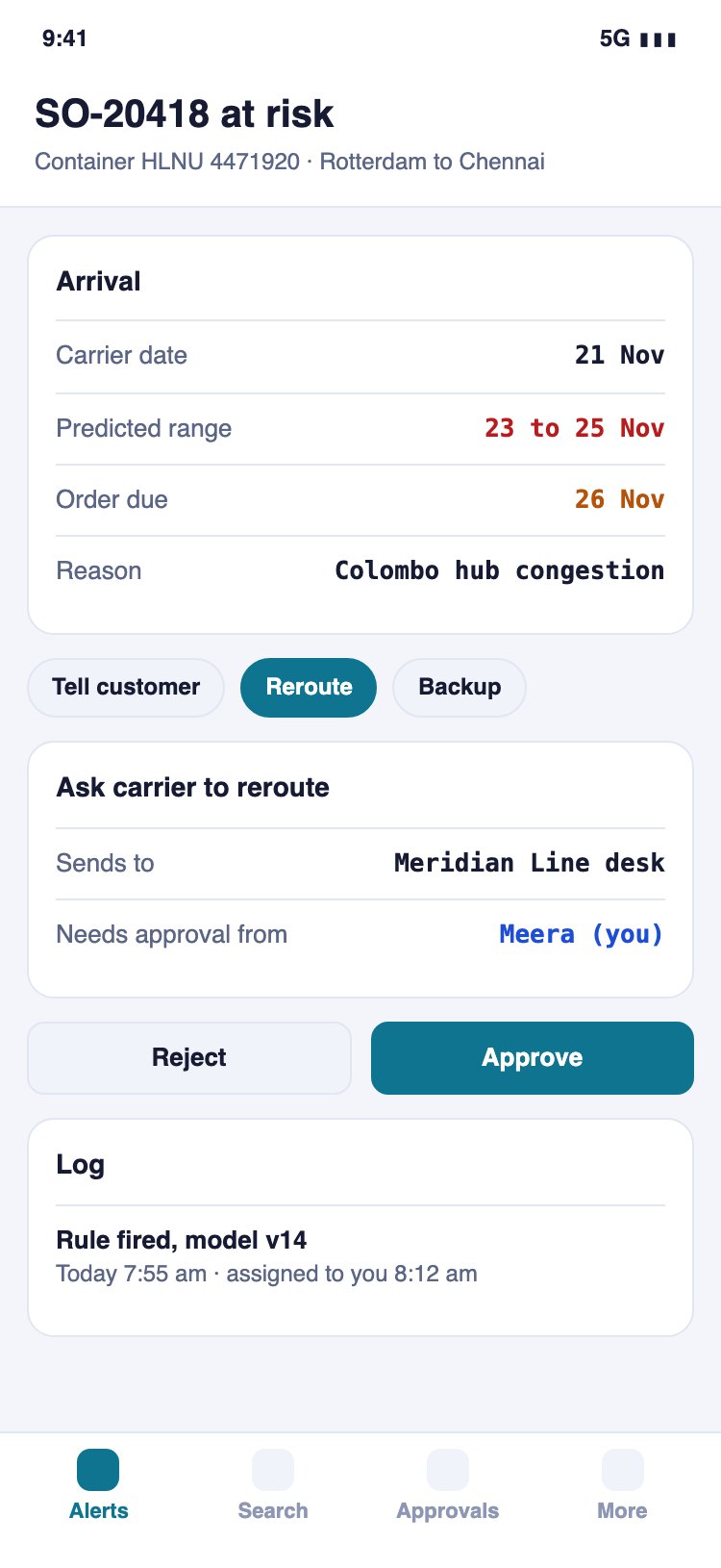
The concept keeps two dates side by side: the date the carrier promised and the date FreightWatch predicts for the real arrival, with a range and the top reasons for any gap. An exception appears in the inbox only when a rule or a prediction crosses a limit the customer set, and it is tied to the customer order it feeds. Weak data is shown honestly, with a confidence label, a note such as no event for 36 hours, and a manual update form for carriers that offer nothing else.
The team stays in charge. FreightWatch suggests a next step, such as telling the customer, asking a carrier to reroute or booking backup capacity, and a named person approves it. A phone companion carries alerts and approvals, and an audit log records every status change and action.
Why This Matters Now
Market, rule and technology context for this kind of product, checked on 16 November 2026. Each item names its source.
- The ICC reported on 21 October 2026 that the FIT Alliance 2026 survey found electronic bill of lading use rising, with interoperability between platforms named as the main concern.International Chamber of Commerce (ICC), 21 Oct 2026
- The European Commission says the EU adopted its largest customs reform on 16 September 2026, with a temporary 3 euro duty on low-value parcels since 1 July 2026 and a customs data hub for e-commerce from 2028.European Commission, Taxation and Customs Union, 16 Sep 2026
- US Customs and Border Protection published a rule on 24 June 2026 that ends duty-free de minimis treatment for postal shipments and creates a postal informal entry process.US Federal Register (via govinfo.gov), Customs and Border Protection, 24 Jun 2026
- FreightWaves reported on 11 May 2026 that project44 launched Autopilot, where AI agents react to signals such as late shipments, with every agent action logged for audit.FreightWaves, 11 May 2026
- Sea-Intelligence reported that the Strait of Hormuz disruption pushed diverted cargo into hubs such as Colombo and West Coast India, causing yard congestion that hurt reliability on unrelated trade lanes.Sea-Intelligence, 7 May 2026
Requirements & Objectives
- Hold one record per shipment, container or parcel, with every leg, carrier and handover in order on a single timeline.
- Take in events from carrier APIs, electronic data interchange (EDI) messages, parsed emails and a manual update form, and map each carrier's status words to one shared event model.
- Store the carrier date and the predicted arrival date as separate fields, with a range, the top reasons for the gap and the model version.
- Raise exceptions only when a rule or prediction crosses a limit the customer set, group them by cause, and rank them by impact on the linked order.
- Link each shipment to the customer order or production line it feeds, so lateness reads as an order that misses its date.
- Track the documents each shipment needs and flag a missing or mismatched one before the vessel arrives.
- Let a named person approve every suggested action before anything goes to a customer or a carrier, and log who did what.
- Give each business unit its own view, keep tenants apart, and record every status override.
The Engineered Solution
1One timeline per shipment
Every event from every carrier lands in an append-only history, and the current state is worked out from it. Duplicates, late messages and out-of-order events do not corrupt the record.
2A predicted date people can check
The carrier date and the predicted date sit side by side with a range and the reasons for the gap, such as hub congestion or a missed connection. Staff can judge the number instead of trusting it blindly.
3Exceptions that follow the order
One port delay becomes one exception that covers many shipments, ranked by the customer orders it threatens. Thresholds belong to the customer, and snoozing needs a reason.
4Human approval for every response
Playbooks suggest a next step with a ready message or request. A named person approves it from the web app or the phone, and the action is written to the audit log.
Design Concept Screens
Design concepts with fictional demo data. They show how the product could look and work, not a live release.
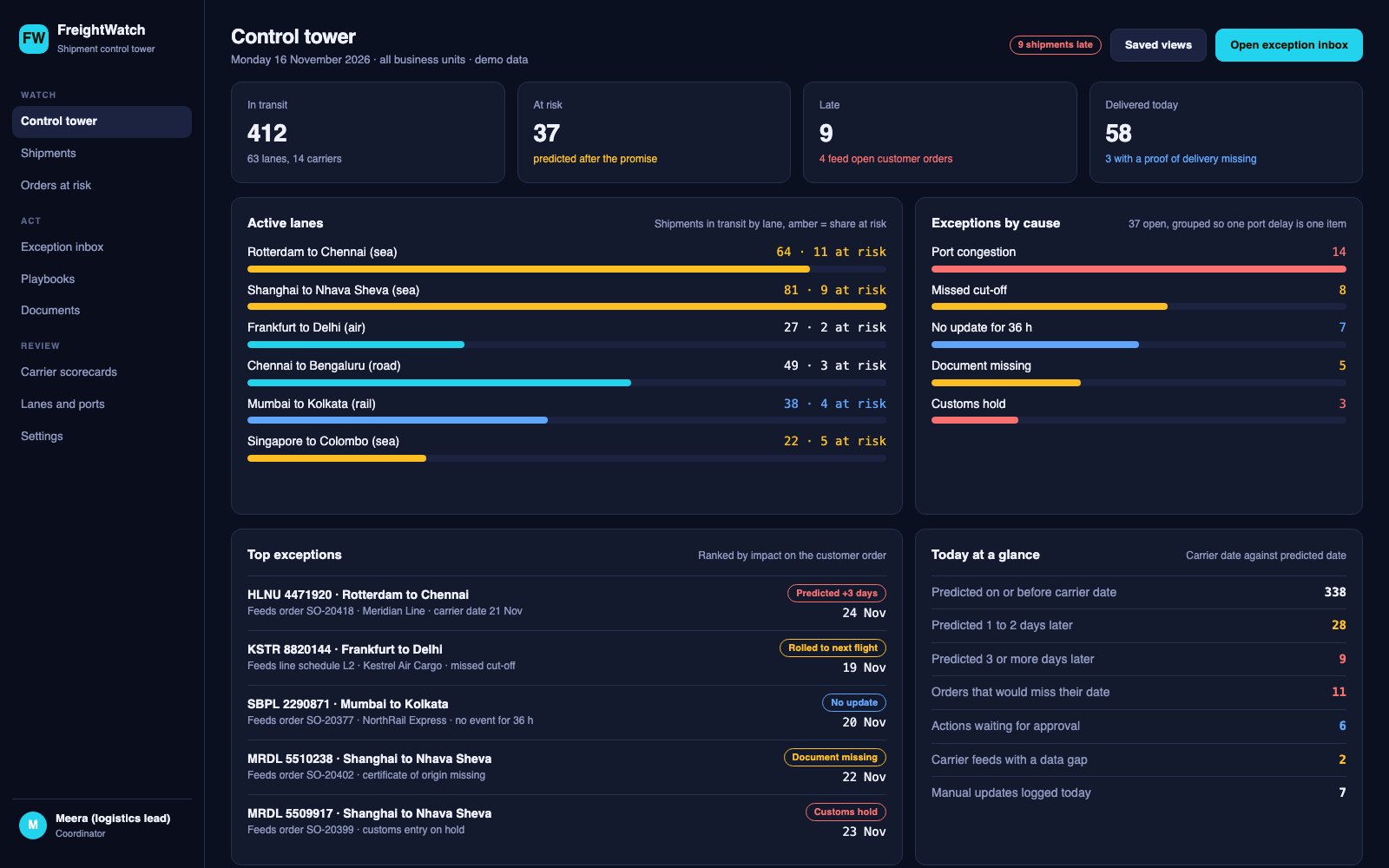
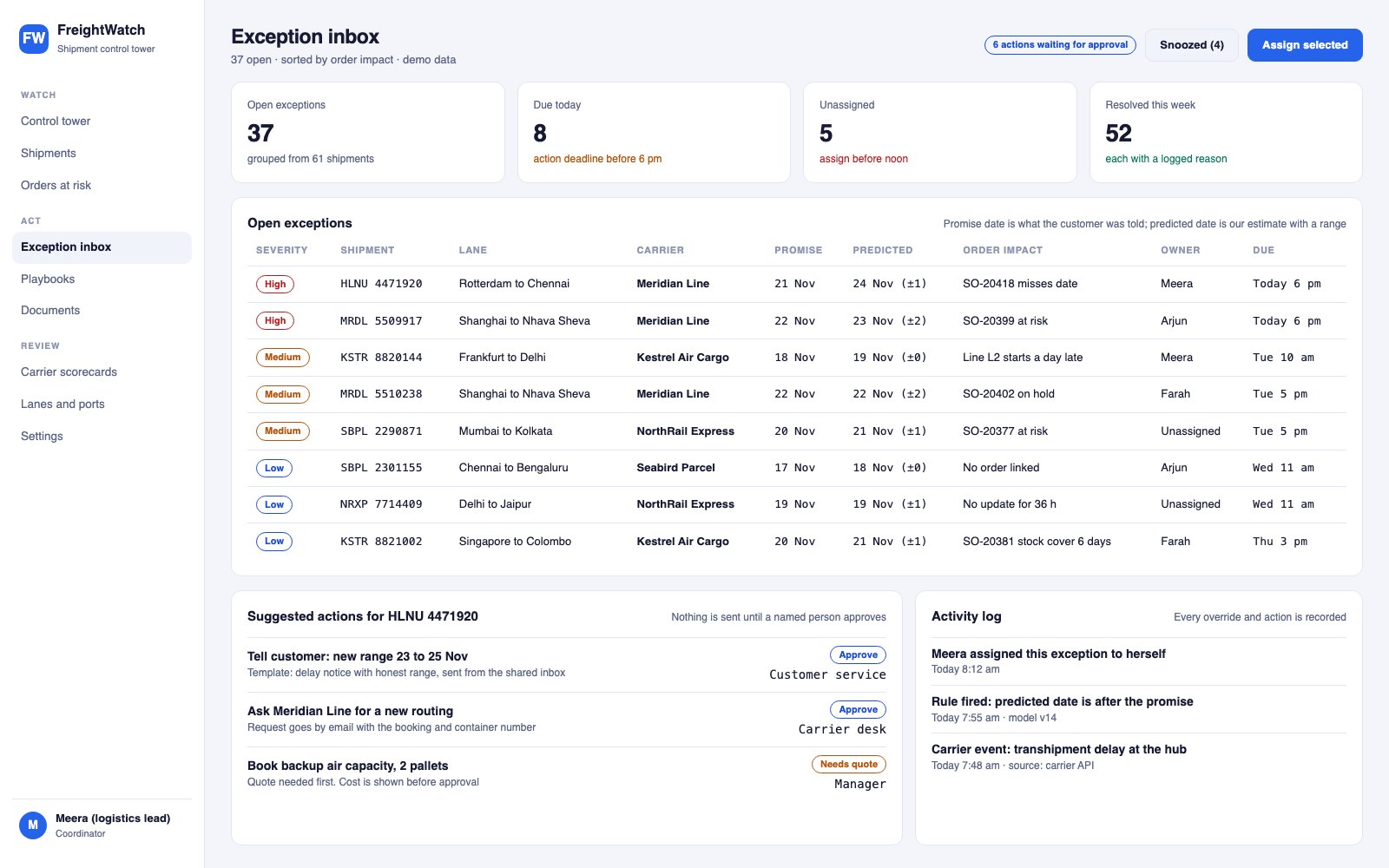
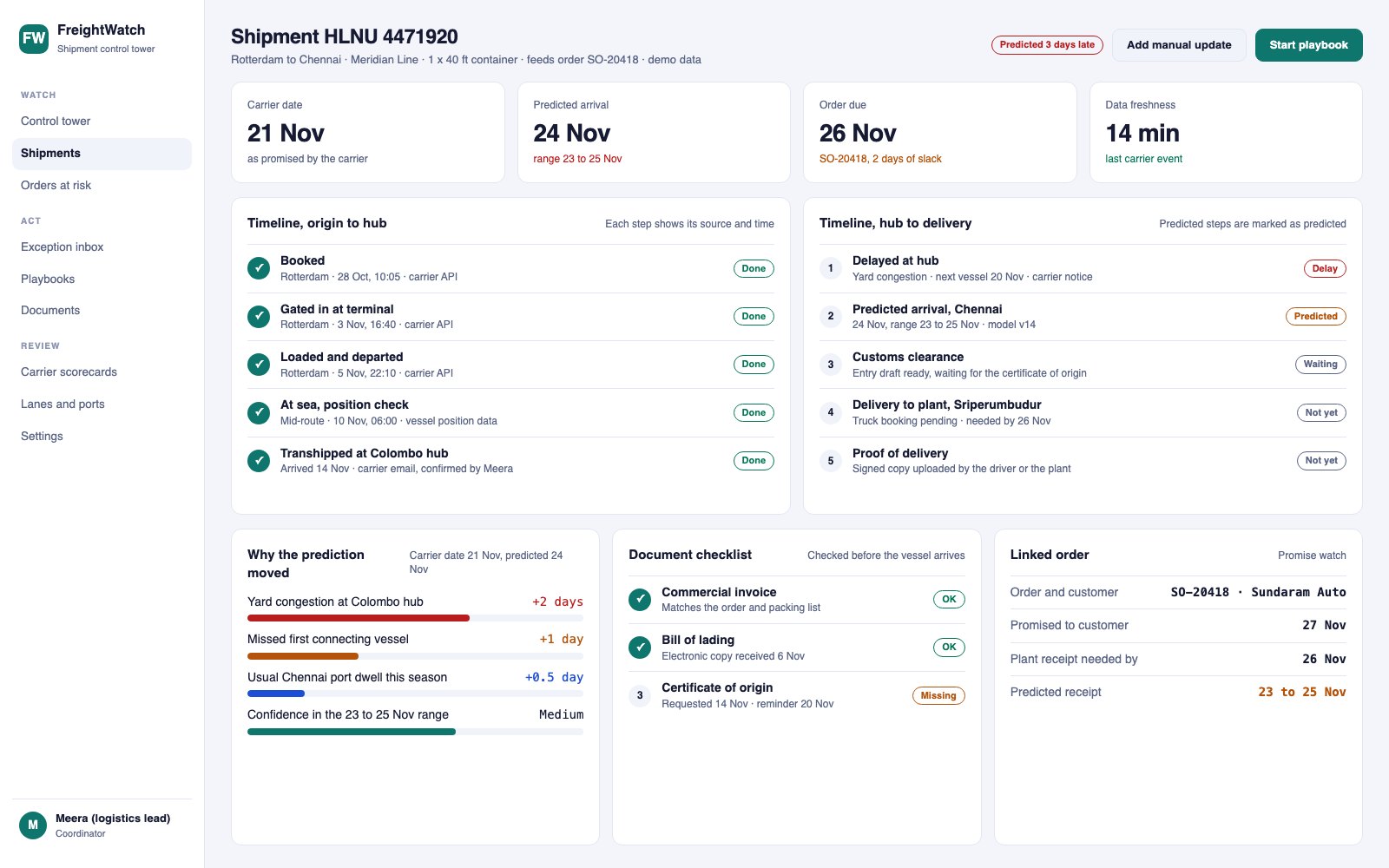
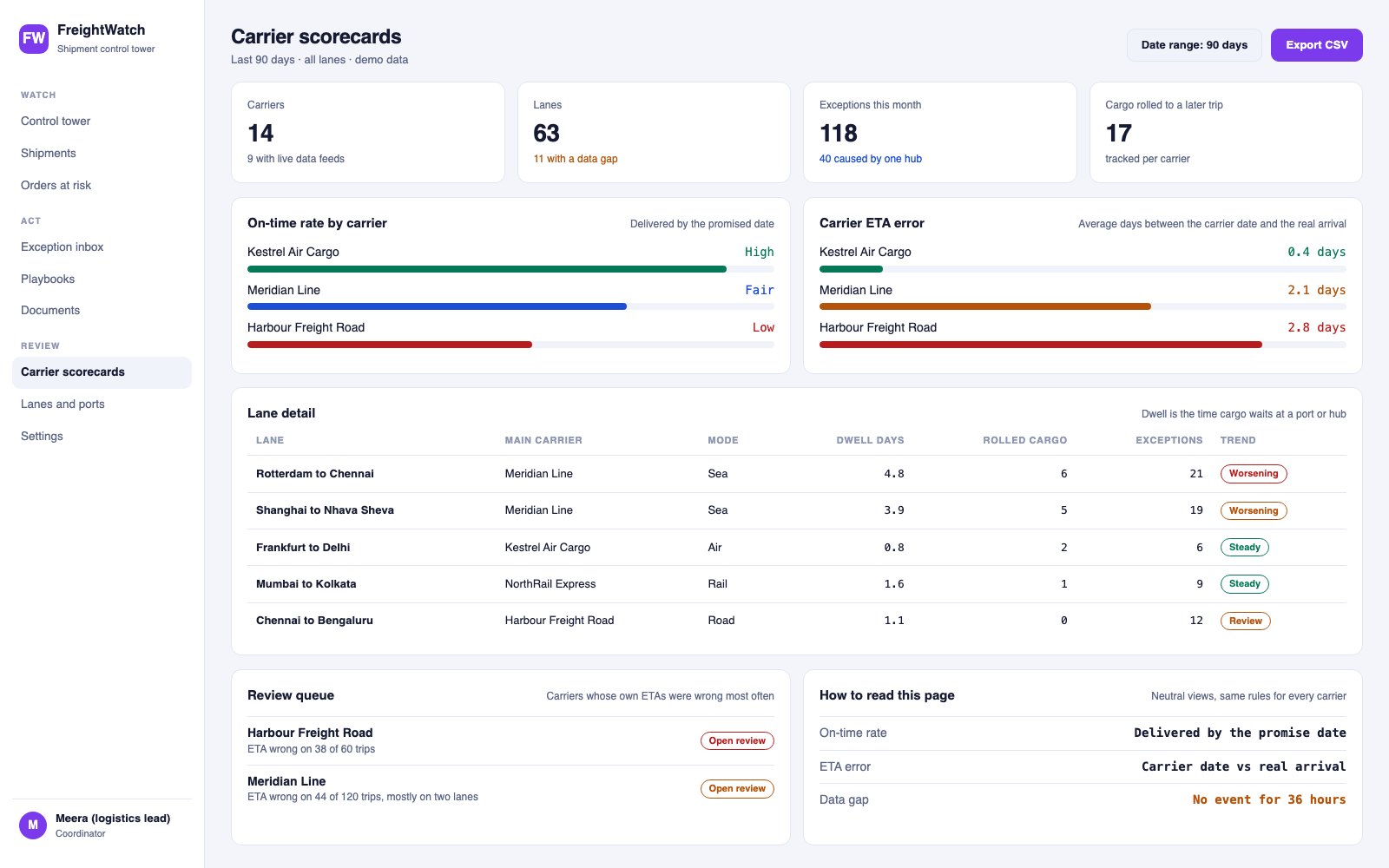
01 / 05 Control tower - see what is late, why, and which customer order each late shipment feeds
Engineering Process
- Map the real shipment flow with coordinators, customer service, planners and customs staff, starting from their own spreadsheets and carrier portals.
- Define the shared event model and the status mapping for the first three carriers, including how to rank sources when they disagree.
- Prototype the control tower, exception inbox and shipment timeline and test them with coordinators on their messiest lanes.
- Build the ingestion service in slices: tenants and sign-in, the event store, two carrier connectors, then email parsing and the manual update form.
- Add the rule engine, order linking by CSV import, the document checklist and notifications, with limits that each customer sets.
- Train and evaluate the arrival model on past trips, show its range and reasons in the interface, and compare it with carrier dates before staff rely on it.
- Harden with playbooks, the phone companion, audit log views and a security review, then migrate pilot data and run beside the old process.
Production Tech Stack
| Layer / Component | Production Technologies |
|---|---|
| Web app | Next.js (App Router)TypeScriptTailwind CSSshadcn/uiTanStack Table for dense listsZustand for saved views |
| Phone companion | Installable web app with web pushwith React Native and Expo as the option if native push or dock scanning is needed |
| API and ingestion | Node.js with FastifyZod validationSQS queues with dead-letter queuesidempotency keys on every inbound event |
| Data | PostgreSQL with PostGIS and TimescaleDBRedis for cachesS3 storage for documentsrow-level security by tenant |
| Arrival model | Python with FastAPI and LightGBM quantile modelsmodel and feature versions logged with every prediction |
| Cloud and sign-in | AWS (ECS FargateRDSCloudFront)TerraformGitHub ActionsOpenTelemetryClerk or Auth0 with SAML single sign-on |
What the design aims for
FreightWatch aims to unify the status of every carrier into one shipment record, with a predicted arrival that staff can check against the carrier's promise before a customer order slips.