ClaimLane
Claim Intake, Triage and Assessor Workspace for General Insurers
A concept study: we worked up this product, its architecture and its screens as an example of how we would approach it. The screens use fictional demo data and are design concepts, not screenshots of a live product, and this is not a client project.
About the Project
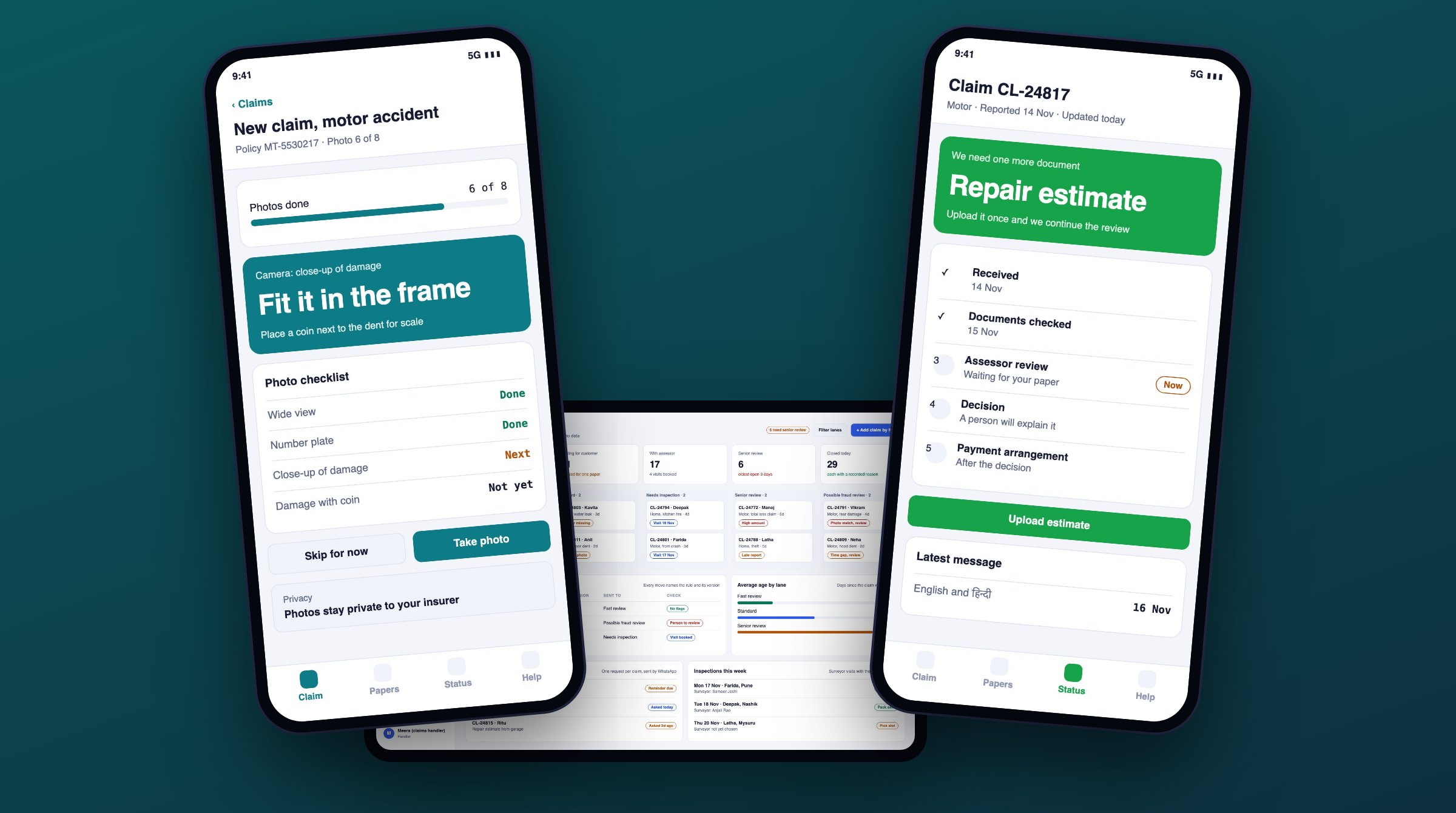
ClaimLane is a design concept for a claims intake and triage product for a small or mid-size general insurer, a managing general agent or a third-party administrator (TPA). A customer reports a loss with guided photos and papers. The claims team sorts the claim into the right lane with written rules. An assessor or surveyor then reviews one screen with the evidence, the policy terms and the notes.
Every automatic step is a suggestion or a routing rule that a person can read, override and explain. The software never approves or rejects a claim. It sorts, flags and drafts. A named person decides and writes the reason, and the customer sees that reason in plain words. Photo checks such as capture time, location, duplicate match and content credentials show as flags with their cause, because none of them proves anything alone.
The customer sees a plain status page and receives messages by WhatsApp, SMS or email. Every upload, flag, rule version and decision goes into an audit trail. The design accounts for the Digital Personal Data Protection (DPDP) Act and the claims rules of the Insurance Regulatory and Development Authority of India (IRDAI), and does not claim to satisfy them.
Why This Matters Now
Market, rule and technology context for this kind of product, checked on 16 November 2026. Each item names its source.
- IRDAI told insurers handling the July 2026 Assam floods to use digital channels for claims correspondence and submission and to ask only for papers needed to support the claim amount (reported by TaxGuru).TaxGuru (secondary, reproduces IRDAI circular), 31 Jul 2026
- An IRDAI circular says insurers must file their written reply and papers for an Insurance Ombudsman case within 7 days and any extra documents within 3 days (reported by Oquilia).Oquilia (secondary, summarises IRDAI circular), 23 Jul 2026
- A law-firm review of 13 US state positions says aerial imagery should be one input among several, with human review, specific reasons for adverse decisions and checks that images are current and accurate.Troutman Pepper Locke, republished from Carrier Management (law firm), 25 Mar 2026
- Debevoise, a law firm, warned that generative AI can fabricate or exaggerate claim photos and listed controls such as several angles, a scale reference object, AI-image detection and live remote inspection.Debevoise & Plimpton (law firm), 20 Jan 2026
Requirements & Objectives
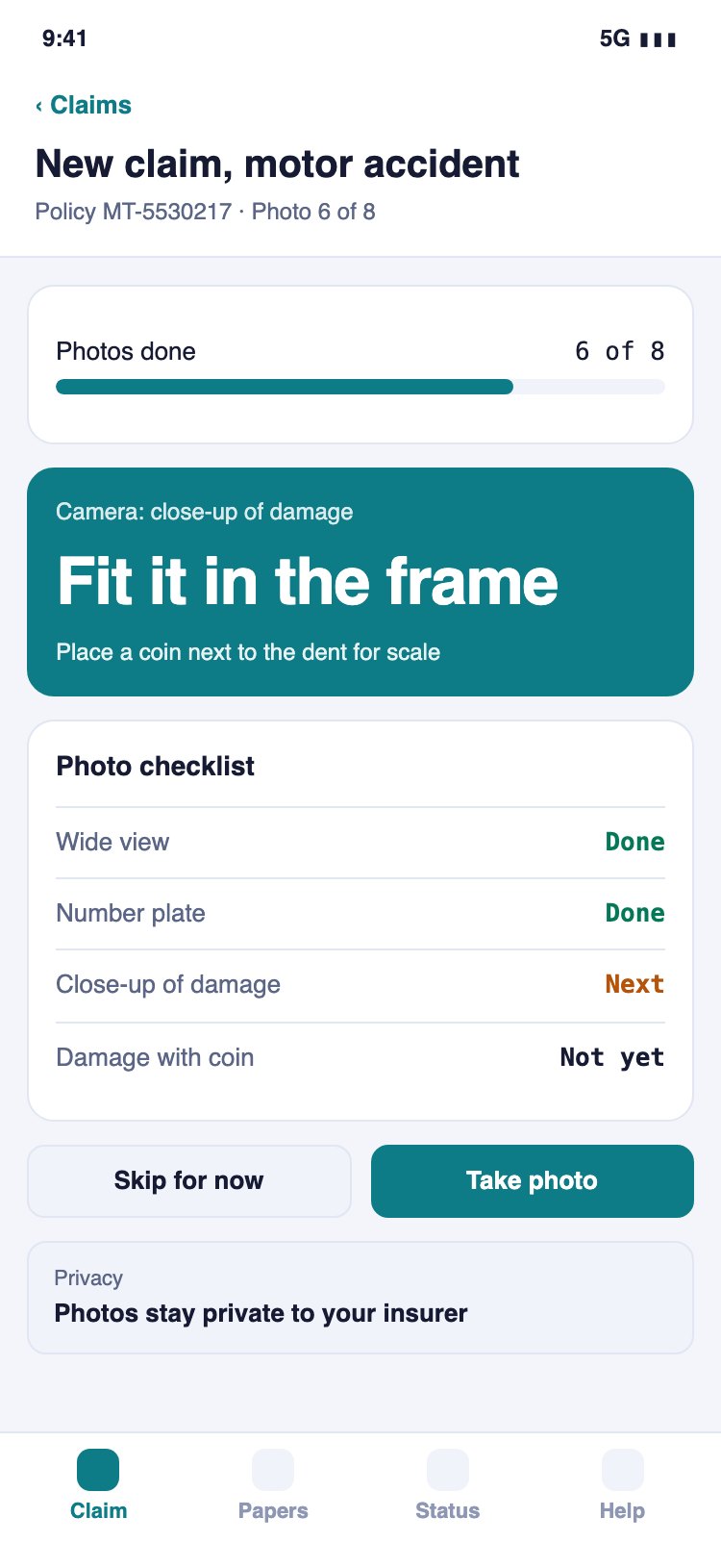
- Let a customer report a motor or home loss in a phone app, with a guided list of photos and the papers that claim type needs.
- Check each photo for capture time, location where the customer allows it, a match with earlier claims and content credentials, and show the result as a flag with its reason.
- Compare uploaded papers with the checklist for the claim type and ask the customer once for exactly what is missing.
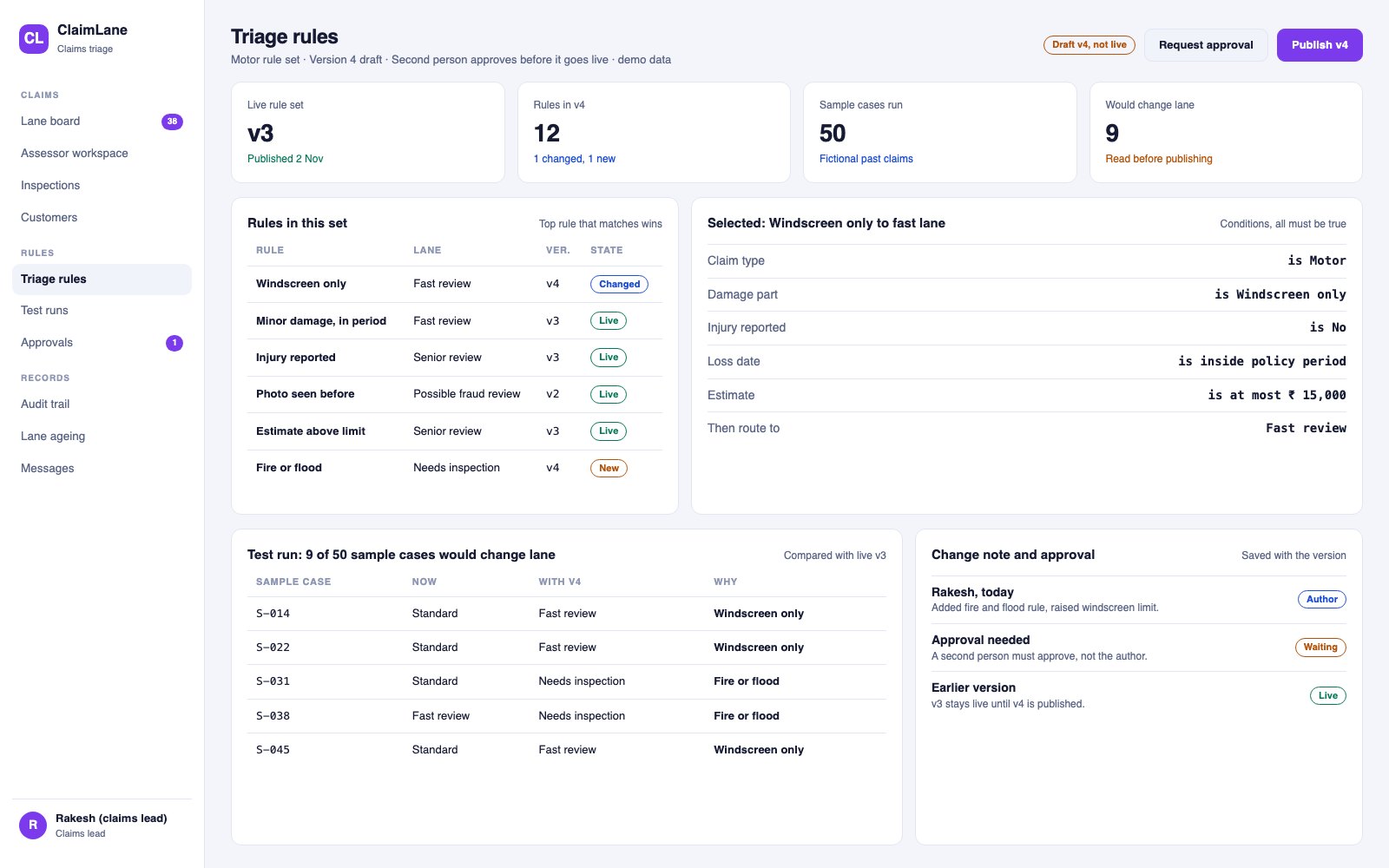
- Let a claims lead write routing rules as versioned data, run them on sample cases, and publish only after a second person approves.
- Show every open claim in a lane with its age, owner, next action and the rule version that placed it there.
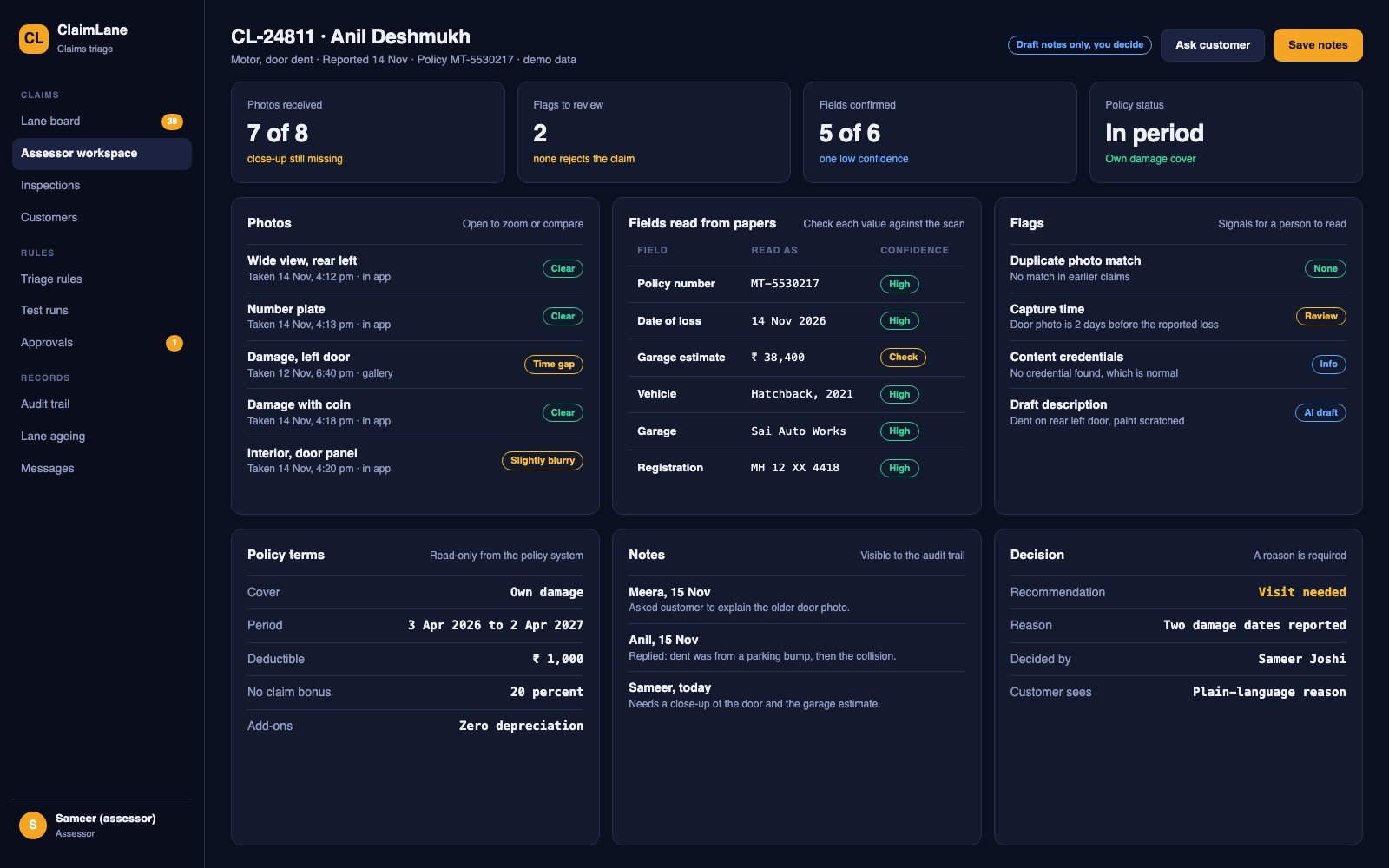
- Give the assessor one workspace with photos, fields read from papers, policy terms, flags, notes and a decision form that requires a written reason.
- Show the customer a secure status page, with messages by WhatsApp, SMS or email, that keeps working on a weak network.
- Keep an append-only audit trail of uploads, flags, rule versions, views and decisions, and limit each role and each insurer to its own cases.
The Engineered Solution
1Evidence captured at the start
The app walks the customer through wide, close, number plate and scale-reference shots, and checks blur and brightness before upload. The assessor gets better material and the customer gets fewer follow-up requests.
2Rules a person can read
Routing is a list of written conditions, each with a version. Every claim stores the version it ran under, so the team can explain a past move and test a change before it goes live.
3One screen for the assessor
Photos, extracted fields beside the source image, policy terms, flags and notes sit together. A drafted description is labelled as a draft, and the decision form asks for a reason.
4A customer who is never left guessing
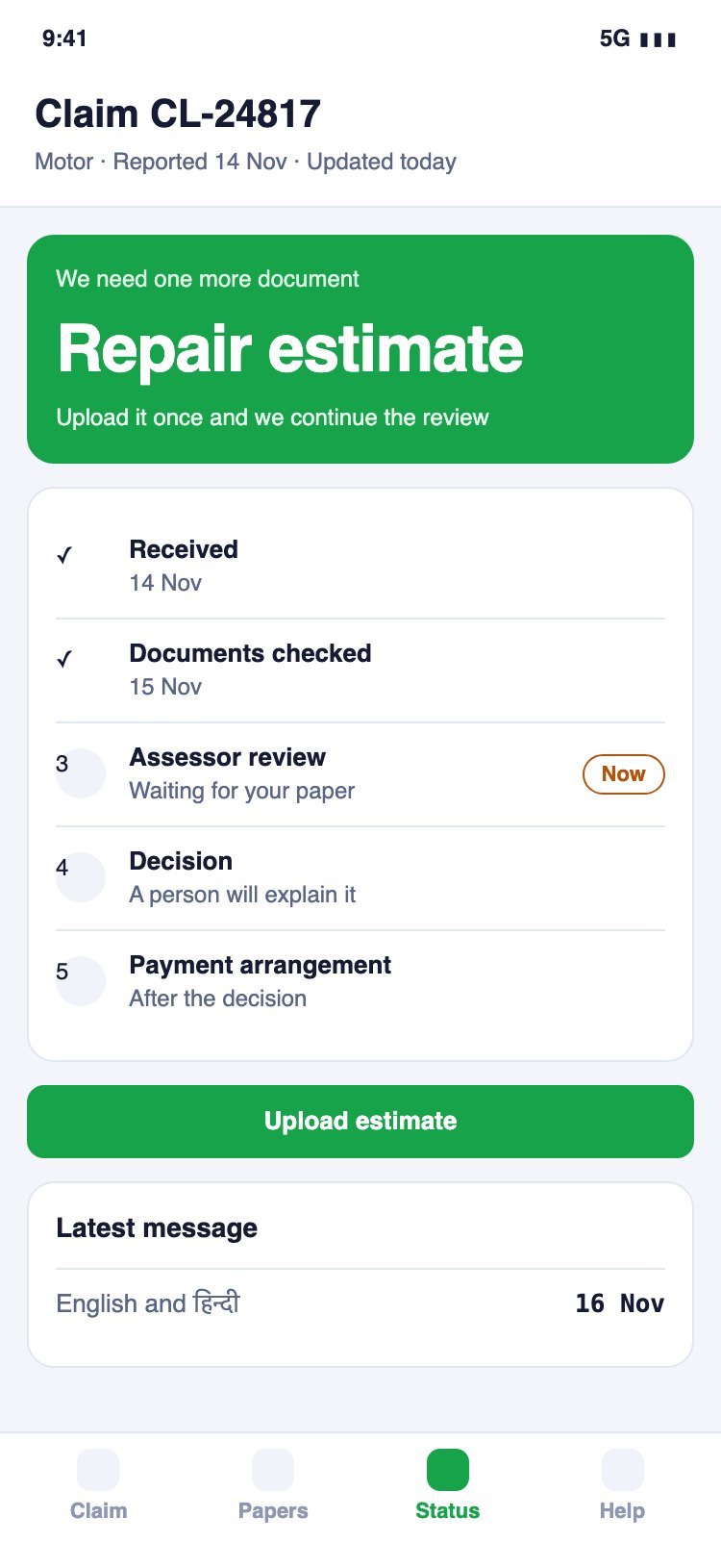
A secure link and the app show the current step, the one thing still needed and who to contact. Messages go out in the customer's language and the page is light enough for low-end phones.
Design Concept Screens
Design concepts with fictional demo data. They show how the product could look and work, not a live release.
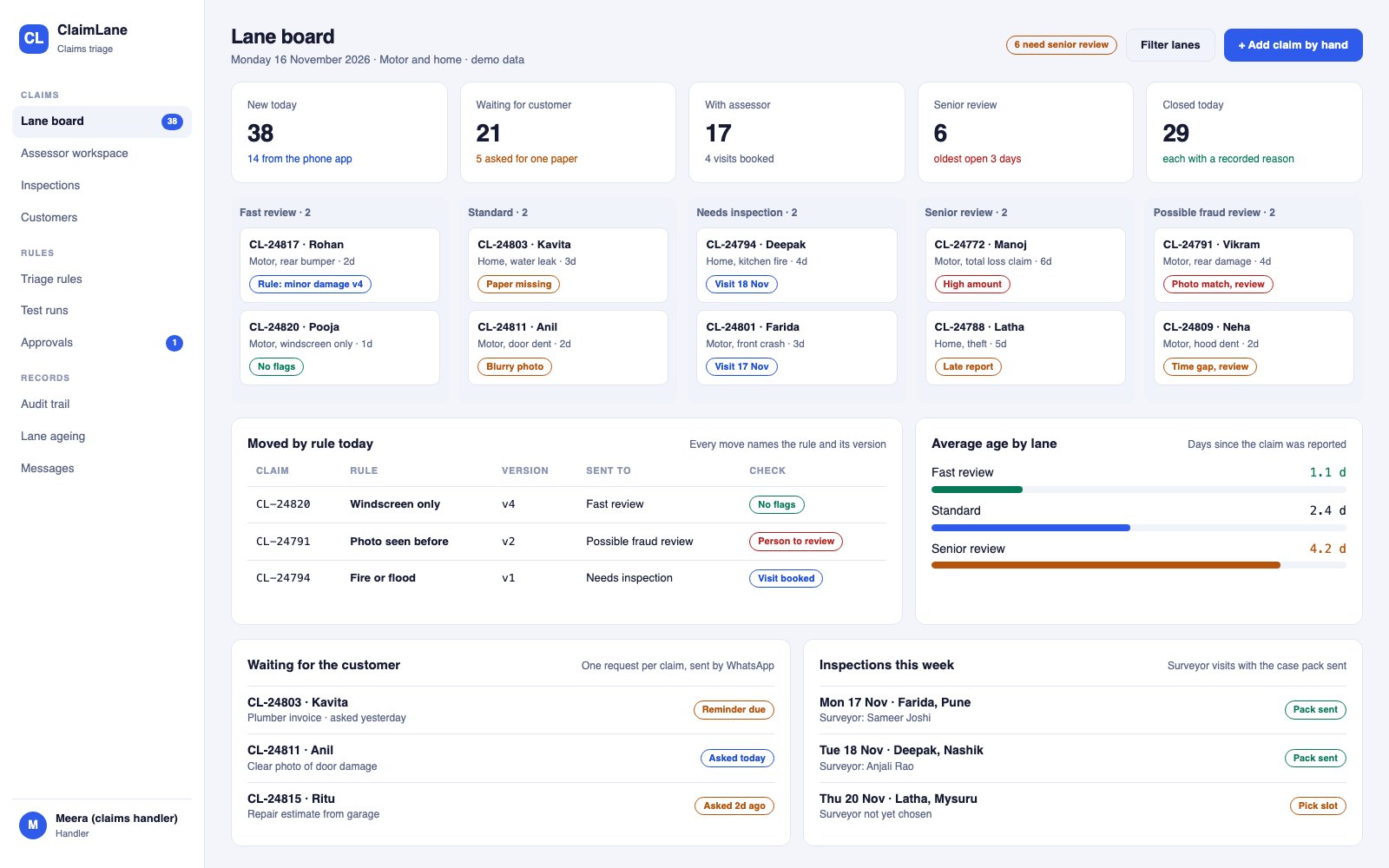
01 / 05 Lane board - see every new claim in its lane, with the rule that put it there and what it waits for
Engineering Process
- Map the insurer's claim types, papers, lanes and hand-offs with handlers, assessors and surveyors, using their own forms and call notes.
- Model the data: claims, evidence items, extracted fields, rule sets with versions, decisions and an append-only audit table, with access limited per insurer.
- Prototype the capture flow, lane board, assessor workspace and rules screen, and test them with claims staff on sample cases first.
- Build the claims API, evidence storage with malware scanning and the customer capture app with an offline upload queue.
- Build the document reading and photo checks, then the rules builder with test runs and second-person approval.
- Connect read-only policy lookup and the messaging providers, then add the surveyor field app with offline notes.
- Test uploads under heavy load and on weak networks, review security with the insurer, and pilot on fictional or anonymised cases with a design partner.
Production Tech Stack
| Layer / Component | Production Technologies |
|---|---|
| Web console | Next.jsTypeScriptTailwind CSSshadcn/uiTanStack TableOpenSeadragon image viewer |
| Mobile apps | Expo (React Native)expo-camera with a framing guideexpo-sqlite upload queue |
| Backend | Node.js with TypeScript (NestJS)a JSON rules evaluatorTemporal for long-running claim steps |
| Documents and images | Python FastAPI serviceAmazon Textract or Google Document AIperceptual hashingC2PA libraries |
| Data and security | PostgreSQL with row-level security per insurerRedis queuesClamAV scanningClerk or Supabase Auth with SSO |
| Cloud | AWS Mumbai region with S3 presigned uploadsECS FargateTerraformGitHub Actions |
What the design aims for
ClaimLane aims to steer each loss report to the right reviewer through readable routing rules, with evidence, flags and a written reason attached for a named person to decide.