ChargeGrid
An Operations Platform for EV Charging Networks: Secure Chargers, Sessions, Tariffs and Faults
A concept study: we worked up this product, its architecture and its screens as an example of how we would approach it. The screens use fictional demo data and are design concepts, not screenshots of a live product, and this is not a client project.
About the Project
ChargeGrid is a design concept for the back office of an electric vehicle charging network. A charge point operator, a mall group or a fleet depot would see every charger on one live console: which are free, which are charging, which have a fault and which have gone quiet. The platform talks to chargers in the Open Charge Point Protocol (OCPP), the common language chargers use with a back-end system, so units from different makers can sit in one network.
The charger link is treated as an attack surface from the first day. Every charger is registered before it can connect and gets its own credentials over an encrypted link. Unknown identities are refused, a second live connection for the same charger is not accepted, and repeated login attempts are rate limited. This follows the gaps that US Cybersecurity and Infrastructure Security Agency (CISA) advisories described in 2026. The design accounts for them and does not claim to remove all risk.
Money and field work follow the same data. Each session stores the tariff that applied, so the price a driver saw is the price billed. A fault code becomes a ticket, a technician task and a resolution note without retyping. Drivers use one app to find a charger, scan its QR code, see the price before starting and get a receipt. Partner networks reach the same chargers through the Open Charge Point Interface (OCPI).
Why This Matters Now
Market, rule and technology context for this kind of product, checked on 16 November 2026. Each item names its source.
- CISA advisory ICSA-26-188-01 said the Hydro-Quebec charging back end accepted charger WebSocket connections without proper authentication, and the operator disabled OCPP on most stations.CISA, 7 Jul 2026
- CISA advisory ICSA-26-176-02 on a charging management system listed missing WebSocket authentication, no rate limit and predictable session IDs, and the vendor planned OCPP Security Profiles 2 or 3 and one connection per charger ID.CISA, 25 Jun 2026
- Trade site eMobility+ reported that the Ministry of Heavy Industries, BHEL and NPCI are building Unified Bharat e-Charge, an open layer so drivers can reach many charging networks from one app, with OCPI as one integration route.eMobility+ (trade press), 13 Jul 2026
- Business Standard, relayed by electrive, reported that the Ministry of Heavy Industries told the Lok Sabha 6,562 public chargers were sanctioned under PM E-DRIVE but none were installed as of 22 July 2026.electrive, 5 Aug 2026
- The Open Charge Alliance published OCPP 2.1 edition 2 and OCPP 2.0.1 edition 4, with the 2.1 edition adding certification profiles and test cases.Open Charge Alliance, 4 Dec 2025
Requirements & Objectives
- Accept charger connections over OCPP 1.6J and 2.0.1, with TLS, per-charger credentials and an allow-list of registered charger identities.
- Show every charger on a live map and list with one of four states: available, charging, faulted or offline.
- Record each session with start, end, energy from meter values, the tariff applied, the driver and the payment state, and hold uncertain sessions for review instead of billing them.
- Let commercial staff set tariffs by site, connector type, time of day and idle-time fee, with a start date and a preview of what drivers will see.
- Turn fault codes into tickets with severity, site, technician, history and a resolution note.
- Let staff send reset, unlock, availability and configuration commands to a charger, with every command logged by person and time.
- Give drivers an app to find chargers, see price and availability, start by QR code, pay by UPI or card, and read a receipt.
- Record sessions from partner networks through OCPI and reconcile them in a monthly settlement report.
The Engineered Solution
1A gateway that only knows registered chargers
A connection gateway ends each charger link, checks its identity and credentials, and allows one live connection per identity. Rate limits and alerts flag repeated attempts from unknown identities.
2Sessions priced from stored tariffs
Raw messages are kept, energy is computed from meter values with sanity checks, and billing is idempotent so a replayed message cannot charge a driver twice. Odd sessions wait in a review queue.
3One path from fault to fix
A fault code opens a ticket with the charger, site and recent messages attached. A controller can try a remote reset, then assign a technician whose phone shows the charger history and takes the closing note and photo.
4Standards at both edges
OCPP faces the chargers and OCPI faces partner networks. The console, driver app and partner API read the same session and tariff data, so roaming sessions and settlement use the records the operator already trusts.
Design Concept Screens
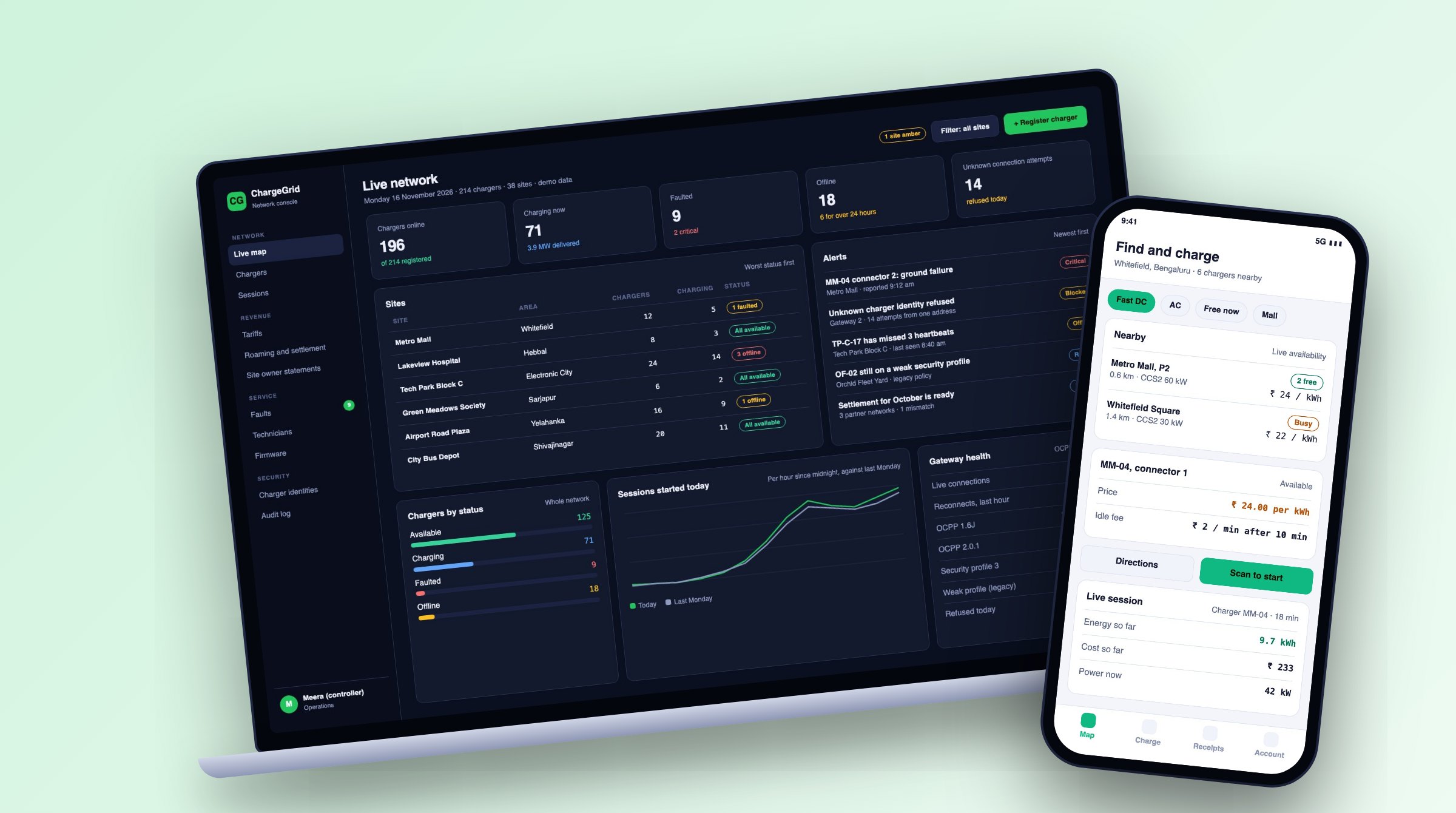
Design concepts with fictional demo data. They show how the product could look and work, not a live release.
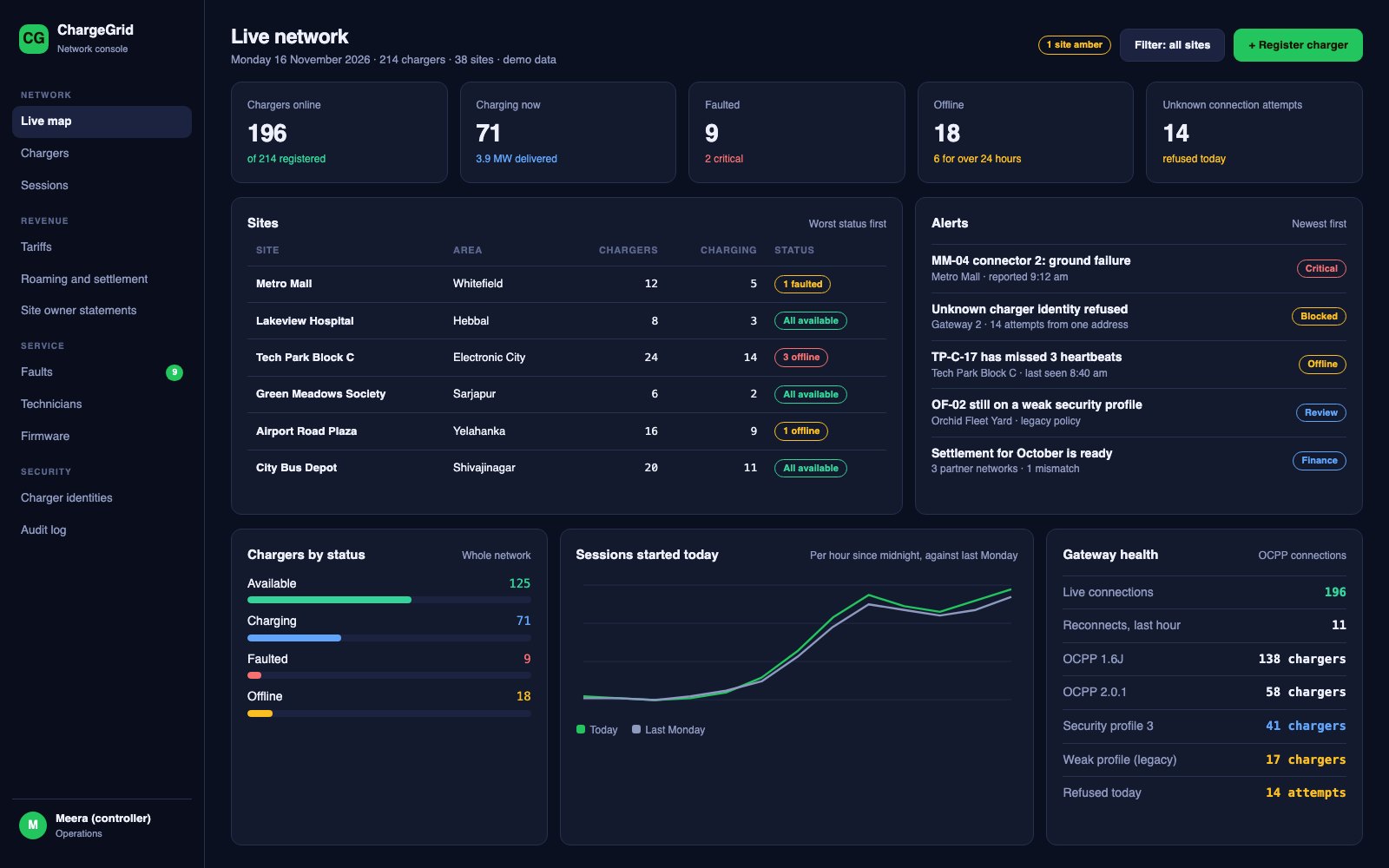
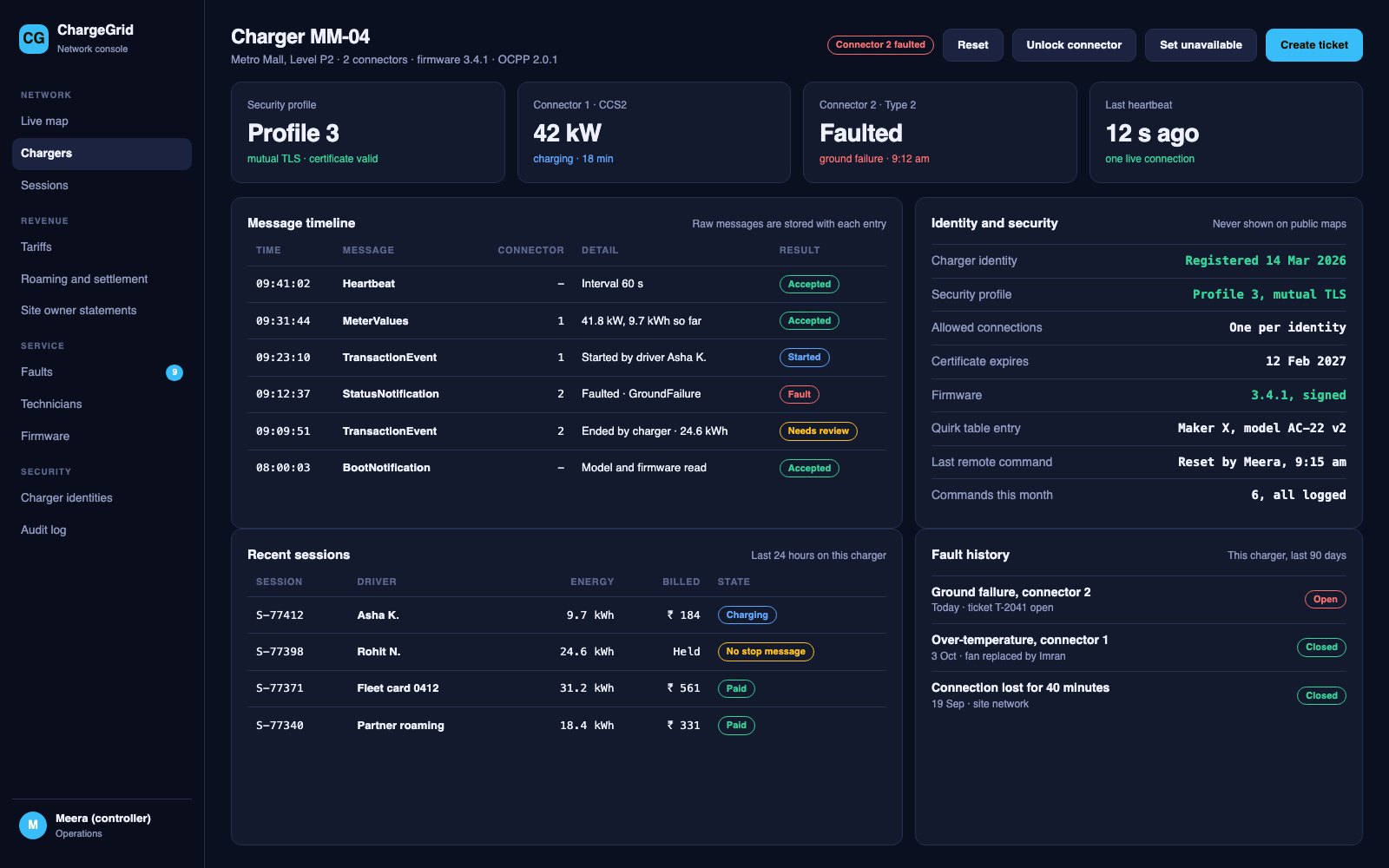
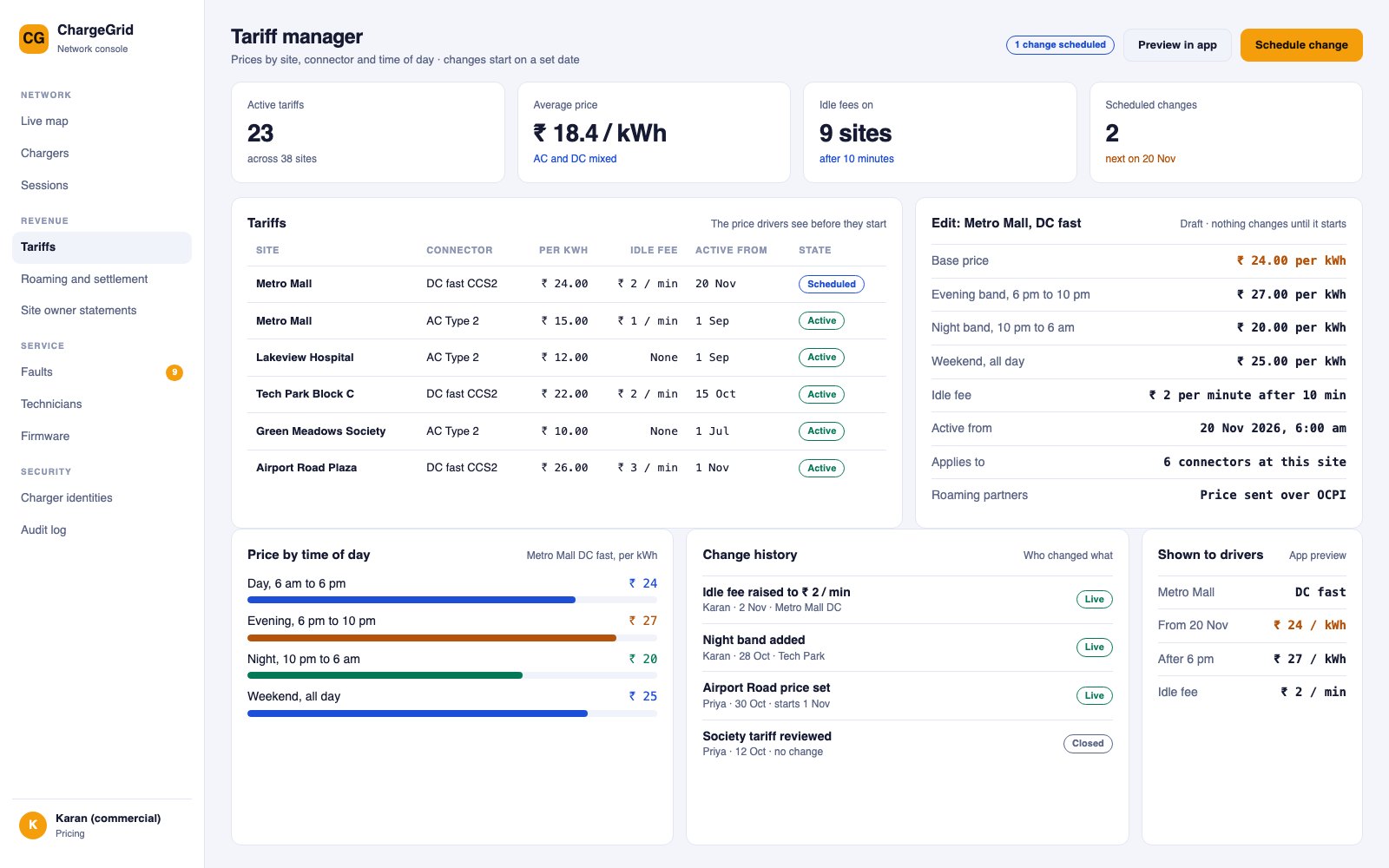
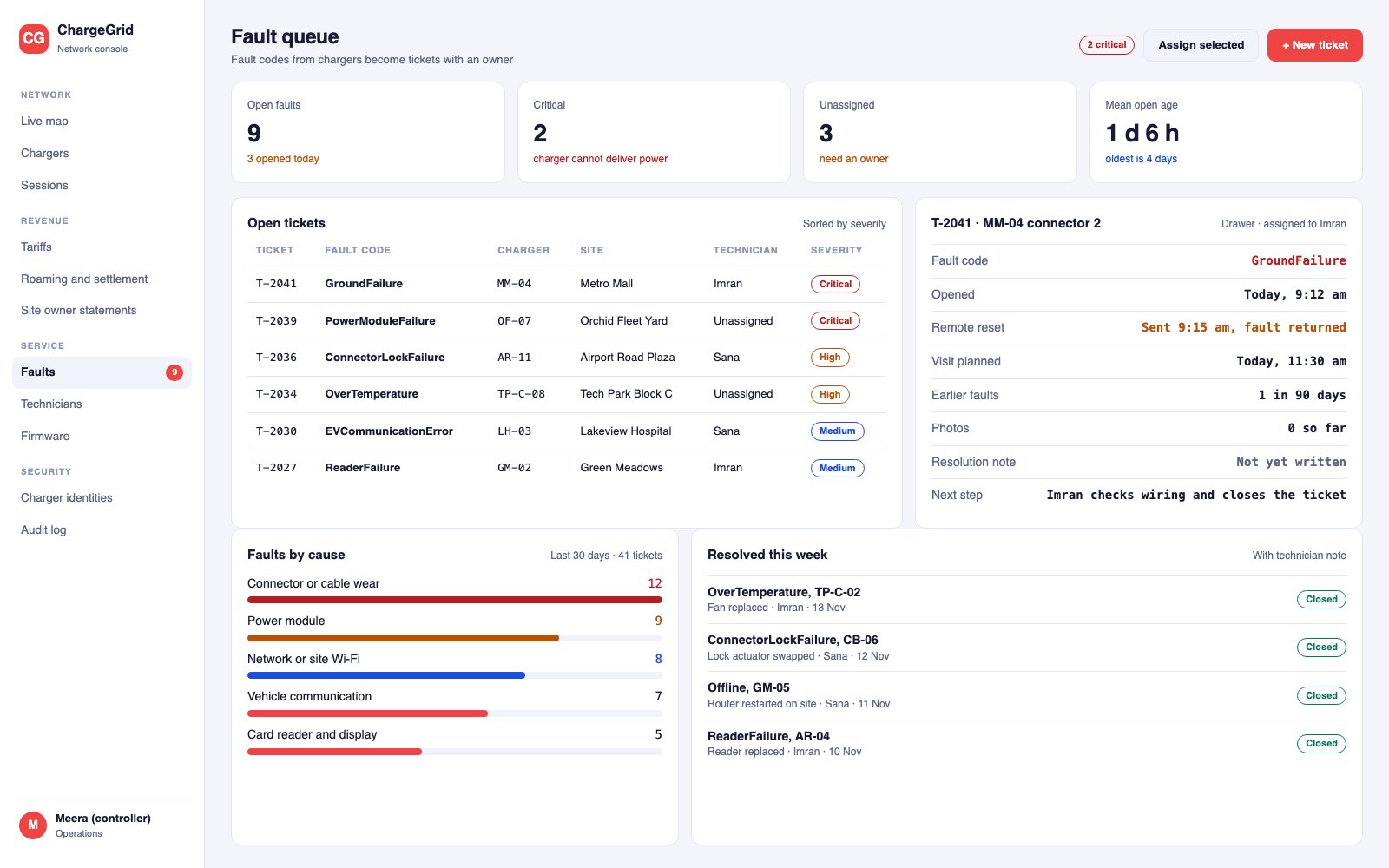
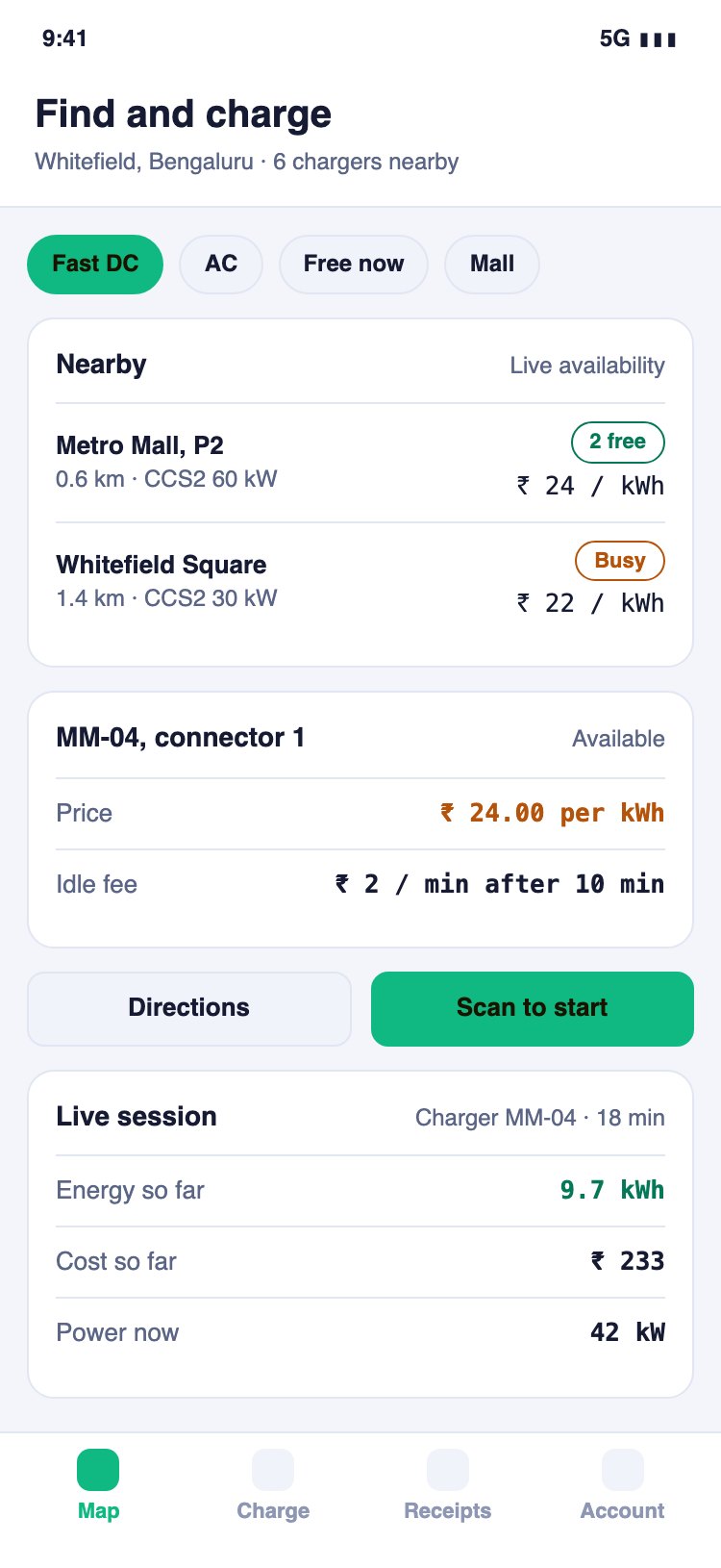
01 / 05 Live network - see every site and charger status, the newest alerts and the health of the charger connections
Engineering Process
- Map the operator's real day with controllers, technicians, finance staff and site owners, including how they hear about a fault today.
- List the charger models in the field and collect test units, so the gateway can handle each maker's quirks from the start.
- Build the OCPP gateway with security profiles, the charger registry and a charger simulator that replays recorded message traces.
- Prototype the live map, charger detail, tariff and fault screens and test them with controllers on simulated outages.
- Build the driver app with QR start, payment and receipts, and add technician mode with offline notes and photo upload.
- Add OCPI roaming and settlement, then run reconnect storms, load tests and a security review against the gateway.
- Write runbooks, train the operations team and roll out site by site, starting with a few chargers.
Production Tech Stack
| Layer / Component | Production Technologies |
|---|---|
| Operations console | Next.jsTypeScriptTailwind CSSshadcn/uiMapLibre GL JSApache EChartsServer-Sent Events |
| Driver and technician app | React Native with Expopush through Firebase Cloud Messaging and Apple Push Notification service |
| Charger gateway | GoOCPP 1.6J and 2.0.1 over secure WebSockets |
| Services and messaging | NestJS (Node.jsTypeScript)Apache KafkaRedis for live charger state |
| Data | PostgreSQL with the TimescaleDB extension for meter values and status history |
| Cloud and operations | Amazon EKS in the Mumbai regionTerraformGitHub ActionsPrometheusGrafanaOpenTelemetrySentry |
What the design aims for
ChargeGrid aims to trace every charging session and fault back to a charger that the network registered and authenticated, from the first connection message to the technician's closing note.