Taking orders on WhatsApp costs a little more to run than it did in September, but for a small shop Meta's fee is not the big cost. From 1 October 2026, per Meta's pricing page, Meta charges for service messages beyond 1,000 free per business phone number each month, and for utility templates sent while a chat window is open. In the worked example below, a shop with 30 orders a day pays about Rs 720 a month to Meta, GST included. The larger cost is the person retyping each order into a billing sheet. This post covers what Meta charges, which messages an order flow needs, and when to build, buy or stay manual. The rules come from Meta's own pages. The rupee rates come from a trade source, so treat them as a guide and check them against your rate card.
Why do WhatsApp orders break at around 30 a day?
Orders arrive as chat: a photo of a handwritten list, a voice note, a message that says "same as last time". Someone reads each one and retypes it into a billing or stock sheet. Say that takes three minutes an order. That figure is our assumption, not a measurement. At 30 orders it is 90 minutes a day, and the errors start to show.
- You ask the customer to repeat what they ordered.
- The stock count is wrong by the end of the day.
- Two people answer the same customer, or nobody does.
- Nobody can say which orders are paid and which are not.
Thirty is a rough guide from general practice, not a measured limit. A shop with simple, repeat orders can go well past it. A shop with custom items and three people sharing one phone may break at ten.
What does Meta charge for WhatsApp messages now?
Meta sorts every message into one of four categories. Marketing, utility and authentication are template messages. Service is any other message, and a business can send it only while a customer service window is open. That window is a 24-hour timer that starts when the customer messages you and resets each time they write again.
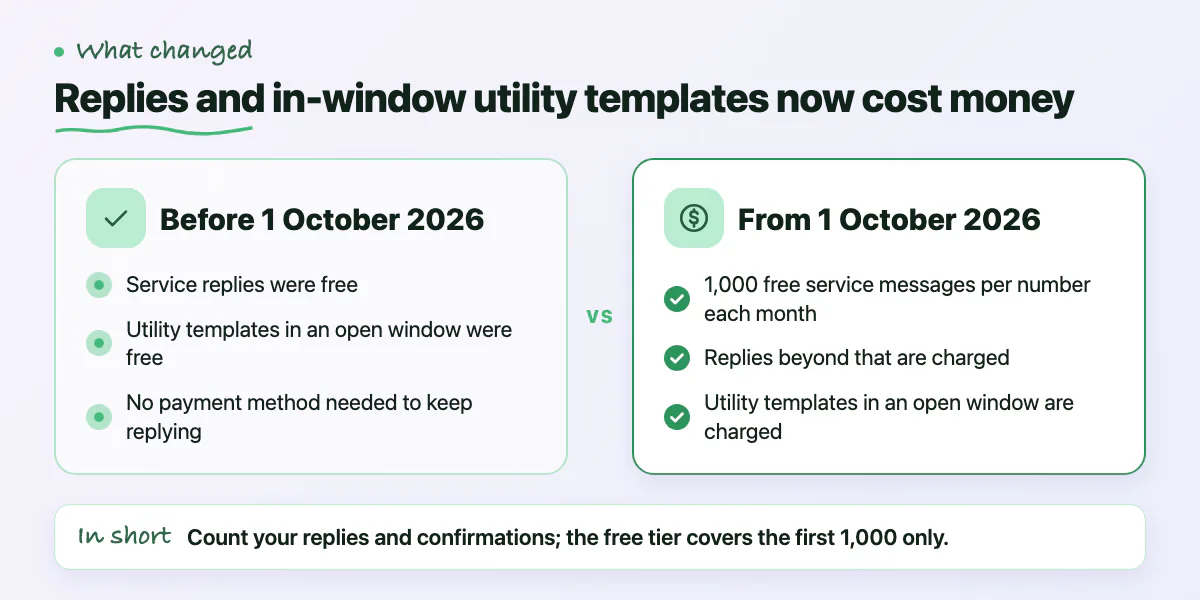
Meta's pricing page says what changed on 1 October 2026:
- Service messages, free since 1 November 2024, are charged again. Each business phone number gets 1,000 free service messages a month. The count resets monthly and unused messages do not roll over.
- Utility templates sent inside an open window, free since 1 July 2025, are charged.
- Messages sent in a free entry point window are not charged. This is the window that opens when a customer messages you from a Click to WhatsApp ad. Meta's pages state its length differently (72 hours on the WhatsApp Business site, up to 7 days on the developer pricing page), so read the current page.
- Meta's page says that solution providers and directly connected businesses without a payment method on file by 30 September 2026 have service messages stopped when charging begins.
India-based customers also have an INR deadline. Meta's page says eligible customers must move all messaging accounts to INR billing by 31 December 2026, and from 1 January 2027 Meta stops delivering messages from their non-INR accounts.
For rates, we used a trade source that says it checked Meta's rate card on 2 November 2026. It lists Rs 0.115 for a service message after the free tier, Rs 0.115 for utility and Rs 0.8631 for marketing. All three exclude GST and your provider's fee. The source also says Meta bills Indian accounts with 18% GST. Ask your accountant how GST applies to you.
Here is a worked example. Assume 30 orders a day for 30 days, so 900 orders a month. Assume six free-form replies per order and one order-confirmation utility template sent inside the window. These are our assumptions.
- Service messages: 900 times 6 is 5,400. After 1,000 free, 4,400 are charged at Rs 0.115, which is Rs 506.
- Utility templates: 900 at Rs 0.115 is Rs 103.50.
- Total before GST: Rs 609.50. With 18% GST: about Rs 720 a month.
Before 1 October the same traffic cost nothing in Meta fees. Your provider's monthly fee and per-message markup come on top, and they vary a lot, so ask for them in writing.
Which messages does an order flow need?
Every message you send now has a price, so send the ones that remove a support question and skip the rest.
- Needed: replies while the customer is chatting (service). They are free up to 1,000 a month, then charged.
- Needed: an order confirmation with the order number. Sent inside the window it is a utility template and is charged.
- Needed: status updates at the steps the customer cares about, such as packed, dispatched and delivered. Once the window has closed, Meta says template messages are the only type you can send, so these must be approved templates.
- Needed: an invoice link, with the UPI QR code if you take payment that way. See our post on UPI QR codes on invoices.
- Optional: offers and reminders. These are marketing templates, the highest rate, and they need opt-in. Keep them away from order updates.
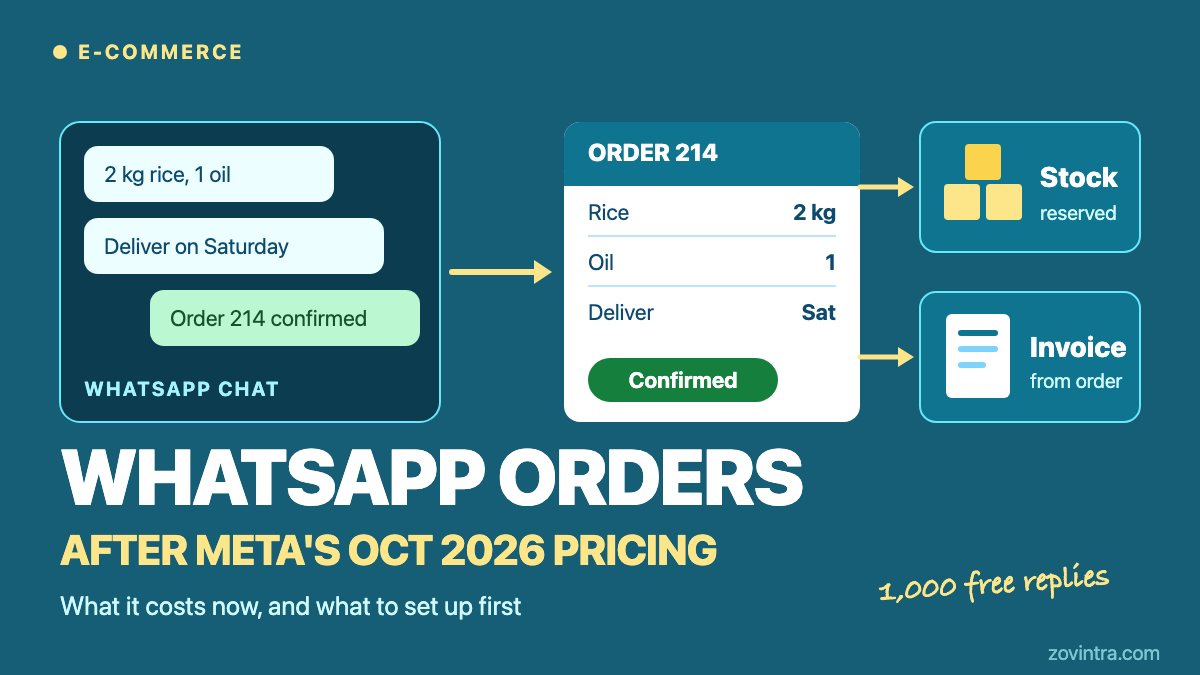
How does a chat become an order record, with stock and billing in step?
This part is general engineering practice, not a Meta rule. The aim is that nobody types an order twice.
- Let the customer write freely. Do not force a form.
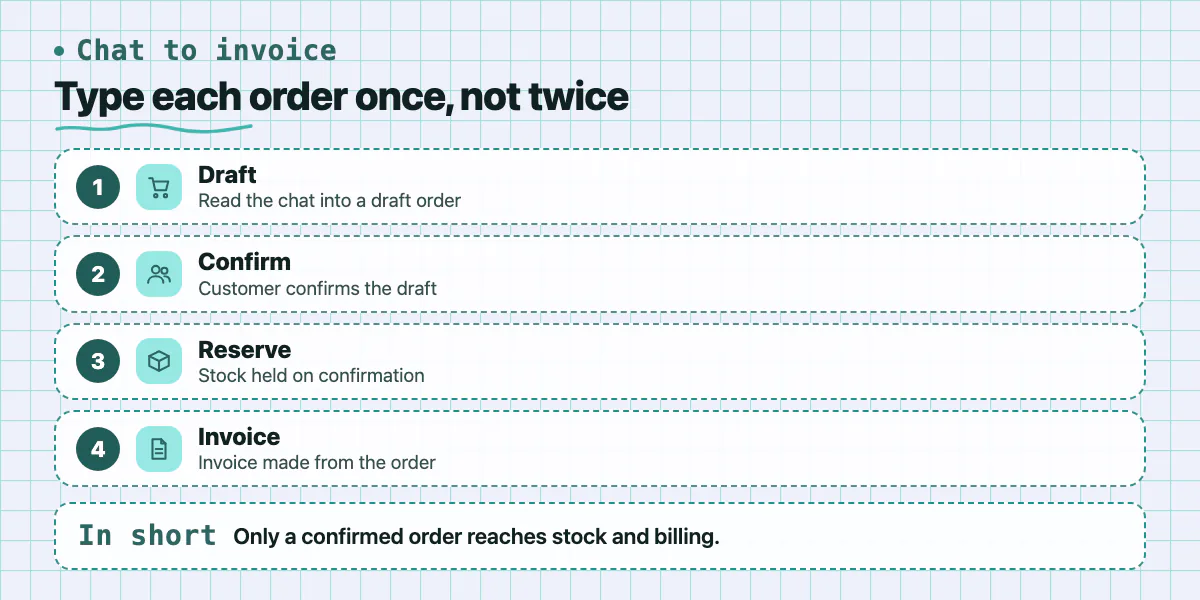
- Read each message into a draft order: customer number, items, quantities, address, delivery date and a reference to the original message.
- Send the draft back and ask the customer to confirm. Only a confirmed order counts.
- Reserve stock when the order is confirmed. Deduct it when the order is dispatched.
- Create the invoice from the order, so the invoice carries the order number. Our post on GST-ready invoice fields lists what an Indian invoice must capture.
Use the WhatsApp message ID as the key for the draft. Webhooks can arrive twice, and without a key the same order is created twice. Store only the data you need, and keep consent records with the customer number. Our DPDP checklist for small apps covers the data side. For a worked example of invoicing built into a product, see our Mandizo case study.
Should you build, buy a provider tool or stay manual?
The thresholds below are our rough guide, not measured limits. Your order mix matters more than the count.
- Stay manual: under about 10 orders a day, one person handles the phone, and mistakes are cheap. Add a shared order sheet and a saved-reply list.
- Buy a provider tool: about 10 to 30 orders a day with standard products and normal billing. Ask each provider for the monthly fee, the markup on Meta's rates, who holds the payment method, and whether you can export your chats and customers.
- Build or integrate: above that, or when stock rules, price lists or billing are unusual, or when the order must reach software you already use. A provider tool that cannot write to your stock system just moves the retyping.
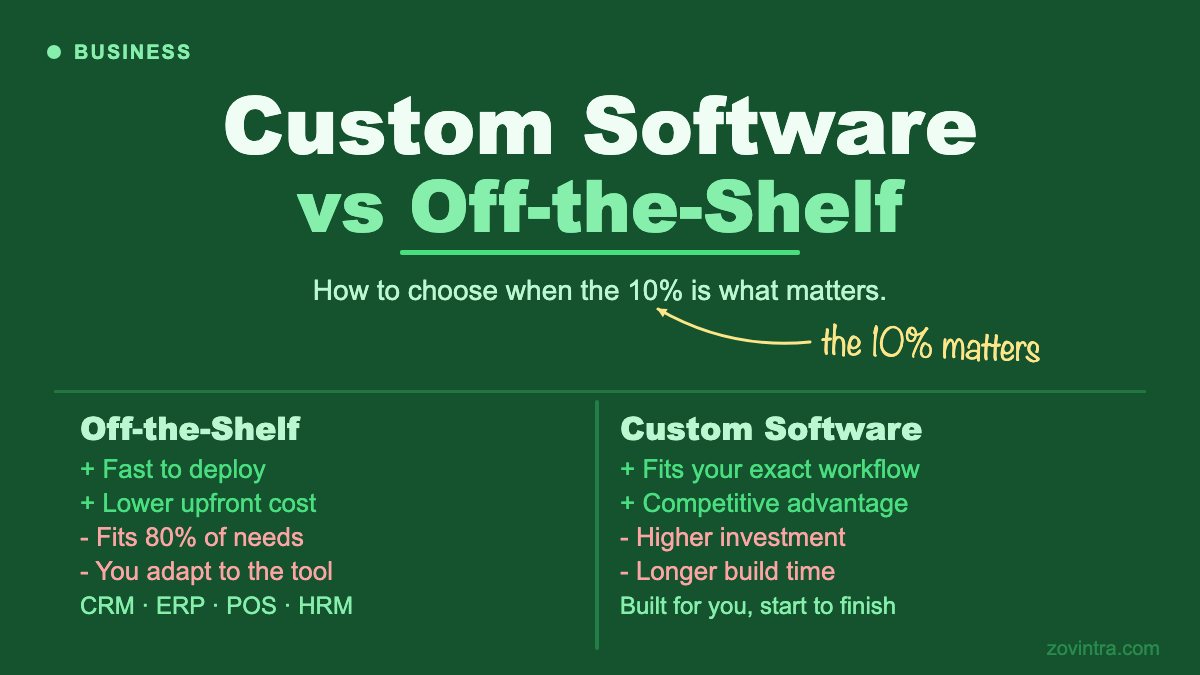
Our posts on build versus buy and custom versus off-the-shelf software explain how to weigh the choice.
What should you set up before you launch?
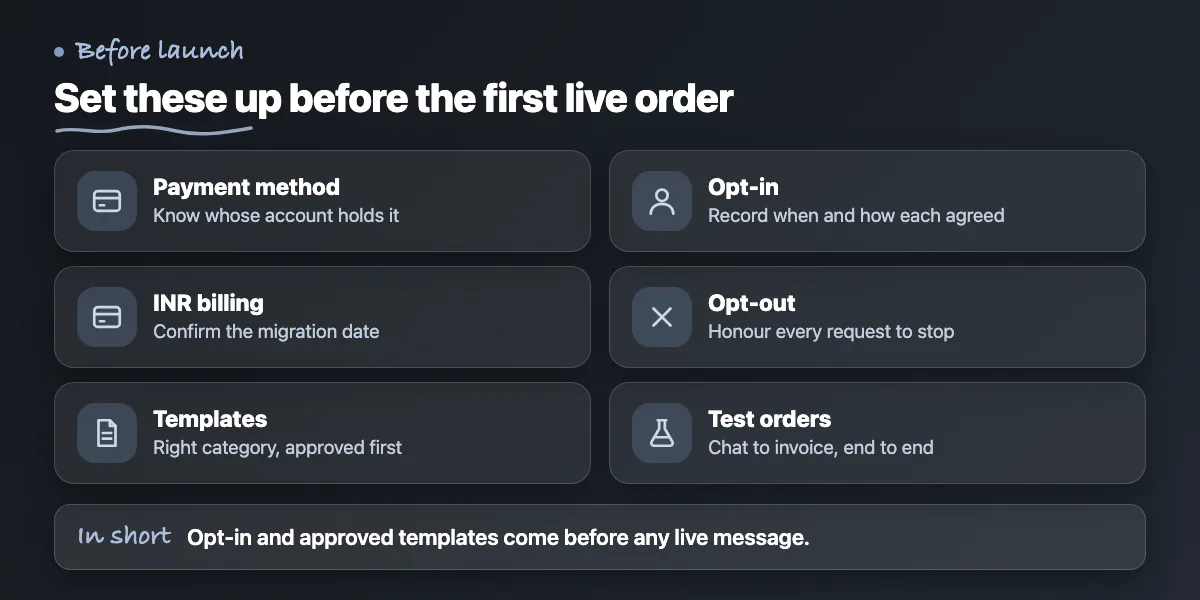
- Payment method: confirm which account holds it, yours or your provider's.
- INR billing: confirm the migration date with your provider.
- Templates: create order confirmation, dispatch and delivery templates. Meta reviews templates when you create or edit them, only approved ones can be sent, and their status can change later.
- Categories: pick the right category for each template, because the category sets the price.
- Opt-in: Meta's business messaging policy says you may contact a person only after receiving their opt-in, and that you decide how to collect it and must meet applicable law. Record when and how each customer agreed.
- Opt-out: honour every request to stop, and record it.
- Budget: set a monthly message estimate and review it after the first month.
- Test: run ten real orders from chat to invoice before you tell customers.
When can you skip this?
If you send fewer than 1,000 free-form replies a month, the new service charge does not apply to you, though utility templates in the window are still charged. If you handle a handful of orders a day and enjoy the chats, manual is fine. Meta's pricing page is part of its developer documentation for the Business Platform. We did not find Meta's statement on messages typed in the WhatsApp Business app, so check Meta's Help Center if that is how you work.
Want an order-flow and cost estimate for your shop?
If your orders already outgrow retyping, we can map your message flow, estimate the Meta and provider fees, and scope the order record, stock and billing steps. Request an estimate or read how we handle custom software and integrations.
Common questions
Are WhatsApp service messages free now?
Partly. Meta gives each business phone number 1,000 free service messages a month, and the count resets monthly. From 1 October 2026 messages beyond that are charged. A trade source lists Rs 0.115 per message, before GST and provider fees. Messages in a free entry point window are not charged.
What happens if I have no payment method on file?
Meta's page says solution providers and directly connected businesses without a payment method by 30 September 2026 have service messages stopped once charging starts. If you use a provider, ask who holds the payment method. If you connect directly, add one in your Meta account and test a reply.
Do I need my customers' permission before messaging them?
Yes. Meta's messaging policy says you may message a person only after receiving their opt-in, and you must honour opt-outs. You choose how to collect consent, and it must meet applicable law. Meta recommends separate consent for each message category. This is not legal advice.
Sources
- WhatsApp Business Platform pricing
- Updates to pricing
- Template fundamentals
- WhatsApp Business Messaging Policy
- WhatsApp Business API pricing in India
Building something similar?
Talk to our engineering team about your architecture, roadmap, and delivery timeline.
Request a Technical Review →
We design, engineer, and deploy high-performance web platforms, mobile applications, and intelligent cloud systems.