AI coding tools do reduce time on some implementation tasks. They do not cut your software quote in half. The gap between those two statements is where founders get burned: they negotiate the price down based on an assumption that was never verified, then receive a product that either cuts corners or runs over budget. This post explains what the evidence says about AI speed gains, which cost components it touches, and which it does not.
The Speed Question Has an Honest Answer: We Do Not Know Yet
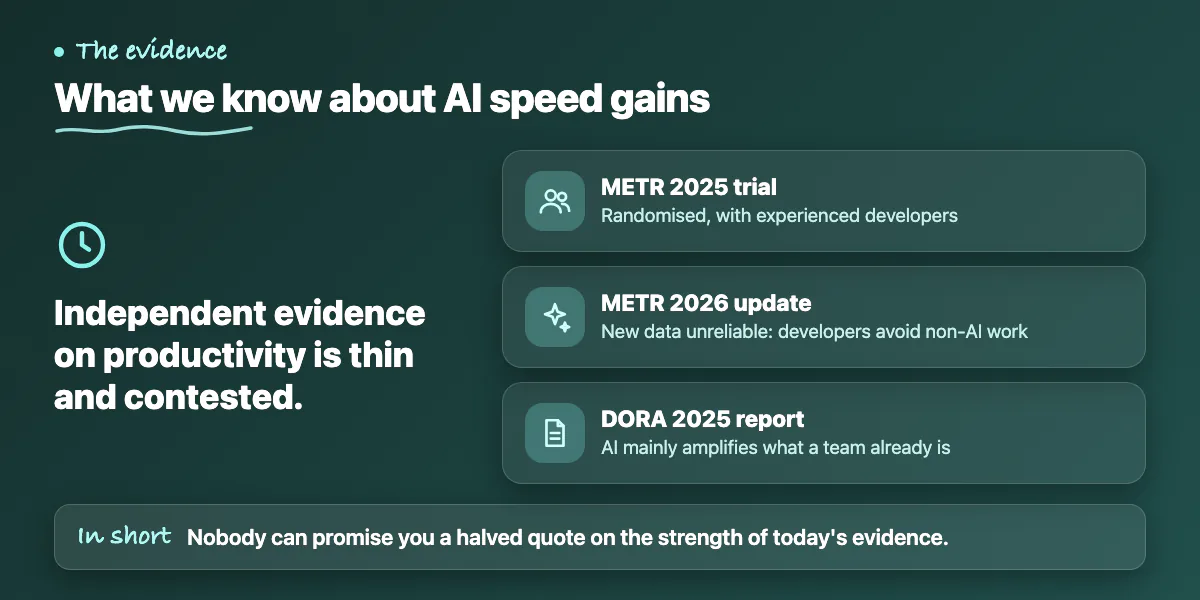
The best independent evidence is mixed. In a 2025 METR trial, experienced open-source developers took longer with AI tools while believing they were faster, and METR's February 2026 update says its newer data is too weak to put a number on the change. No credible group has yet published a blinded measurement of end-to-end delivery speed. Our reading of DORA, METR and the surveys goes through each study.
For a quote, the useful lesson comes from the DORA 2025 report: AI mostly amplifies what a team already does well or badly. Developers also use these tools faster than their employers write policies for them, as IT Brief's report on the Stack Overflow 2026 Developer Survey shows. Tools used without governance are not tools used well.
What Actually Happens in a Typical Software Build
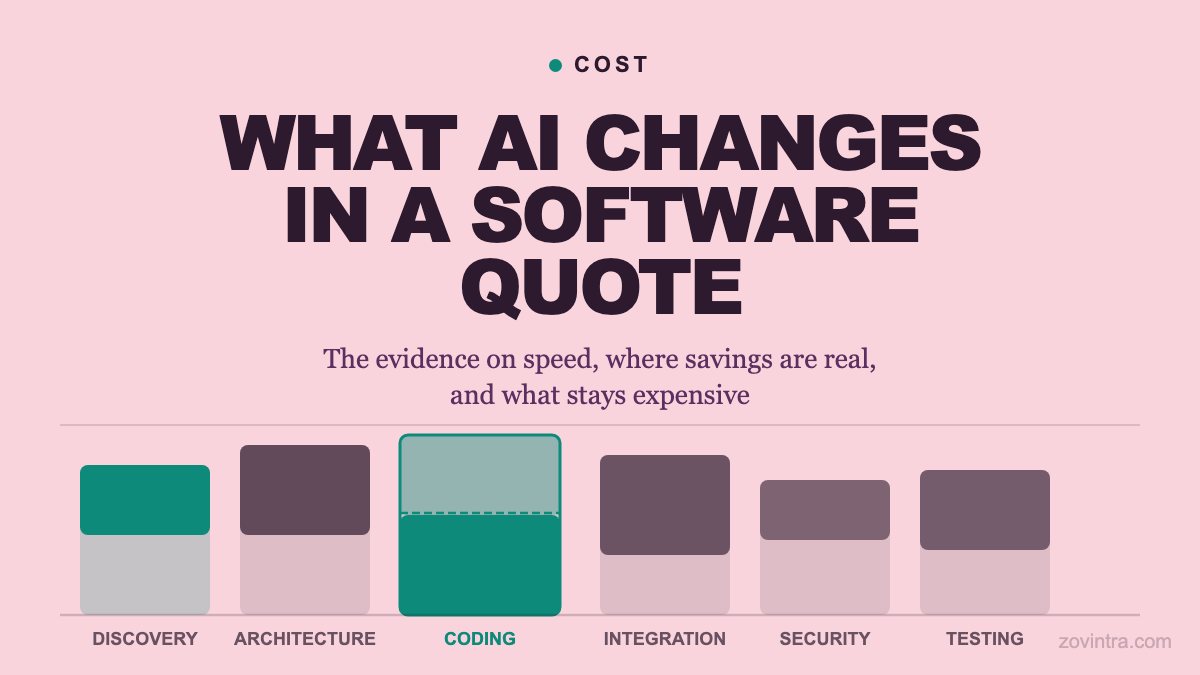
A software project breaks down roughly as follows. These are illustrative ratios, not measured averages, but they reflect how professional teams typically describe their time allocation.
- Discovery and requirements: 10-20% of project effort. AI tools contribute almost nothing here. Understanding what to build, resolving ambiguity with stakeholders, and translating business logic into specifications is human work.
- Architecture and design decisions: 10-15%. Choosing the right database, authentication approach, API structure, and data model requires context that AI tools do not have about your business, your team, and your future plans. Getting this wrong is expensive to fix.
- Implementation of standard patterns: 20-35%. This is where AI coding tools are most helpful. Boilerplate code, CRUD endpoints, standard UI components, and test scaffolding can all be generated faster. This is the component of a quote that may genuinely shrink.
- Integration and debugging: 15-25%. AI-generated code frequently introduces subtle bugs that look correct and fail at the edges. Integration work, where pieces connect to each other and to third-party APIs, still requires careful human attention.
- Security review and hardening: 5-10%. Often underquoted by teams in a hurry. The Veracode 2026 GenAI Code Security Report, found that AI-generated code has an average security pass rate of about 56 percent, essentially unchanged from the previous year. Coding-specific models average 51 percent, against 52 percent for general-purpose models. Nearly half of all AI-generated code fails security checks when produced without security-specific guidance.
- Testing, QA, and deployment: 10-20%. Automated tests help, but writing the right tests, running them in a realistic environment, and verifying edge cases is still labour-intensive.
- Post-launch: ongoing. Bugs in production, performance tuning, and feature changes do not disappear because the code was written faster.
Where You Should See a Price Change
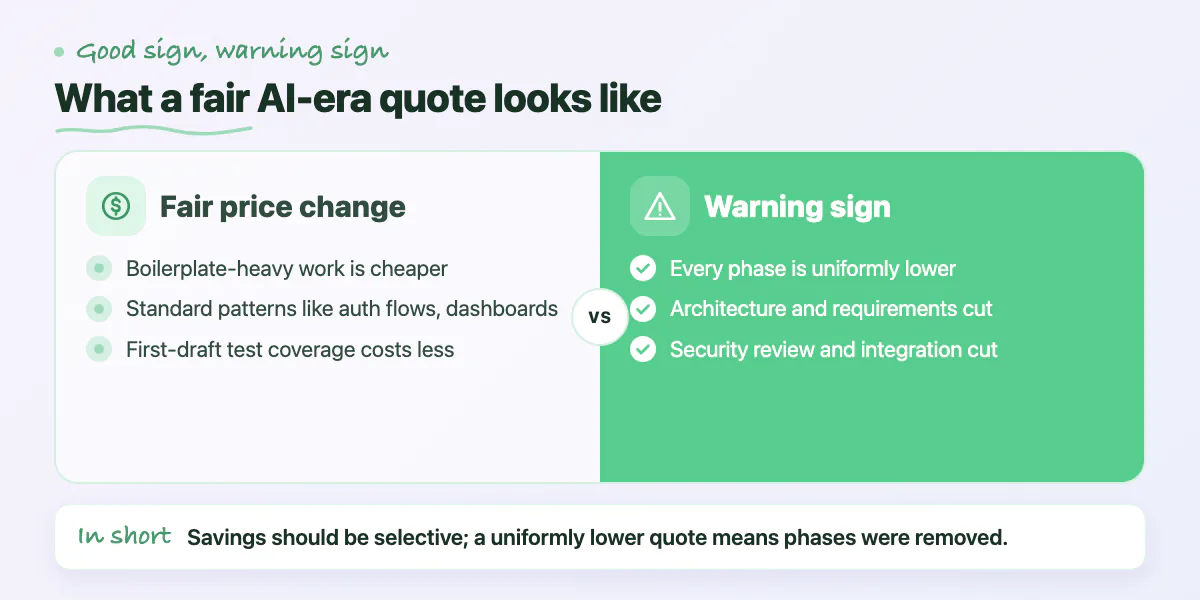
An honest development team using AI tools well should be able to deliver certain things faster. Boilerplate-heavy work, standard patterns like authentication flows or admin dashboards, and first-draft test coverage are reasonable areas where quoting fewer hours is defensible. If you are comparing quotes and one agency is significantly cheaper for these components, that can be legitimate.
What to watch for: a quote that is uniformly lower across all phases, including architecture, requirements, security review, and integration. That is not a productivity gain. It is a sign that those phases have been quietly removed. An AI tool does not think about what happens when two services that each work individually interact incorrectly. That integration debugging time does not vanish.
The Hidden Costs That AI Tools Can Make Worse
A 2026 study published on arXiv (Yue Liu et al., arXiv:2603.28592) analysed 302,600 verified AI-authored commits across 6,299 GitHub repositories. It found 484,366 distinct issues introduced, of which 89.3 percent were code smells. More concerning for long-term projects: 22.7 percent of those issues were still present in the latest version of the repository, meaning they had not been caught or cleaned up. The study found that between 7.5 and 14.8 percent of each AI assistant's commits introduced at least one issue.
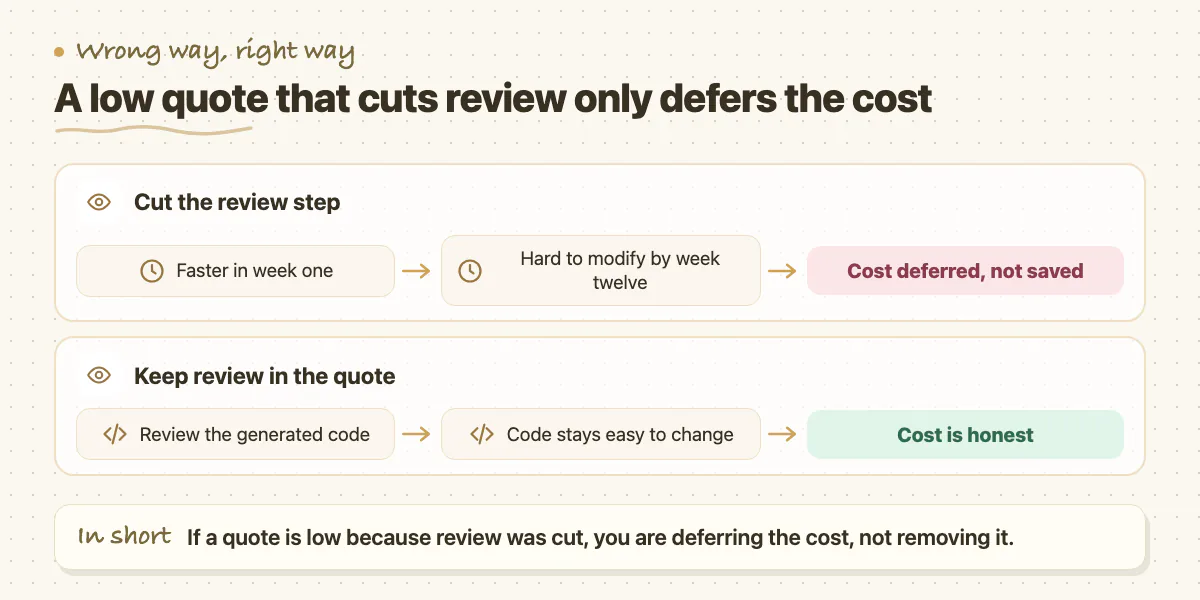
This does not mean AI tools are bad. It means that generated code needs review, and review takes time. A team that moves faster in week one but produces code that takes two hours to understand and modify in week twelve has not saved money. If a quote is low because the review step has been cut, you are deferring that cost, not eliminating it.
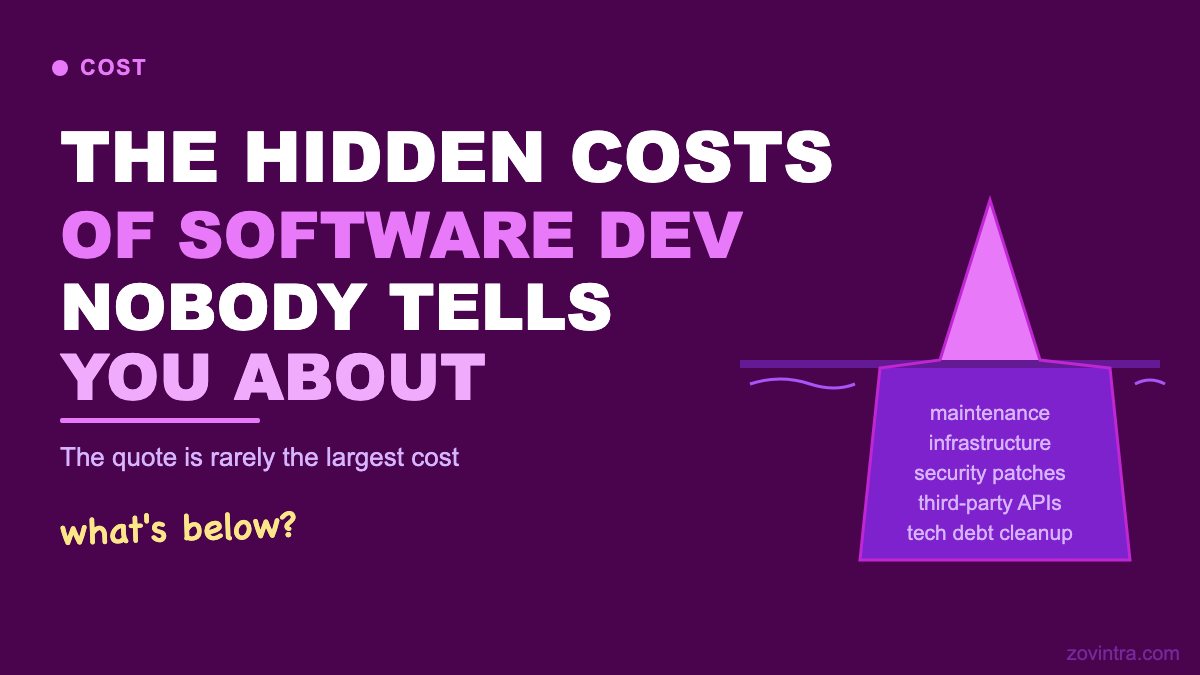
The hidden costs of a software project rarely appear in the original quote. Maintenance overhead from technical debt is one of the most common ones. AI-assisted development does not automatically reduce that risk and, in teams without strong review culture, can increase it.
Questions to Ask Before Accepting a Quote
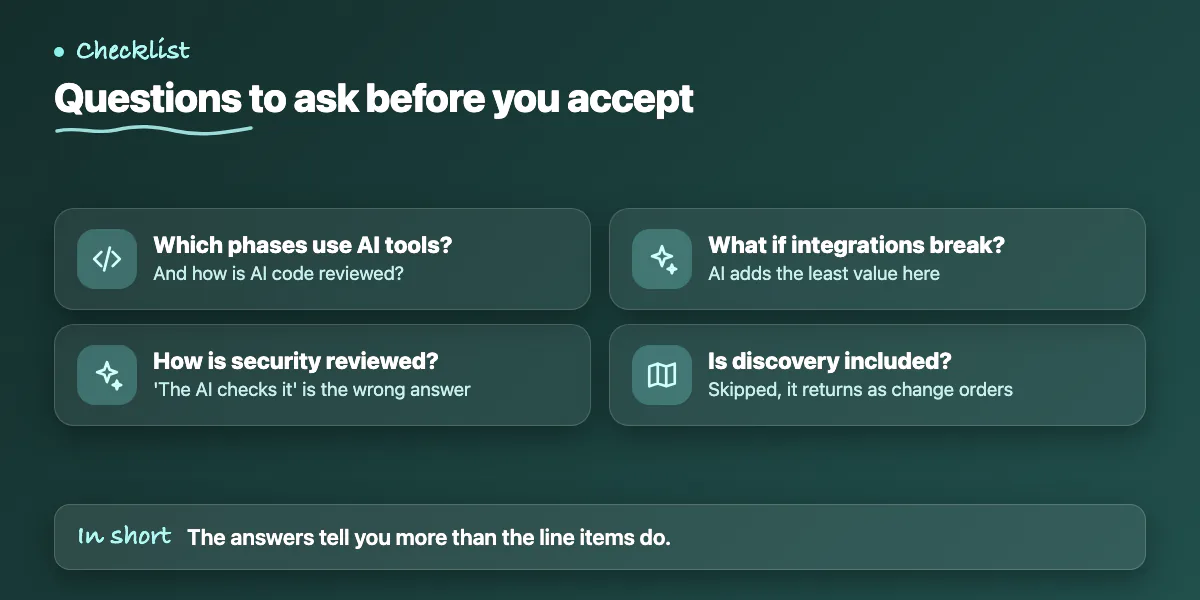
When you receive a software development quote, the following questions will tell you more than the line items themselves.
- Which phases are using AI tools, and what does the review process look like for AI-generated code? A team that generates code and ships it without review is moving fast toward a problem.
- How is the security review handled? If the answer is 'the AI checks for it,' that is the wrong answer. In Veracode's 2026 report the highest-scoring model passed 68 percent of security tasks, so even the best result leaves a third unpassed.
- What happens when integration points break? This is where AI tools add the least value and where estimate accuracy matters most.
- Is the time for requirements and architecture included? If a quote starts at 'implementation' and skips the phase where you decide what to build, you will pay for discovery later, often at a change-order rate.
- What does handoff look like? AI-assisted codebases that were built fast but without documentation can be difficult for a new developer to maintain. Ask for examples of past codebases and, if possible, have a technical person review a sample.
What a Reasonable Quote Looks Like in 2026
AI-assisted development, done well, may reduce implementation time by a meaningful amount for certain kinds of work. A team that is honest about this might quote 10 to 20 percent less on implementation-heavy phases compared to a fully manual workflow, while keeping architecture, integration, security review, and project management at realistic levels. A quote that is 40 or 50 percent lower across the board is either cutting phases you need or working on assumptions that are not backed by evidence.
The other thing to understand is that speed and cost are not the same. A faster team costs less only if the outcome is the same. If speed comes from skipping review, you are buying a different product.
If you are at the stage of comparing quotes and want to understand what is realistic for your scope, the project planner walks through the main cost drivers and gives you a structured way to compare what different teams are actually quoting for.
The Honest Summary
AI coding tools are genuinely useful and are now part of professional software development. Independent measurement of their productivity impact is incomplete and contested as of October 2026. The components of a project where they help most, standard implementation patterns and test scaffolding, are real but not dominant. Architecture, requirements, integration, security review, and ongoing maintenance are still human work, and those costs do not disappear because a tool writes code faster. A quote that collapses those phases is not a bargain; it is a risk shifted onto you.
If you would like a second opinion on a quote you have received, or want to understand what a particular scope should realistically cost, get in touch. We are happy to look at what you have been sent and tell you what the line items actually represent.
Common questions
Does AI-assisted development make software quotes cheaper?
Only for some parts. Boilerplate, standard patterns and first-draft test coverage may shrink, so a team might quote 10 to 20 percent less on implementation-heavy phases. Architecture, integration, security review and maintenance still need human work.
Is a quote 40 or 50 percent lower than others a good deal?
Usually not. A quote that is 40 or 50 percent lower across the board is either cutting phases you need or relying on assumptions not backed by evidence. A uniformly lower quote across requirements, architecture and security review suggests those phases were removed.
Who can help me judge a software quote I have received?
If you want a second opinion on a quote or a view on what a scope should realistically cost, ZoVintra will look at what you were sent and explain what the line items represent. The project planner also walks through the main cost drivers.
Sources
- METR: early-2025 developer study
- METR: changing the developer productivity experiment design
- DORA 2025 State of AI-assisted Software Development
- Stack Overflow survey coverage
- Debt Behind the AI Boom
- Veracode 2026 GenAI Code Security Report
Building something similar?
Talk to our engineering team about your architecture, roadmap, and delivery timeline.
Request a Technical Review →
We design, engineer, and deploy high-performance web platforms, mobile applications, and intelligent cloud systems.