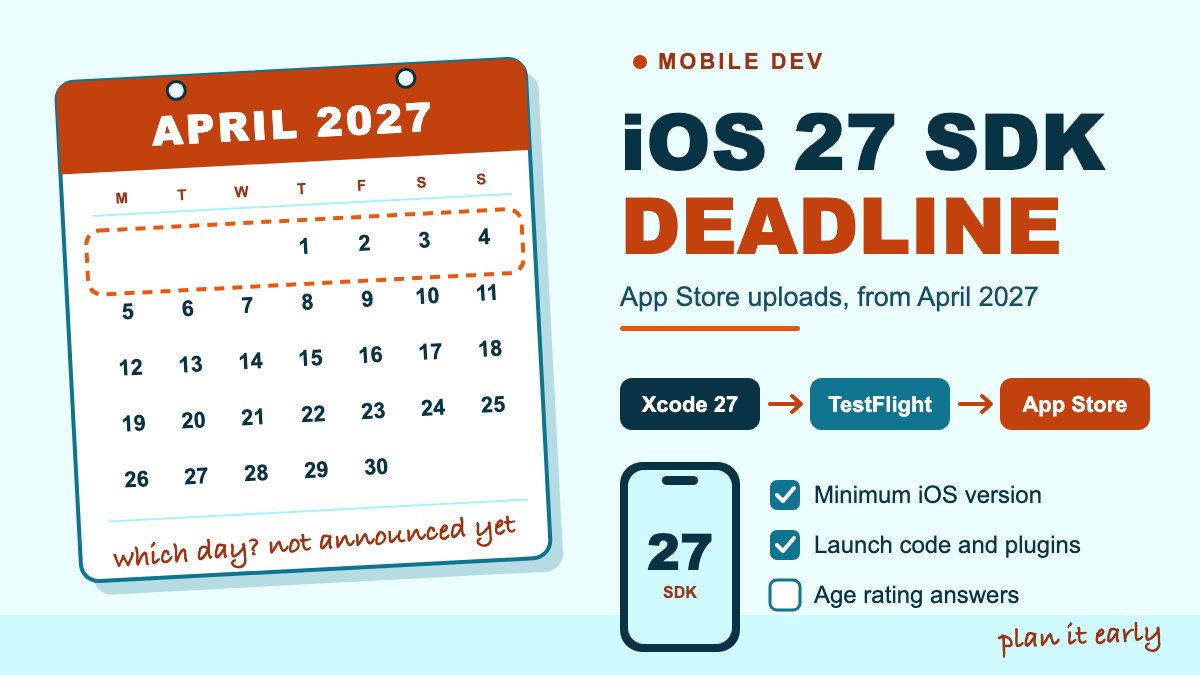
Yes, plan a rebuild. From April 2027, every iPhone and iPad app uploaded to App Store Connect, Apple's upload portal, must be built with the iOS and iPadOS 27 SDK (software development kit) or later. Apple announced this on 9 September 2026, seven weeks before this post. It gave no exact day in April. The rule is about new uploads, so in our reading the first update you ship after the cutoff is where it bites. This post covers who is affected, what usually breaks in a rebuild and a dated plan. Facts about Apple's rules come from Apple's own pages. Advice marked as ours is general engineering practice.
What did Apple announce, and what did it leave open?
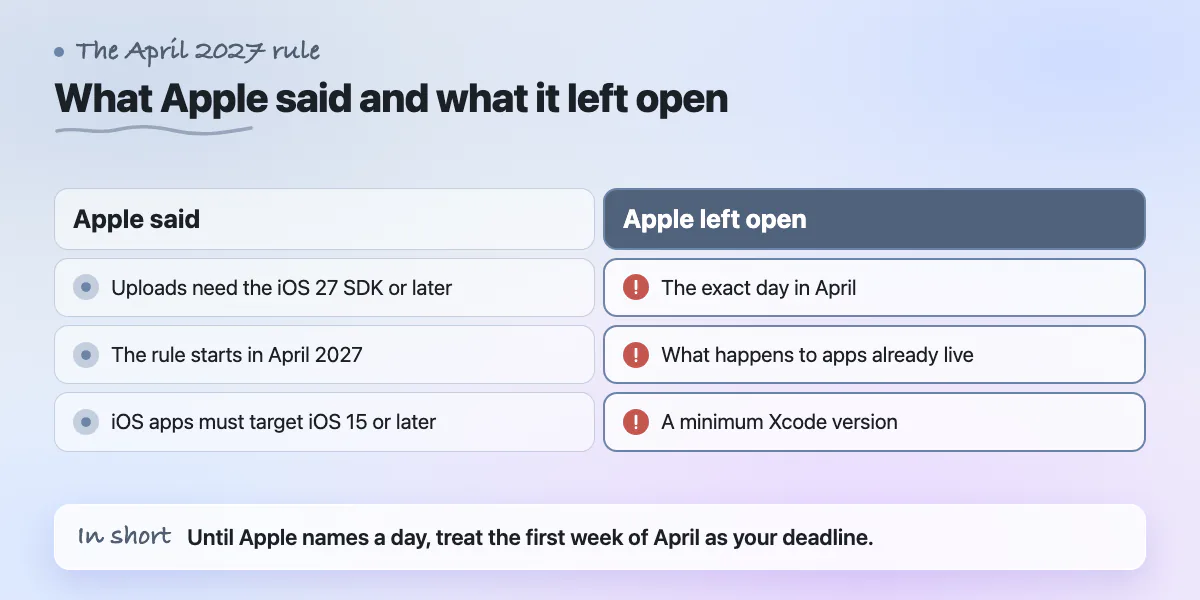
Apple's developer news post of 9 September 2026, App Store submissions now open for the latest OS releases, sets the rule. Starting April 2027, uploads must meet these minimums:
- iOS and iPadOS apps: built with the iOS 27 and iPadOS 27 SDK or later.
- tvOS, visionOS and watchOS apps: built with the matching 27 SDK or later.
- For Mac apps, the same post says macOS 26 is the last release that supports Intel Macs and Rosetta, and macOS 27 will be Apple silicon only.
Apple's Submitting apps page repeats the April 2027 rule and adds a second condition for iOS and iPadOS apps: they must target iOS 15 or later. The news post does not mention that line, so read both pages. The deployment target is the oldest iOS version your app is set to run on. For comparison, Apple's upcoming requirements page lists a floor of iOS 13 since 9 September 2026.
The open questions matter as much as the rule. Last year Apple posted its equivalent rule on 3 February 2026 with a start date of 28 April 2026. This time it says only April. The post also does not say what happens to apps already on the store, and it names no minimum Xcode version. Apple's Submitting page points to Xcode 27 as the tool that supports the latest SDKs. Until Apple names a day, treat the first week of April as your deadline.
Which apps are affected, and what usually breaks?
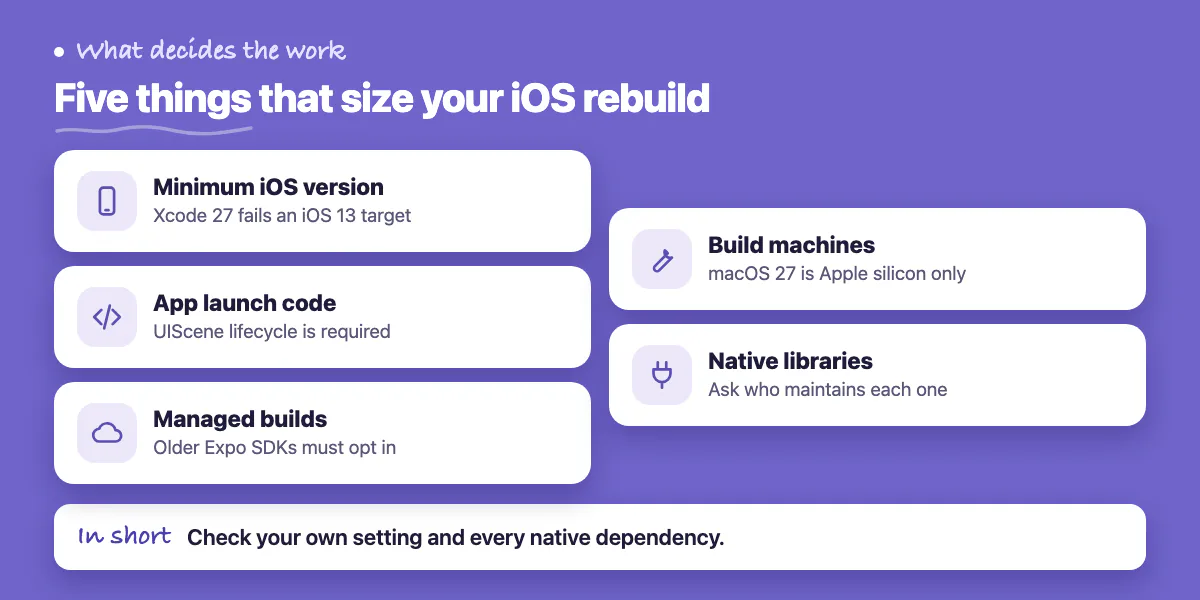
Every iOS app, whatever it is written in. Flutter and React Native apps still go through Xcode to produce the iOS build, so the SDK rule applies to them as it does to a Swift app. Android builds are outside this rule. Five things tend to decide how big the rebuild is:
- Minimum iOS version. Flutter's own tracker shows Xcode 27 failing a project with a deployment target of iOS 13, and the fix raised Flutter's minimum to iOS 15 (issue 187741, opened 9 June 2026). Weeks later a user still saw errors that pointed to a 9.0 target in the app's Pods, the third-party iOS libraries. Check your own setting and every native dependency.
- App launch code. The React Native 0.88 release post, dated 19 October 2026, says Apple requires the UIScene lifecycle from the iOS 27 SDK and that UIKit apps built with Xcode 27 fail to launch without it. UIKit is Apple's long-standing interface framework. React Native 0.88 adds support, and the migration means moving startup code, forwarding link and user-activity callbacks and adding an entry to Info.plist. In our reading, apps with hand-edited native startup code are the ones most likely to need changes.
- Managed builds. Expo's April 2026 post shows how last year went: apps on Expo SDK 54 and 55 already used an Xcode 26 build image, while older SDKs had to opt in, and not every SDK version worked with the new Xcode. Expo is a vendor, so this is secondary evidence. We expect a similar split in 2027, but that is our expectation, not Expo's statement.
- Build machines. macOS 27 is Apple silicon only, per Apple. Check Apple's Xcode requirements page for the macOS version your build Mac or CI runner needs.
- Native libraries. The CocoaPods team announced that its trunk stops accepting new podspecs on 2 December 2026, and says existing builds keep working. A plugin that ships only through CocoaPods may stop getting updates, so ask who maintains each one.
Our own Flutter app, ManOps, is one example of a project that already sits above the iOS 15 line: our post on Flutter and React Native for an ops app lists iOS 15.1 as its minimum.
What do the new age rating answers involve?
This is separate from the SDK rule, and it is already in force. Apple's 9 July 2026 post added questions to the App Store Connect age rating form about social media capabilities. Apple describes these as the ability to redistribute, amplify or interact with user-generated content through a social feed or similar discovery method. From September 2026, Apple says answers are required when you submit a new app or an update. The 9 September post repeats that apps with these capabilities must say so.
The answer has effects. Per the July post, it drives a new Social Media label on your product page and decides whether parental Time Allowances in iOS 27 count your app as social media. If you turn social features off for users under 13, the app is not counted in that category for those users.
This is a product decision, not a build task. Someone who knows the features should answer it. Read Apple's definition against your feeds, shared posts and discovery screens, and write down the reasoning.
What should you do between now and April?
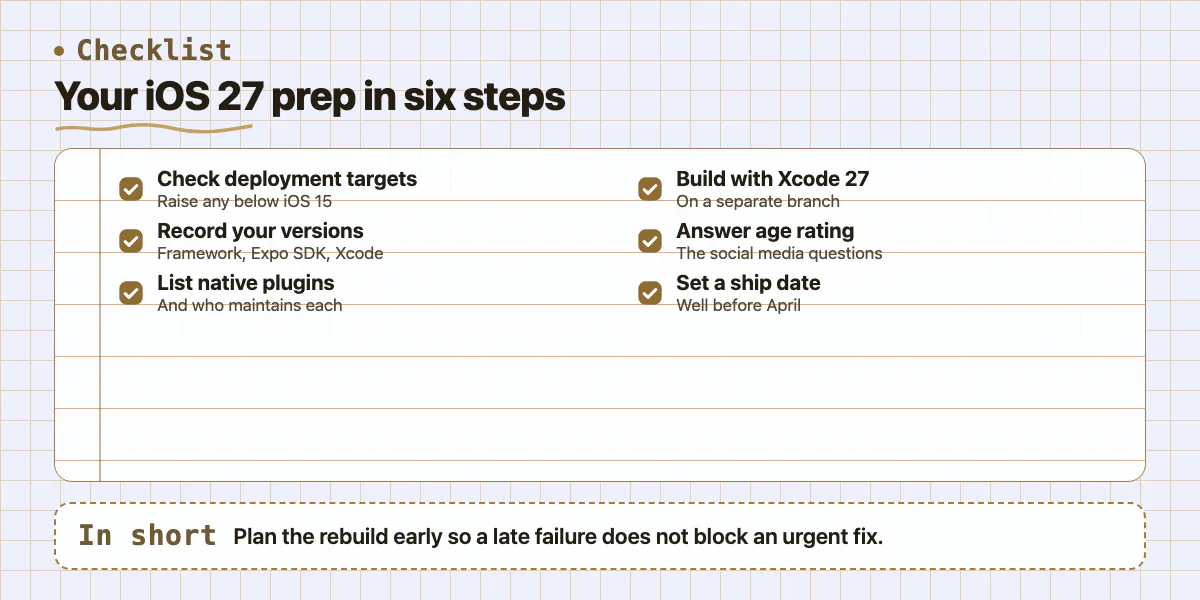
The risk is a late surprise: a rebuild that fails in March, just when you need to ship an urgent fix. The steps below are general planning advice, not Apple guidance. Work through them in order.
- Write down the deployment target of every iOS app you own. Raise any below iOS 15.
- Record your framework and build versions: Flutter or React Native version, Expo SDK if you use it, Xcode on your build machine or CI.
- List every plugin or library with native iOS code, and who maintains it.
- Search for custom app startup code, such as a hand-edited app delegate. This is where the launch change is most likely to bite.
- Build once with Xcode 27 on a separate branch and write down what fails. Apple's own post suggests testing with TestFlight.
- Answer the social media age rating questions, and keep the reasoning in your release notes.
- Retest sign-in, payments and push notifications on a real device after the new build. Our push notification gotchas explains why push needs a real device.
- Set an internal ship date for the update. Pick one well before April, because review time and a failed first attempt eat the buffer.
A rough shape, again our advice: have the Xcode 27 build running on a branch within a month or two, a build in TestFlight by the new year and the store update through review by the end of March. Pair it with the App Store and Play Store readiness checklist, so the resubmission does not trip a review rule. If an AI tool wrote parts of the app, the store rejection risks apply to the new build too.
When can you skip this?
Not every product needs action. Android-only apps, web apps and PWAs (progressive web apps) are outside the rule. An iPhone app you will never update again can stay live as it is: the rule covers uploads, and Apple's post does not say live apps are removed. The catch is that you then cannot ship any fix after April without doing the rebuild, so make that choice on purpose.
If an agency or in-house team builds and uploads for you, the deadline is still yours. Ask them for their plan in writing. A brand new app started on current tools has no migration to do, though it still needs the age rating answers.
Want a second pair of eyes on your iOS build?
If you own an iPhone app and are not sure which of these items apply, we offer a mobile app maintenance and store-readiness check: your current Xcode and framework versions, deployment target, native dependencies and age rating answers, ending in a dated plan. Talk to us about your mobile app, or read what a maintenance retainer covers first.
Common questions
Do I need Xcode 27 to upload an app after April 2027?
Apple's rule is written as an SDK requirement: iOS and iPadOS apps must be built with the iOS and iPadOS 27 SDK or later. Apple's Submitting page points to Xcode 27 as the tool that supports the latest SDKs and states no separate Xcode minimum. In practice, plan to build with Xcode 27 or later.
Will my app stop working on iOS 27 if I do nothing?
Apple's 9 September post concerns uploads to App Store Connect. It does not mention removing apps already on the store. The React Native team says the launch rule applies to apps built with Xcode 27, which implies an earlier build keeps running. What you lose is the ability to upload new builds without the rebuild.
When in April 2027 is the deadline?
Apple has not said. Its 9 September 2026 post says only that the rule starts in April 2027. Last year's equivalent rule started on 28 April 2026, but nothing says 2027 will match. Plan against the start of April, and check Apple's upcoming requirements page for a specific date as it gets closer.
Sources
- App Store submissions now open for the latest OS releases
- Age rating questionnaire now includes social media questions
- Upcoming SDK minimum requirements
- Submitting apps
- SDK minimum requirements and other upcoming requirements
- React Native 0.88
- Increase iOS minimum supported version from 13 to 15 to support Xcode 27
- App Store Connect minimum SDK requirements update
- CocoaPods Specs repo notice
- iOS SDK version deadline
Building something similar?
Talk to our engineering team about your architecture, roadmap, and delivery timeline.
Request a Technical Review →
We design, engineer, and deploy high-performance web platforms, mobile applications, and intelligent cloud systems.