Answer what you can truthfully, say plainly where you have a gap, and attach evidence for the rest. You do not need a SOC 2 report (an independent audit report on a company's security controls) to get through a vendor security questionnaire. ComplyDog's guide says the missing report is a gap to explain, not a disqualifier. What costs deals is a vague answer or a claim you cannot back up. Two of the guides we read come from compliance vendors that sell related products, so we mark where that matters. The advice is general practice, not legal or audit advice.
What should you do in the first hour after the questionnaire arrives?
A vendor security questionnaire is a list of questions a buyer sends to decide whether it can trust you with its data. Wolfia, a vendor of questionnaire software, says rules, cyber insurance and internal risk policies push buyers to ask. It also says buyers often give 10 to 15 business days to respond, and the full review can take four to six weeks. ComplyDog, which sells a compliance portal, calls it a sales gate, not a test. Before you answer anything, find out five things:
- Format: a standard template such as SIG (Standardized Information Gathering) or CAIQ (Consensus Assessments Initiative Questionnaire) can be reused later. A custom spreadsheet or web portal is more work.
- Length: count the rows. ComplyDog says they range from about thirty questions to several hundred.
- Who is asking and why now: a request right after a pricing call usually means a gate before signing.
- The real deadline: the stated date may be an internal target, so ask.
- What travels with it: SOC 2 reports, penetration test summaries, a data processing agreement (DPA) or an architecture diagram.
Then name one owner by the end of day one and reply the same day with a return date. ComplyDog says questionnaires shared across several people tend to come back late, with the hard sections left blank. The owner does not have to be the most technical person, only someone who notices gaps early.
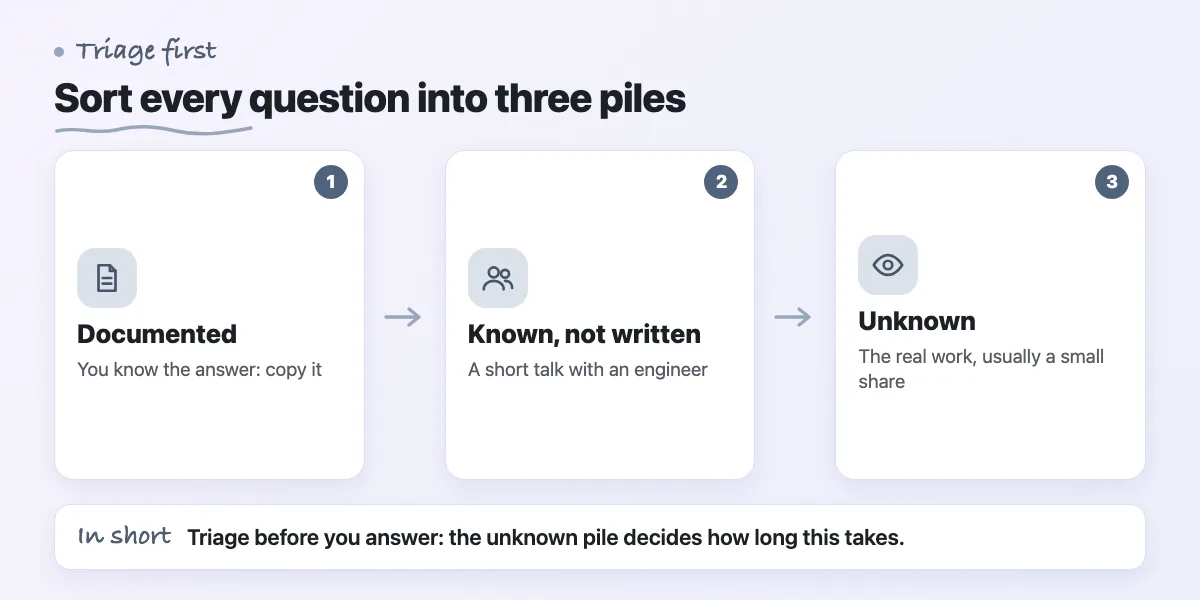
Next, sort every question into three piles: documented, known but not written down, and unknown. The first pile is copying. The second needs a short talk with an engineer. The third is the real work, and ComplyDog says it is usually a small share of the total. Budget time honestly: Wolfia says first-timers often spend 20 to 40 hours, and ComplyDog puts a first questionnaire of several hundred rows at two to three weeks of part-time work across several people. If the third pile is large, the minimum viable secure checklist shows what to fix first.
What do questionnaires ask, and what can a Next.js and Supabase product honestly say?
Wolfia lists these topics: encryption at rest and in transit, key management, data classification and retention, access control, incident response, business continuity and disaster recovery, and third-party (subprocessor) risk. Some buyers add application security or AI questions. ComplyDog also names backups and data residency. Below is where a typical product built on Next.js, hosted on Vercel, with a Supabase database usually stands. Platform facts come from the providers' own documentation. They describe the platform, not your app.
- Encryption: Supabase's shared responsibility page says Supabase encrypts data at rest and in transit. Vercel's compliance page states AES-256 at rest and TLS 1.3 in transit. Your part: serve everything over HTTPS and keep API keys and secrets in an encrypted store, which Supabase says is the customer's job. Evidence: the provider pages and your secrets setup.
- Access control: Row Level Security (RLS) is yours to get right. Supabase says to always apply it, and that acting on its Security Advisor recommendations is your responsibility. Turn on multi-factor authentication for staff accounts and keep a short list of who can reach production. Evidence: a table list showing RLS on each table, plus ownership tests, as in the Mandizo case study. See also why RLS on does not always mean data is private.
- Backups and recovery: Supabase says it is responsible for Postgres backups. You own the proof that a restore works. Evidence: the date of your last restore test.
- Incident response: this is entirely yours. Write one page with an owner, a first-hour checklist and how you tell customers. Our first-hour incident guide is a starting point.
- Subprocessors: list every vendor that touches customer data, such as Vercel, Supabase, email, payments, analytics and AI providers, with the region of each. Vercel says customers can choose the region for their functions.
- Provider attestations: Vercel says it holds a SOC 2 Type 2 attestation for Security, Confidentiality and Availability and is ISO 27001:2022 certified. Supabase says it is assessed annually against SOC 2 and shares its Type 2 report with Team and Enterprise plan customers. You can point to these for infrastructure questions. Supabase's own page says its compliance does not transfer to your application.
- Application security: this is your code. An independent review or test report is the best evidence. Security review, code review and pen test explains which one answers which question.
How do you answer no without losing the deal?
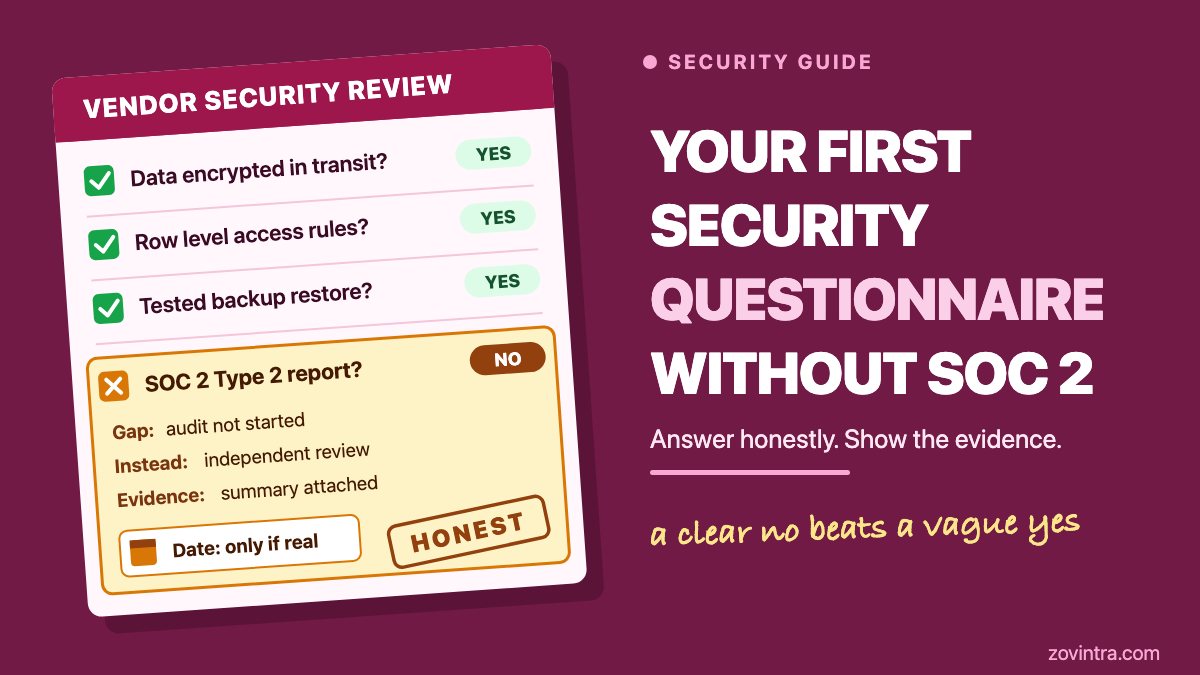
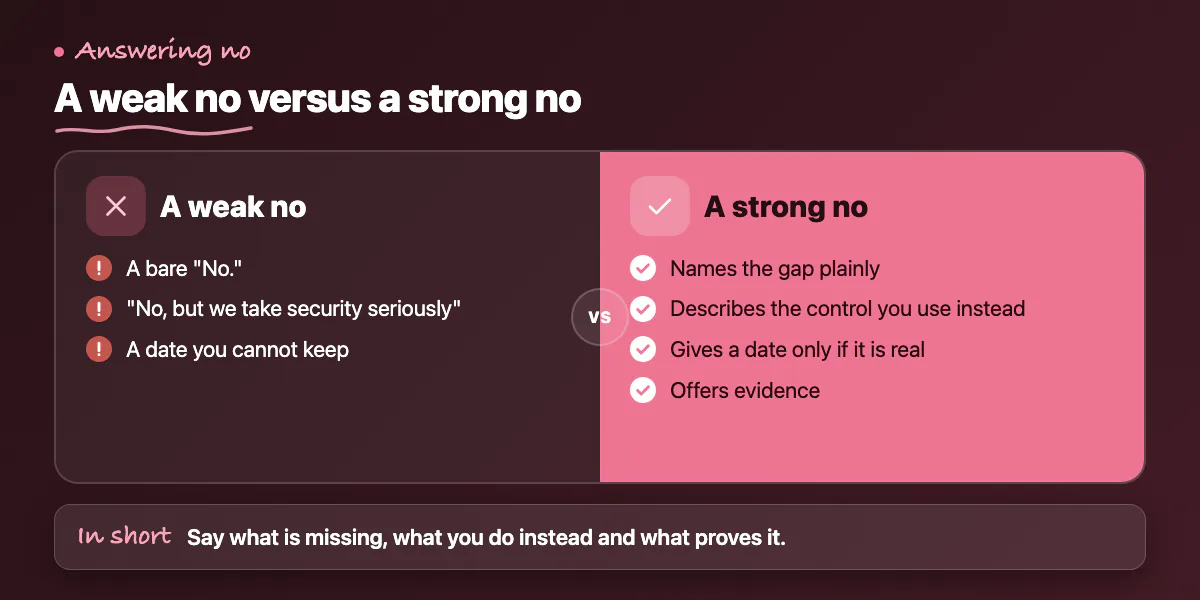
ComplyDog says a no is not automatically disqualifying. What matters is whether the reviewer believes you understand the gap. It compares three styles. A bare "No." looks like a gap with nothing behind it. "No, but we take security seriously" looks worse, because it adds a deflection. A strong answer names the gap, describes the control you use instead, gives a date only if a real one exists, and offers evidence. ComplyDog says that takes about ninety seconds longer to write.
Do not invent a date. ComplyDog notes that a reviewer told "Q1" will check in Q2. Wolfia also warns that aspirational answers, such as promising multi-factor authentication by a future quarter, read as red flags, and that reviewers cross-check answers, so contradictions surface fast. Wolfia adds that answering yes without the evidence the buyer asked for triggers follow-up rounds that can add weeks.
Here is an example for the most common question, written as a template, not as a claim about any real company:
- Question: Do you hold a SOC 2 Type 2 report?
- Answer: No. We have not started a SOC 2 audit. Our hosting providers hold SOC 2 Type 2 attestations for their platforms. For our own application we can share our latest independent security review summary, our access control rules and our incident response plan. We will revisit SOC 2 when [a real trigger, such as a contract requirement].
Raise likely no answers early, before you return the document, and ask for a call if the buyer's team can accept an alternative. ComplyDog's advice on refusing is blunt: it usually ends the deal with a formal procurement team, so offer a public security page, a standard questionnaire or an existing attestation instead.
What can you finish in a week?
A week is realistic for a small product and a short questionnaire. A first questionnaire of several hundred rows can take longer, as noted above. This checklist combines both guides with general engineering practice:
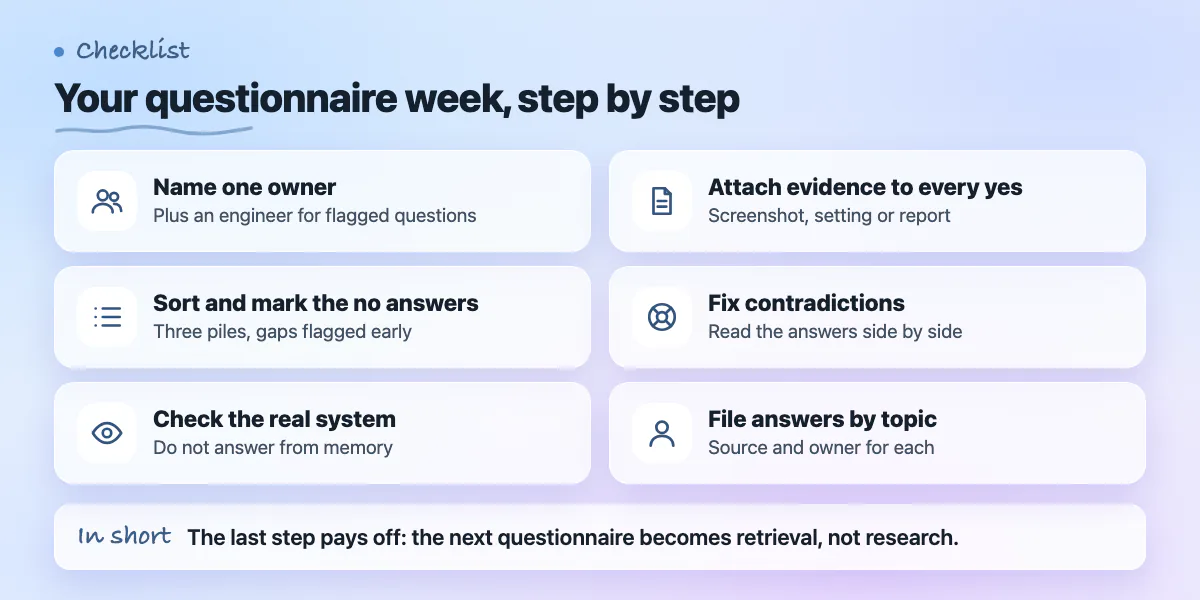
- Name one owner and one engineer who answers flagged questions in a fixed block of time.
- Sort every question into the three piles and mark the no answers.
- Check the real system before writing: RLS on every table, multi-factor authentication on staff accounts, who has production access, when a restore was last tested. Do not answer from memory.
- Write the short documents Wolfia says buyers expect: an information security policy, a DPA, an incident response plan, a business continuity and recovery note and a subprocessor list.
- Attach evidence to every yes: a screenshot, a setting, a test result or a provider report.
- Read the answers side by side and fix contradictions.
- Send it at least three days before the buyer's date, as Wolfia suggests, so there is time for review.
- File each answer by topic, not by customer, with its source document and an owner.
That last step is the one that pays off. Both guides recommend an answer bank: encryption, access control, backups, subprocessors, incident response and retention, each tagged with its source and kept current. ComplyDog also suggests publishing non-confidential material at a public URL, so you can link it instead of rewriting it. A one-page security overview works well for this. Cover where you host and in which regions, how logins and access work, how data is encrypted, when you last tested a restore, who to contact about an incident, your subprocessors and any known gaps with a plan. Keep secrets out. If you attach a reviewer's report, our guide to reading a security report helps.
When is SOC 2 worth starting, and when can you skip it?
You can skip it for now when your questionnaires are few, your answers are honest and well evidenced, and buyers accept alternatives. ComplyDog says a SOC 2 report is not required to answer a questionnaire.
Start thinking about SOC 2 when deals stall on it, when several buyers in a row ask for it, or when a contract names it. Wolfia, which sells to teams in this position, says a current SOC 2 Type 2 report answers many common questions with third-party validation. Both guides come from vendors that benefit when you buy compliance tools, so weigh that. One timing point is general knowledge: a Type 2 report looks back over a period. Supabase, for example, says its audit covers a rolling 12 months. You cannot get one in a week, so start the conversation before a deal depends on it.
Want a second pair of eyes before you answer?
If you are about to send a first questionnaire, an independent review of access rules, secrets, backups and logging gives you evidence to attach and a list of gaps to fix or explain. You can start with the free code review or contact us about a security review.
Common questions
Do I need a SOC 2 report to pass a vendor security questionnaire?
Not by default. ComplyDog says a SOC 2 report is not required and that its absence is a gap to explain, not a disqualifier. Some buyers still require one by policy or contract, so ask what they accept. Otherwise offer an honest no, the controls you use instead and evidence.
How long do I have to answer a security questionnaire?
Wolfia says buyers often allow 10 to 15 business days, and the full review can take four to six weeks after you submit. ComplyDog says the stated date may be an internal target, so ask for the real one, and ask for any extension at the start.
Does using Supabase and Vercel make my app SOC 2 compliant?
No. Supabase's documentation says its compliance does not transfer to environments outside the Supabase product, so you need your own controls and your own audit to claim SOC 2. Vercel holds its own attestation for its platform. You can cite both for infrastructure answers, but you answer for your application.
Sources
- Your first enterprise security questionnaire
- You've been sent a vendor security questionnaire - what now?
- Shared Responsibility Model
- SOC 2 Compliance and Supabase
- Security & Compliance Measures
Building something similar?
Talk to our engineering team about your architecture, roadmap, and delivery timeline.
Request a Technical Review →
We design, engineer, and deploy high-performance web platforms, mobile applications, and intelligent cloud systems.